"We Teach Korea, Not Just the Korean Language" ... 'Vietnam's First' Korean Department Chair Offers Special Classes [Southeast Asia Focus]
- Input
- 2026-09-26 06:00:00
- Updated
- 2026-09-26 06:00:00
To mark the 100th anniversary of the establishment of Hangul Day on the 9th of next month, [Southeast Asia Focus] will visit Korean-language education sites in Vietnam, Indonesia, India and other countries. Over the coming weeks, we will provide an in-depth look at the Korean-language boom sweeping the region and the realities of local education.
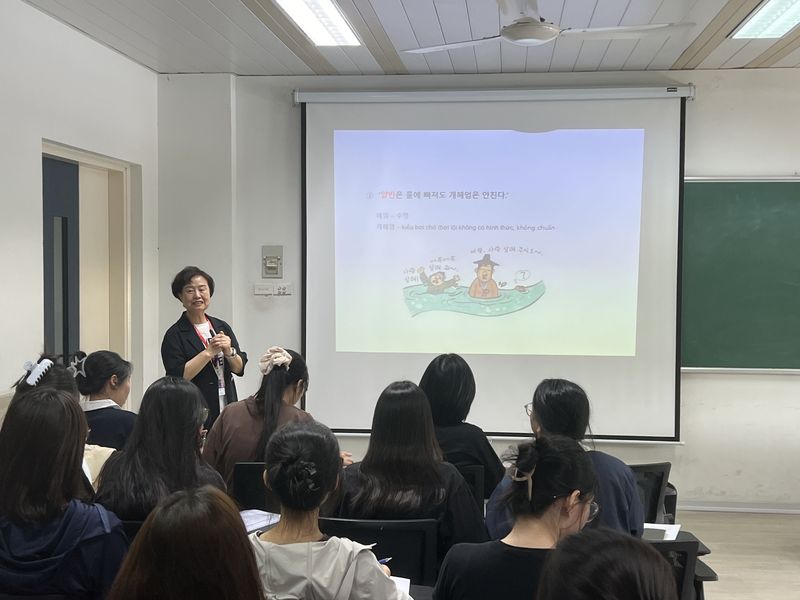
"Save face, have one's face upheld, preserve someone's face, protect one's face."
As Lee explained the subtle differences among the similar-sounding expressions, the professor also discussed what 'face' means in Korean society.
The class then turned to how Korean expressions should be rendered in Vietnamese. Lee urged the students, who will serve as a bridge between Korea and Vietnam, not to reduce translation to simply replacing one word with another.
Lee said that for Korean cultural concepts that are difficult to translate precisely with a single word, such as 'uri' ('our'), 'jeong' and 'han,' it is important to retain the Korean expression and explain its meaning rather than force it into another word. Lee stressed that unique expressions containing the essence of Korean culture should be understood on their own, just as 'Hallyu' is already commonly used by that name in Vietnam.
When the lecture ended, the students rose from their seats in unison.
"Thank you for your hard work."
As the students greeted Lee with one voice, the department chair smiled and brought the class to a close.
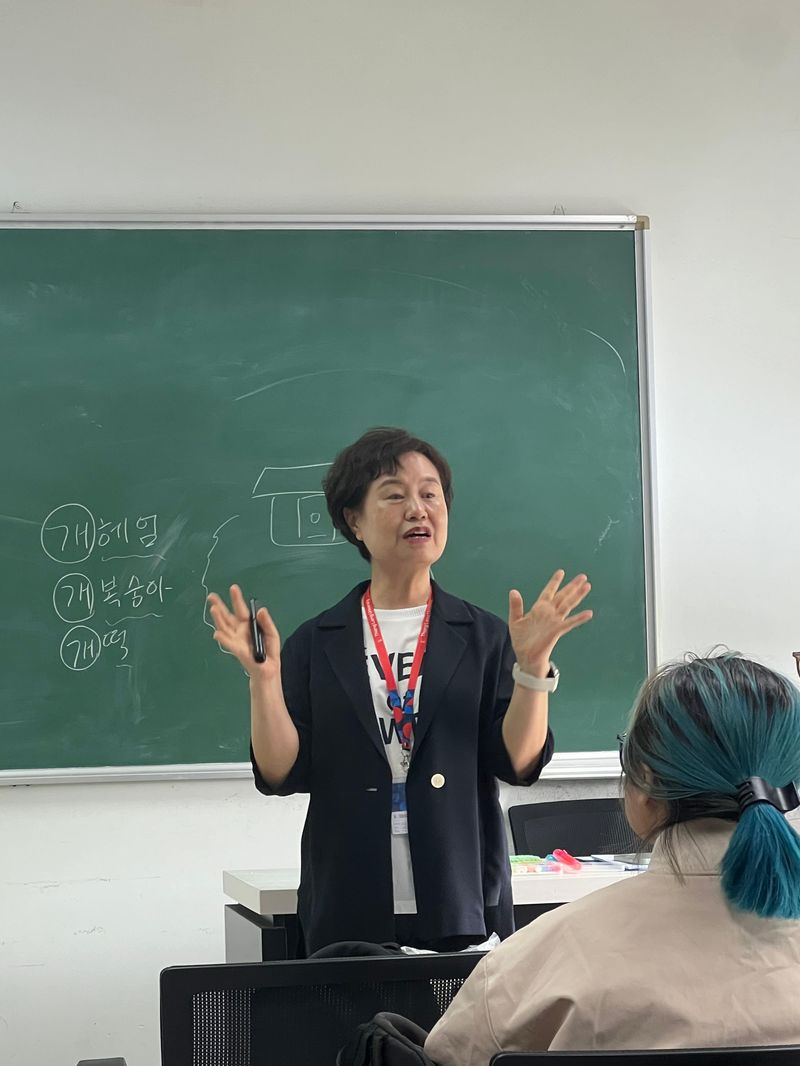
Lee's background is also exceptional. After graduating from the Korea Armed Forces Nursing Academy (KAFNA), Lee was commissioned as a nursing officer in 1981 and served for 24 years before retiring from the military as a lieutenant colonel in 2004. At age 46, Lee moved to Vietnam, learned Vietnamese and earned a doctorate in sociology from the College of Social Sciences and Humanities at Vietnam National University, Hanoi.
Beginning in 2008, Lee worked as a visiting lecturer in Korean and Vietnamese interpretation at the Department of Korean Language at Hanoi University. In 2013, Lee became a full-time lecturer in the Department of Sociology at Thang Long University. Later, at the university's request, Lee took part in establishing the Korean-language department, personally handling the curriculum design and review process for its launch. In 2016, Lee became the department's inaugural chair.
The connection between language and culture is what Lee emphasizes in Korean-language education.
Thang Long University offers classes that distinguish it from other Korean-language departments in Vietnam. Students nearing graduation either write a thesis or choose one of two courses. One examines the Korean mindset through idioms and proverbs. The other explores the organizational culture of Korean companies operating in Vietnam and Korean corporate culture.
Because many graduates go on to work for Korean companies or study in Korea, the courses are designed to familiarize them in advance with the culture and environment they will encounter in Korean society and workplaces.
Lee said, "Language is ultimately culture," adding, "To learn a language, you must know the culture and society of that country. Teaching students about that culture and society should be the role of the Department of Korean Language at Thang Long University."
Lee particularly stressed the need to cultivate people who understand Korea, rather than merely people who speak the Korean language well. In an era when artificial intelligence (AI) can translate Korean and generate sentences fluently, simply speaking the language is no longer enough, Lee explained.
As a sociologist with a doctorate, Lee's classes go beyond presenting Korean culture from a single perspective. Students compare and examine Vietnam's historical and cultural background alongside Korea's, preparing them to introduce Vietnamese society and culture in depth to Koreans and communicate effectively when they later enter Korean companies or other workplaces. The goal is to help them become people-to-people diplomats and bridges between the two countries.
Lee said, "I tend to give students many assignments comparing the histories and cultures of the two countries," adding, "One student from the first cohort was deeply inspired by this process and went on to study history at the Academy of Korean Studies (AKS)."
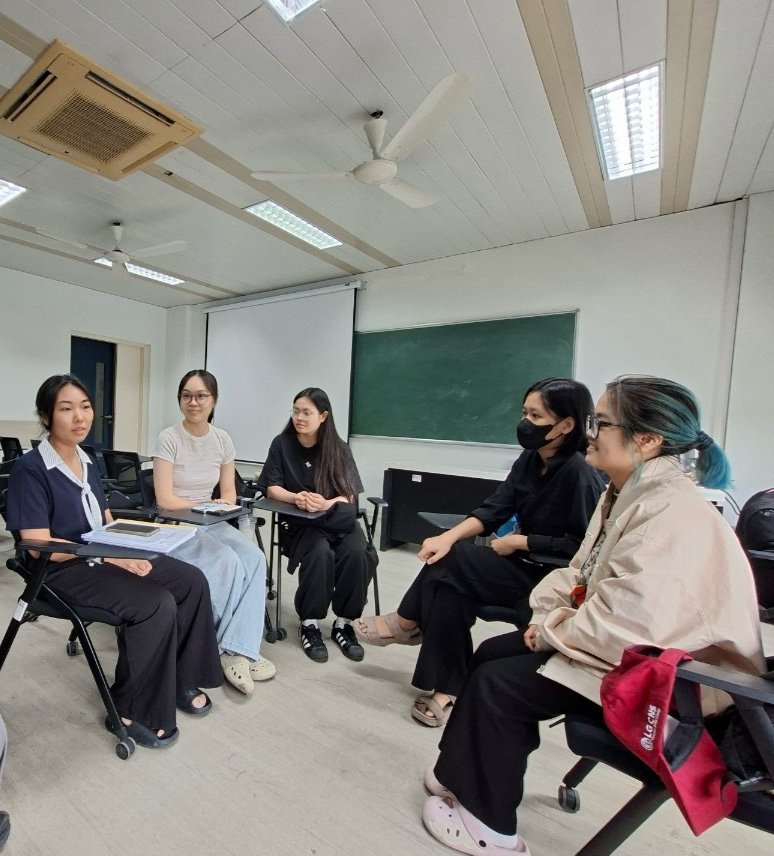
Thuy began learning the Korean language out of an interest in Korean dramas and the Korean Wave. Later, drawn to the structure and system of the language, Thuy chose a career teaching Korean.
Thuy identified the Korean language's 'scientific' nature as its greatest appeal.
Thuy said, "I used to think that a special talent was necessary for languages, but Korean is scientific. Its appeal lies in the fact that anyone can learn it by understanding certain principles and making an effort."
Thuy added, "I wanted to share with students the beauty of the Korean language that I had experienced myself," explaining that this desire led Thuy to become a Korean-language instructor.
The fourth-year students attending the class that day identified honorifics and terms of address as the most difficult aspects of studying the Korean language.
The students had varied reasons for learning the Korean language, as well as different career plans after graduation.
Student Nguyen Ngoc Linh said, "I was choosing between Chinese and Korean, but my uncle strongly recommended Korean, so I enrolled in the department."
Student Chu Thi Nhu Quynh said, "I started studying the Korean language because of the Korean idol group EXO."
Student Pham Thanh Truc said, "I decided to enroll in the Korean-language department after watching the film "Parasite," and I want to introduce Korean cultural content to Vietnam in the future."
Student Luong Thi Thu Hien said, "I want to attend graduate school in Korea, major in human resources (HR), and then work for a Korean company."
Lee said the students choosing the Korean-language department today are clearly different from those of the past. Ten years ago, many of the first students wanted to learn Korean because they enjoyed dramas and the Korean Wave. Today, their goals are more specific and varied: some want to work in a particular field at a Korean company, while others want to study in Korea in connection with their own majors. Lee explained, "The Korean Wave was the starting point, but students' aspirations seem to be diversifying across different areas of K-culture."[Southeast Asia Focus] is a feature that delivers vivid, in-depth coverage from the field of major issues and behind-the-scenes stories in Southeast Asia, which is emerging as a key hub for global supply chains as well as diplomacy and security.[email protected] Kim Jun-seok Reporter