‘Mecca Joint Defence Agreement’ Goes Into Full Operation: Saudi Arabia, Türkiye and Pakistan to Respond Jointly to Houthi Rebels
- Input
- 2026-09-25 23:08:56
- Updated
- 2026-09-25 23:08:56
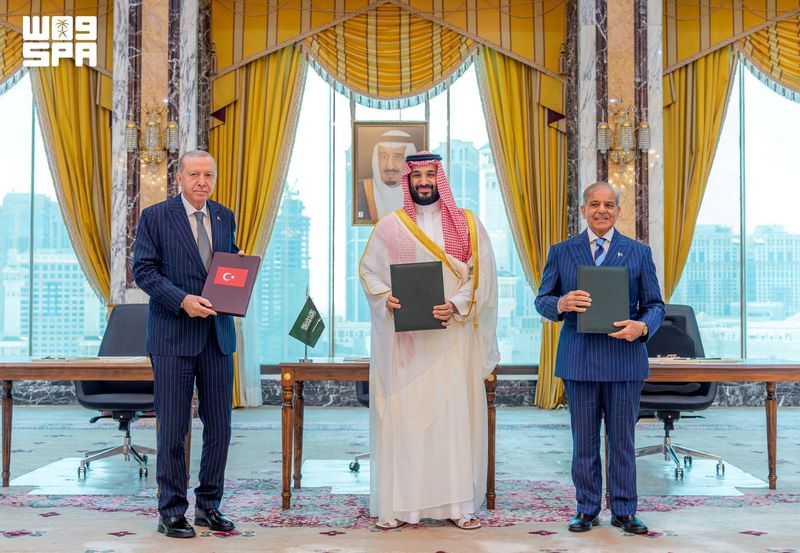
[Financial News] Saudi Arabia, Türkiye and Pakistan are fully activating the Mecca Joint Defence Agreement, a collective security framework, in response to indiscriminate attacks by Iran-backed Houthi rebels in Yemen. As the Houthi rebels threaten Saudi territory, key energy infrastructure and even the area around Mecca, Islam’s holiest site, the three countries are launching a joint military response under a NATO-style collective defence treaty.
According to foreign media outlets, including The New York Times (NYT), on September 25 local time, Saudi Foreign Minister Prince Faisal bin Farhan, Hakan Fidan, Minister of Foreign Affairs of Türkiye, and Pakistani Foreign Minister Ishaq Dar held a trilateral meeting on the sidelines of the UN General Assembly in New York. They issued a joint statement strongly condemning the Houthi rebels’ attacks on Saudi Arabia.
The three countries said in the statement, "We strongly condemn attacks targeting Mecca and Saudi Arabia’s civilian and economic facilities," adding, "We have agreed to hold an emergency meeting of the three countries’ chiefs of staff to discuss ways to support Saudi Arabia under the Mecca agreement, which considers an armed attack on any one location an attack on all member states." The agreement was signed on August 7. The upcoming meeting of the military chiefs is expected to address specific joint-defence measures, including the deployment of assets to reinforce air defences and the sharing of reconnaissance intelligence.
Türkiye and Pakistan, which initially maintained a cautious stance, have also shifted toward active involvement. Türkiye has left open the possibility of providing military and technical support, while Pakistan’s military authorities have declared their “physical” support for Saudi Arabia.
The Houthi rebels have recently escalated their offensive against Saudi Arabia to an unprecedented level. On September 13, they used drones to strike the East-West Pipeline, a key crude-oil transport route linking oil fields in eastern Saudi Arabia with Yanbu port on the Red Sea coast, forcing it to halt operations. They also launched dozens of ballistic missiles and drone attacks against Saudi Aramco facilities in Riyadh and Yanbu. In addition, they have seized the Yemeni port city of Mocha and parts of the Red Sea coast, reaching the Bab-el-Mandeb Strait, a vital artery for global trade, and heightening tensions.
Within Saudi Arabia, signs are also growing that the country is prepared to risk an all-out war. Saudi Arabia’s top religious leader, Sheikh Saleh bin Fawzan Al-Fawzan, the Grand Mufti, said in a statement on September 24 that fighting the Houthi rebels was a “religious duty” and urged soldiers to “be prepared to fight and sacrifice your lives.”
The International Crisis Group (ICG) and other diplomatic experts assessed that the unusually strong religious calls for jihad were likely an effort to rally the public ahead of an expansion of military operations. They warned that if a full-scale war between the Saudi-led coalition and the Houthi rebels expands, the conflict could increasingly take on the character of a proxy war between the United States and Iran, plunging the Middle East into uncontrollable turmoil.
[email protected] Park Ji-hyun Reporter