"Approvals, Discontinuations and Reapplications..." Chuseok Holiday Divides K-Bio's Fortunes
- Input
- 2026-09-25 16:15:17
- Updated
- 2026-09-25 16:15:17
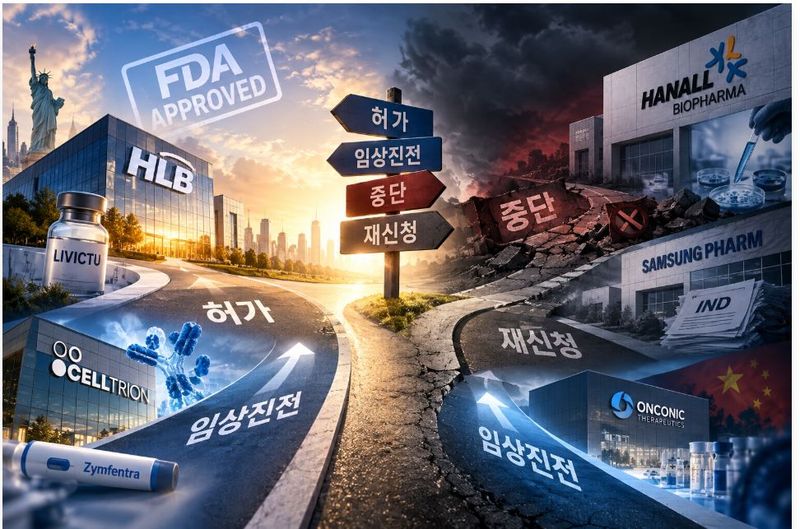
[Financial News] Around the Chuseok holiday, South Korean pharmaceutical and biotech companies posted sharply divergent results in new drug development.
Contrasting events unfolded in rapid succession, ranging from U.S. Food and Drug Administration (FDA) approvals and entry into Phase 3 trials to the discontinuation of indication development and the voluntary withdrawal of investigational new drug (IND) applications.
After the holiday, biotech stocks are expected to focus more on screening individual pipelines than on competition between companies.
The most notable achievement came from HLB, according to the pharmaceutical and biotech industry on the 25th.
LYRFIGTU, a treatment for cholangiocarcinoma developed by HLB's U.S. subsidiary Elevar Therapeutics, received FDA marketing approval. It was approved as a second-line treatment for cholangiocarcinoma with FGFR2 fusions or rearrangements, and the company plans to launch it in the United States in the fourth quarter of this year.
The development is drawing particular attention because HLB, which suffered several setbacks during the FDA approval process for its liver cancer drug Rivoceranib, has crossed the U.S. approval threshold first with another pipeline. As LYRFIGTU has moved from a clinical-stage prospect to a commercial asset, market attention is expected to shift from whether it will be approved to its actual U.S. sales and revenue.
Celltrion received FDA approval for a global Phase 3 trial of Zymfentra, a subcutaneous formulation of infliximab, in patients with moderate to severe active rheumatoid arthritis. The move is intended to expand Zymfentra's market beyond inflammatory bowel diseases into rheumatic diseases.
On the other side, companies began screening their pipelines. Imeroprubart, an autoimmune disease treatment developed by HanAll Biopharma, failed to achieve statistical significance in a proof-of-concept trial involving patients with cutaneous lupus erythematosus. Its global partner Immunovant decided to discontinue development for the indication, citing market competition and other factors.
However, this does not mean that development of Imeroprubart as a whole has been abandoned. Clinical trials for major indications, including Graves' disease, refractory rheumatoid arthritis, myasthenia gravis and Sjögren's syndrome, will continue. The decision also reflects an effort to drop the lupus indication and concentrate development resources on more promising pipelines.
Samsung Pharmaceutical also voluntarily withdrew its domestic Phase 3 IND application for GV1001, a treatment for progressive supranuclear palsy-Richardson syndrome. The withdrawal followed a request from the Ministry of Food and Drug Safety to supplement the application materials, and the company plans to reapply after making the necessary additions. Development has not been halted, but the timeline for entering Phase 3 now faces uncertainty.
In China, Onconic Therapeutics began dosing the first patient in a Phase 3 trial of injectable Zecuva, a treatment for gastroesophageal reflux disease, and secured a milestone payment worth $1 million. The company is accelerating its expansion in the Chinese market, moving into injectable products after the oral formulation.
A senior bioindustry official said, "Ultimately, the key phrase running through the biotech industry during this holiday was 'pipeline triage.' Even within the same company, the value of assets that have reached approval, those expanding into additional clinical trials and those dropping an indication is diverging. As a result, it is becoming difficult to group stocks together simply under the banner of 'new drug development.'"
Another bioindustry official also noted, "Marketing approvals, clinical-trial entries and indication discontinuations are all drug-development events, but they are reflected in company valuations in different ways. Going forward, what will matter more than the number of pipelines is whether their actual commercialization potential and value are confirmed through subsequent clinical trials."
[email protected] Reporter Kim Kyung-ah Reporter