More Low-Income Borrowers Unable to Repay Jeonse Loans... Korea Housing Finance Corporation's Subrogation Payments Surge 2.4-Fold in Three Years
- Input
- 2026-09-25 15:57:26
- Updated
- 2026-09-25 15:57:26
[Financial News] As high interest rates and economic stagnation persist, the amount that the Korea Housing Finance Corporation (HF) paid to financial institutions on behalf of borrowers who failed to repay their jeonse loans on time has more than doubled in three years.
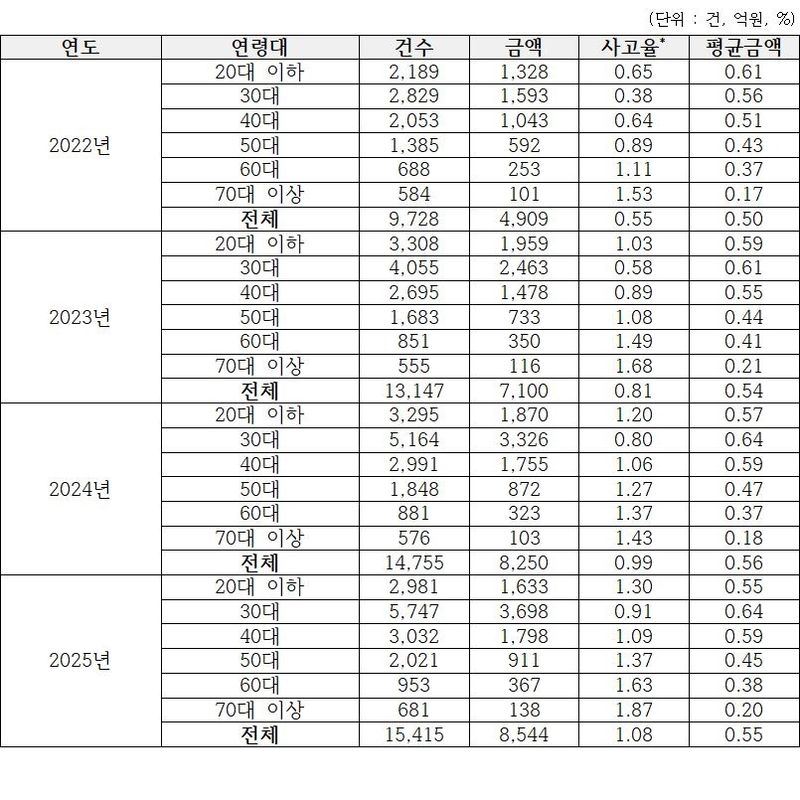
The office of National Assembly member Park Sung-hoon (Busan Buk B, People Power Party), a member of the National Assembly Political Affairs Committee, said on the 25th that it had reviewed data recently submitted by HF and found that the number of jeonse loan guarantee defaults had surged from 9,728 in 2022 to 15,415 last year.
The number of defaults increased by 58.5% in just three years, while the amount involved jumped 74.0%, from 490.9 billion won to 854.4 billion won.
By contrast, new guarantee provision declined. The number of jeonse loan guarantees provided fell 15.8%, from 740,426 in 2022 to 623,660 last year, while the amount decreased by about 10%, from 54.68 trillion won to 49.2055 trillion won over the same period.
Although guarantee provision declined, defaults caused by borrowers' inability to repay their loans increased rapidly. As a result, the burden of subrogation payments made by HF to financial institutions on borrowers' behalf also grew substantially.
The number of subrogation payments rose 102.3%, from 6,276 in 2022 to 12,694 last year. During the same period, the amount paid surged 138.6%, from 305.3 billion won to 728.3 billion won.
The deterioration was particularly pronounced among younger borrowers. The default rate for people in their 20s or younger rose 2.3-fold, from 0.65% in 2022 to 1.50% this July. Among those in their 30s, it increased 2.9-fold, from 0.38% to 1.10% over the same period.
Park Sung-hoon said, "The fact that the amount HF paid on behalf of people unable to repay their jeonse loans has more than doubled in just three years demonstrates that the repayment capacity of low-income and young borrowers has deteriorated to that extent. In particular, as default rates among people in their 20s and 30s and in some regions are rising steeply, we need to move beyond post-management that simply recovers claims after making subrogation payments and strengthen a proactive management system that identifies vulnerable borrowers' risk of default early and provides support."
[email protected] Park Sung-hoon Reporter