"Honey, if you gave your parents 500,000 won, shouldn't you give mine 500,000 won too?" ... A Couple in Their 40s Who Nearly Turned the Car Around on Their Way Home [How Much Is Enough?]
- Input
- 2026-09-25 13:57:55
- Updated
- 2026-09-25 13:57:55
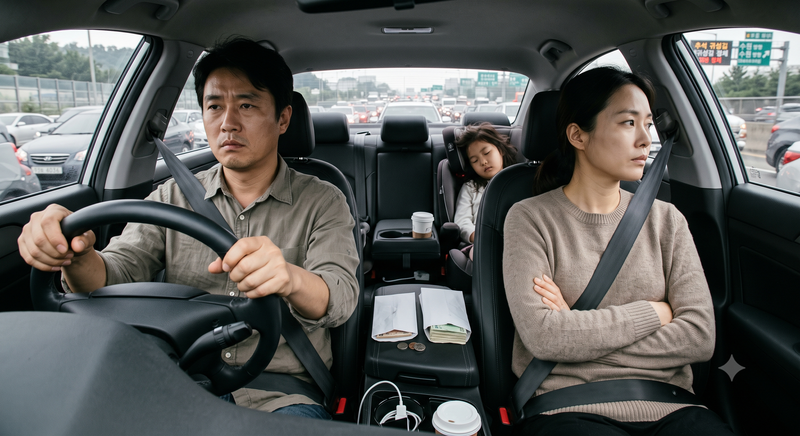
[Financial News] At 9 a.m. on the 24th, as the Chuseok holiday was getting into full swing, a suffocating silence filled the car of Mr. K, an office worker in his 40s, as it traveled along the highway to his hometown. His wife, sitting in the passenger seat, glanced at their 7-year-old son asleep in the back while watching a tablet PC, and finally broke the heavy silence.
"Honey, if you put 500,000 won in the envelope for your parents, shouldn't you give my parents the same 500,000 won? Why is my parents' envelope only 300,000 won?"
Mr. K frowned as he gripped the steering wheel. "My family holds the ancestral rites and prepares all the food. And last month, we paid for a trip for your mother’s 70th birthday. Isn’t it okay to scale things back a little this time?"
They are a respectable dual-income couple with a combined after-tax monthly income of 8 million won. Yet every holiday brings the same battle of pride over allowance money between the two sides of the family.
Prices have risen wildly while salaries have barely moved. The harsh reality facing couples in their 30s and 40s, who must meet both families’ expectations with shrinking budgets, finally exploded inside the car on the way home.
◇ "A Million Won Just to Breathe" ... The Weight of the Holiday Proved by Statistics
The conflict between Mr. K and his wife is not simply a matter of being stingy. It reflects the structural "holiday pressure" experienced by married households in South Korea, as confirmed by the statistics.
A compilation of annual surveys from major HR-tech companies, including Incruit, and financial institutions shows that married workers expect to spend well above the roughly 900,000-won mark during the Chuseok holiday. For four-person households in their 30s and 40s, spending of at least 1 million won is standard.
The spending structure is even more painful. While the share of expenses for food, such as preparing the ritual table and dining out, is declining, cash allowance handed to both sets of parents and nieces and nephews accounts for 60% to 70% of total spending, ranking overwhelmingly first.
The figures vividly reveal the dilemma: startled by prices that have reached gold-like levels, with a single apple costing more than 10,000 won, families simplify the ritual table but still cannot reduce the thickness of the cash envelopes given to their parents.
◇ Outsourcing Filial Duty by Paying for Time and Energy
Why, then, do South Koreans in their 30s and 40s cling so fiercely to the thickness of the envelopes and argue over it, even if it means their bank accounts go into the red? Experts diagnose this as the result of chronic "time poverty" among dual-income couples combined with the capitalist society’s "struggle for recognition."
In previous media columns and academic analyses, the expert explained, "Dual-income couples in modern society have far too little time and physical capacity to visit or care for their parents regularly." The expert added, "Ultimately, the thick cash envelopes handed over during the holidays are a psychological mechanism for compensating with money for the sense of indebtedness over the filial duty they have been unable to fulfill, as well as a means of having their standing within the family affirmed."
In other words, for Mr. K and his wife, the amount of allowance given to both sets of parents is not simply a matter of spending. It is a sorrowful "survival report" that proves to their parents, "We are working this hard and living an ordinary, decent life," as well as an "indulgence" to wash away their guilt over being too consumed by child care and housework to even call and ask how their parents are doing.
◇ "We Could Have Gone to Guam with This Money" ... A Family Man in His 40s Gets a Bitter Reality Check at the Tollgate
The car has made its way through the completely congested highway and is now exiting the tollgate.
Fuel and toll fees, snacks bought at a highway rest stop, several 50,000-won bills to hand to the nieces and nephews, and an 800,000-won envelope for both sets of parents. Over the two-night, three-day Chuseok holiday, the K family will easily spend more than 1.5 million won.
"Honey, with 1.5 million won, we could have gone to a resort in Southeast Asia like everyone else, eaten meals prepared by someone else, and relaxed, right?"
Mr. K could not bring himself to answer the pointed joke his wife tossed out while gazing out the window. He merely swallowed a bitter smile.
They work themselves to the bone to live like everyone else, or perhaps a little more comfortably than others, only to face an empty bank balance after a single holiday. This is the cold, unvarnished reality of the Chuseok homecoming journey in 2026 for the middle class in their 30s and 40s, trapped on a hamster wheel and already dreading this month’s credit card payment date.
[email protected] Jeon Sang-il Reporter