"If You Had 1 Million Won in Chuseok Bonus Money..." Asset Managers Picked 'Semiconductors, Monthly Dividends and a 50-50 Mix'
- Input
- 2026-09-25 10:59:36
- Updated
- 2026-09-25 10:59:36
[Financial News] More investors are considering where to invest spare cash received as a Chuseok bonus or holiday bonus.
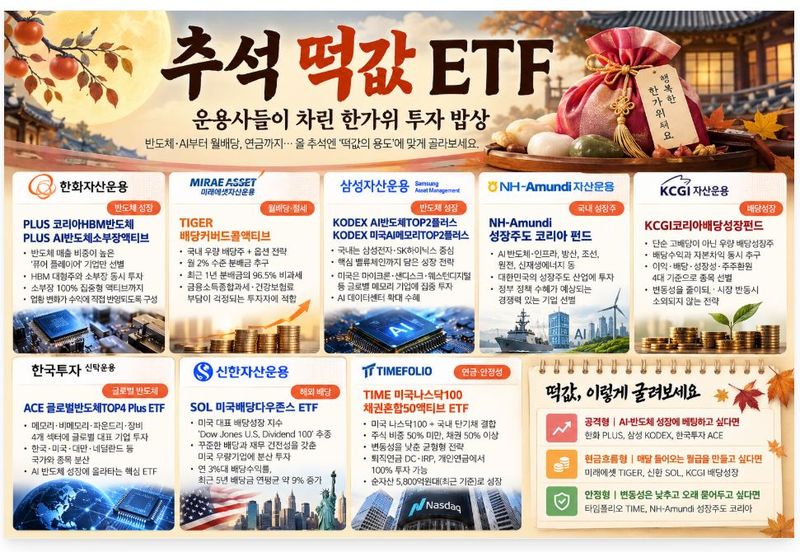
This year's Chuseok recommendations from leading domestic asset managers reveal sharply different strategies. The options range from growth-oriented products that ride the artificial intelligence (AI) and semiconductor rallies, to dividend-focused products that provide monthly cash and pension-oriented products that combine stocks and bonds to reduce volatility.
This year, in particular, asset managers are emphasizing a strategy of choosing products based on the "purpose of the bonus" rather than simply recommending popular ETFs. The choice depends on whether the money is short-term spare cash or seed money for long-term investment.
■The AI Rally Has Further to Run... Samsung, Hanwha and Korea Investment Choose SemiconductorsThe common keyword among asset managers focusing on growth stocks is clearly "semiconductors."
On the 25th, Samsung Asset Management recommended the KODEX AI Semiconductor TOP2 Plus ETF. The fund focuses on Samsung Electronics and SK hynix while also including key value-chain companies such as SK Square and Samsung Electro-Mechanics. It is designed to ride the trend in which expanding AI data centers drives investment in memory and semiconductor infrastructure.
Hanwha Asset Management took a more targeted approach by focusing on "pure players." PLUS Korea HBM Semiconductor invests 50% in Samsung Electronics and SK hynix, with the remaining 50% allocated to eight domestic semiconductor materials, parts and equipment companies. PLUS AI Semiconductor Materials, Parts and Equipment Active invests 100% in domestic materials, parts and equipment companies.
The key is to focus on companies with a high proportion of actual semiconductor revenue rather than businesses that are merely associated with semiconductors by name. If increased investment in AI memory expands into equipment orders and higher production, the strategy aims to reflect the resulting earnings improvements directly in the portfolio.
Korea Investment Management has broadened its focus overseas. The ACE Global Semiconductor TOP4 Plus ETF diversifies its investments among global companies representing memory, non-memory, foundry and semiconductor equipment businesses. It combines companies from South Korea, the United States, Taiwan and the Netherlands in a single product, reducing concentration in any one country or stock.
■Turning Bonus Money Into a "Second Salary"... Dividend ETFs Gain GroundFor investors wary of the semiconductor rally, dividends are emerging as an alternative.
Mirae Asset Global Investments' Mirae Asset TIGER Dividend Premium Active ETF invests in high-quality domestic dividend stocks while combining them with an options strategy to pursue monthly distributions.
A significant portion of the distributions paid over the past year consisted of tax-exempt distributions, drawing interest from investors concerned about comprehensive taxation of financial income and health insurance premiums.
Shinhan Asset Management recommended the SOL U.S. Dividend Dow Jones ETF. The fund tracks the Dow Jones U.S. Dividend 100 Index, a leading U.S. dividend-growth index, and diversifies its investments among high-quality American companies with a history of steady dividend payments. Rather than spending the bonus money, investors can convert it into a long-term dividend asset that generates monthly cash flow.
KCGI Asset Management selected the KCGI Korea Dividend Growth Fund. Rather than simply choosing stocks with high current dividend yields, the strategy evaluates earnings, dividends, growth potential and shareholder returns to identify companies capable of increasing their dividends in the future.
■If Stocks Feel Too Risky, Go "50-50"... Nasdaq and BondsFor investors uncomfortable with aggressive stock investments, another option is to divide their bonus money between growth and defensive assets.
The TIME U.S. Nasdaq 100 Bond Balanced 50 Active ETF from Timefolio Asset Management combines U.S. technology stocks with domestic short-term bonds. It keeps the stock allocation below 50% and domestic short-term bonds at 50% or more, seeking Nasdaq's growth potential while reducing volatility. Another feature is that investors can allocate 100% of their retirement DC, IRP or personal pension accounts to the ETF.
Demand from pension investors has also grown. After listing in March last year, the ETF's net assets surpassed KRW 534.8 billion at the end of June this year. According to recent data released by Timefolio, net assets had expanded to around KRW 580 billion. The product appears to have attracted investors by combining stocks and bonds in roughly equal proportions while pursuing additional returns through active management.
NH-Amundi Asset Management proposed the Growth-Driven Korea Fund rather than a single ETF. The fund selects companies in globally competitive industries such as AI semiconductors, infrastructure, defense, shipbuilding, nuclear power and renewable energy, as well as businesses expected to benefit from policies aimed at advancing the capital market.
Park Jin-ho, head of equity management at NH-Amundi Asset Management, said, "We expect the business environment for companies to improve through future government policies such as regulatory deregulation and infrastructure expansion, providing long-term growth momentum to Korean industries that play a key role in global supply chains. Based on close cooperation between our research and investment teams, we will uphold the principle of investing for the long term in leading companies with solid fundamentals and clear earnings performance, without being swayed by short-term volatility."
An asset management industry official said, "Unlike regular monthly pay, money that comes in temporarily, such as a holiday bonus, is well suited to being used as seed money for long-term investment. Rather than investing blindly in themes that have already risen sharply, investors should first determine their investment horizon, whether they need cash flow and the level of volatility they can tolerate before choosing a product. For investors pursuing bonus-money strategies, it appears advisable to first assess their preferences based on the purpose of the money rather than the individual investment—whether they are seeking further gains in AI and semiconductors, monthly cash from dividends, or a long-term 50-50 stock-and-bond investment."
[email protected] Kim Kyung-ah Reporter