Jeju Consumer Sentiment Recovers to the 100 Mark, but Remains 5.7 Points Below the National Level and Lags on All Six Indicators
- Input
- 2026-09-25 08:58:25
- Updated
- 2026-09-25 08:58:25

[Financial News, Jeju—Jeong Yong-bok] Jeju consumer sentiment recovered to the long-term average of 100 after one month, but remained 5.7 points below the national level. All six indicators that make up consumer sentiment, from current living conditions to the economic outlook, were also lower than the national figures, indicating that the recovery in households’ perceived economic conditions is progressing more slowly in Jeju Province.
According to the Bank of Korea’s Jeju Branch’s September 2026 survey of consumer trends in Jeju Province, the Composite Consumer Sentiment Index (CCSI) stood at 100.9, up 3.1 points from 97.8 in the previous month.
Jeju Province’s CCSI fell from 104.6 in June to 100.8 in July and 97.8 in August, before climbing back above 100 in September.
The CCSI is a composite measure of six indicators: current living conditions, living conditions outlook, household income outlook, consumption expenditure outlook, current economic assessment, and future economic outlook. The benchmark of 100 represents the long-term average from 2003 to 2025. A reading above 100 indicates more optimistic sentiment than the historical average, while a reading below 100 indicates relatively pessimistic sentiment.
■ Recovered to the 100 Mark, but the Gap with the Nation Remains at 5.7 Points
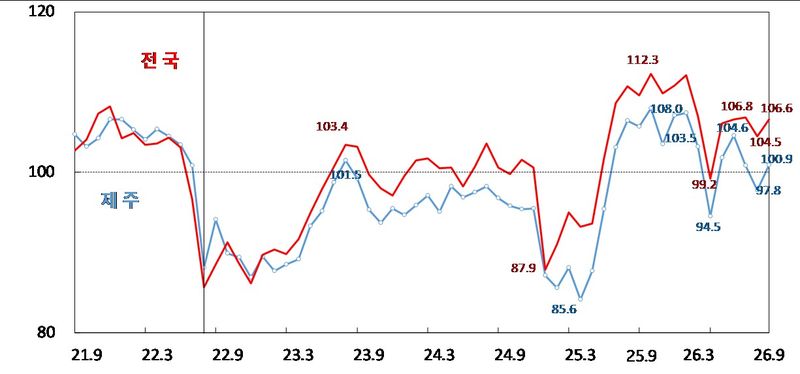
The problem is the difference in economic sentiment between the nation and Jeju.
The national CCSI rose 2.1 points month-on-month to 106.6 in September, 5.7 points higher than Jeju’s. The gap widened from 2.0 points in June to 6.0 points in July and 6.7 points in August. Although it narrowed by 1.0 point to 5.7 points in September, it was still 3.7 points wider than in June.
The difference between Jeju and the nation was also reflected in all six indicators that make up the CCSI.
The current living conditions index was 88 in Jeju and 92 nationwide, a 4-point gap. The living conditions outlook stood at 93 in Jeju and 98 nationwide, a 5-point difference. The household income outlook was 99 in Jeju, 3 points below the national figure of 102.
The consumption expenditure outlook in Jeju exceeded the benchmark of 100 at 104, but the national figure was 110. The 6-point gap was the largest among the six indicators.
The current economic assessment stood at 80 in Jeju and 83 nationwide. The future economic outlook was also lower in Jeju, at 86 compared with 90 nationwide, a difference of 4 points.
The composite index of 100.9 suggests that consumer sentiment in Jeju is above the long-term average, but the individual indicators show that households still feel weak about their current living conditions and economic conditions. In particular, the current living conditions index of 88 and the current economic assessment of 80 indicate that more households gave negative than positive responses.
■ Income and Spending Expectations Drove a 3.1-Point Rebound
Expectations for future income and consumption drove the rebound in September.
The household income outlook rose 5 points from 94 in August to 99 in September. The consumption expenditure outlook also increased 4 points, from 100 to 104. The current economic assessment climbed 6 points, from 74 to 80.
The household income outlook made the largest contribution to the CCSI increase, at 1.6 points. The consumption expenditure outlook contributed 1.0 point, the current economic assessment 0.6 points, and the living conditions outlook 0.4 points.
By contrast, the current living conditions index fell 1 point from 89 to 88. The future economic outlook dropped 2 points from 88 to 86, while the employment opportunities outlook declined 1 point from 82 to 81.
Although assessments of current economic conditions improved from a month earlier, people became more cautious about the future economy and employment situation.
Assessments of households’ ability to save also weakened. The current household savings index fell 2 points from 89 to 87. The household savings outlook rose 4 points from 90 to 94, but remained below the benchmark of 100.
The current household debt index fell 1 point from 103 to 102, while the household debt outlook remained unchanged from the previous month at 100.
■ Travel Expenditure Outlook Jumps 7 Points but Remains at 91

The outlook varied between signs of recovery and caution across spending categories. The travel expenditure outlook rose 7 points from 84 in August to 91 in September, the largest increase among the detailed categories. However, it still fell short of the benchmark of 100.
The dining-out expenditure outlook rose 4 points from 87 to 91. The housing expenditure outlook also increased 4 points, from 104 to 108, while the medical and healthcare expenditure outlook climbed 5 points, from 109 to 114.
By contrast, the outlook for durable goods fell 1 point from 90 to 89. The clothing expenditure outlook remained at 88, while the transportation and communications expenditure outlook stayed at 102. The education expenditure outlook rose 1 point from 97 to 98, as did the outlook for cultural, recreational, and entertainment spending, which increased from 86 to 87.
Caution over inflationary pressures also persisted. The price-level outlook fell 2 points month-on-month to 142, but remained well above 100. This means that far more respondents expected prices to rise over the next year than expected them to fall.
The house price outlook fell 3 points from 119 to 116. By contrast, the wage-level outlook rose 3 points from 119 to 122. The interest-rate outlook also increased 2 points from 126 to 128.
The survey was conducted among 300 households in Jeju Province from Sept. 9 to 16, with 232 households responding.
Consumer sentiment in Jeju rose above the long-term average again in September, but remained below the national level. Expectations for income and consumption improved, while current living conditions and the outlook for the economy and employment remained below the benchmark, indicating that a gap in households’ perceived economic conditions persists.
An official at the Bank of Korea’s Jeju Branch said, "The improvement in expectations for household income and consumer spending was a major factor in the consumer sentiment index rising above 100 again," adding, "However, current living conditions and the outlook for the economy and employment remain low, and the gap with the nation persists. It will be necessary to watch more closely to see whether improved consumer sentiment translates into actual consumption and a recovery in local domestic demand."
[email protected] Jeong Yong-bok Reporter