If You’ve Entrusted Even Your Thinking to AI... Three Humanities Books to Read Over Chuseok [fn Book Briefing]
- Input
- 2026-09-25 07:30:00
- Updated
- 2026-09-25 07:30:00

According to the publishing industry on the 25th, humanities books accounted for 18 of the 100 best-selling books on YES24 during the week before Chuseok, showing strong demand. Books worth reading over the holiday include the revised and expanded edition of Schopenhauer Life Lessons commemorating sales of 300,000 copies, Outsourcing Thought, and When Do Leaders Make a Difference? These books allow readers to broaden their focus from everyday personal concerns to technology and society.■Questioning Life’s Attitude and Who Controls Our ThinkingSchopenhauer Life Lessons, published by Hiest, presents the philosopher’s ideas through four themes: the self, happiness, material wealth and relationships. Compiled by Kim Ji-min, the book adds commentary to passages by Arthur Schopenhauer, allowing readers to connect them with their daily lives.
When it was first published in 2024, the book remained among YES24’s top 20 domestic books for seven weeks. The revised and expanded edition, released to commemorate sales of 300,000 copies, includes refined passages and commentary.
It examines in turn how to understand oneself, how to view the relationship between happiness and material wealth, and what distance to maintain from others. Readers can choose where to begin based on their interests—for example, by starting with the section on relationships if that is their main concern.
Outsourcing Thought by Hong Jin-ki, a professor at Yonsei University, examines human thinking and judgment in the age of AI. It asks what people may lose when they outsource even the process of thinking at a time when AI has become an everyday tool.
The book began with a change the author observed in the classroom. Students’ reports had become more polished, but many could not explain the process that led to the conclusions in their writing. The underlying concern is that the speed of obtaining an outcome is not the same as the depth of understanding it independently.
The book explores the ability to formulate questions, standards for judgment and responsibility for one’s choices. Readers who use AI in their daily lives can use it as an opportunity to reflect on how far to rely on the tool and which decisions to make for themselves.
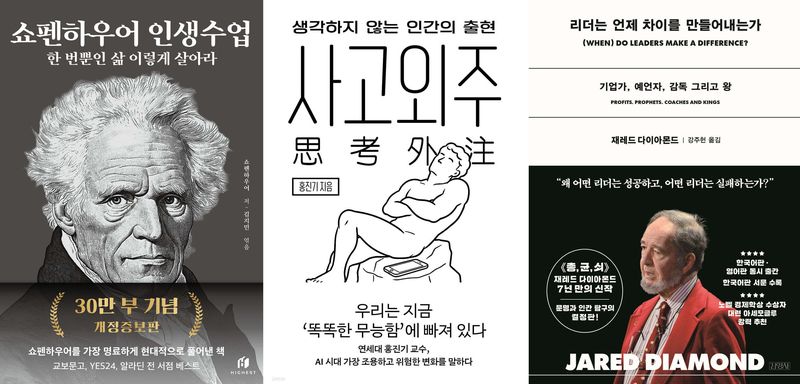
Drawing on historical cases, natural experiments and statistical analyses, it examines both the influence of individual leaders and its limits. The approach considers how much a leader’s capabilities contributed to an organization’s performance and how the conditions and environment surrounding that leader affected the outcome.
Readers can reconsider what they use as a basis for evaluating presidents, business executives and sports coaches, while examining the conditions under which one person’s choices can change the outcome.
The questions raised by the three books are closely connected to readers’ daily lives. They are worth reading through the lens of personal experience: What do you use as the standard for happiness? Which decisions do you leave to AI? And how do you evaluate a leader’s performance?
[email protected] Jang In-seo Reporter