"Why Is It Jammed When There Hasn't Even Been an Accident?" The Unexpected Cause of a Highway Traffic Jam
- Input
- 2026-09-25 06:35:00
- Updated
- 2026-09-25 06:35:00
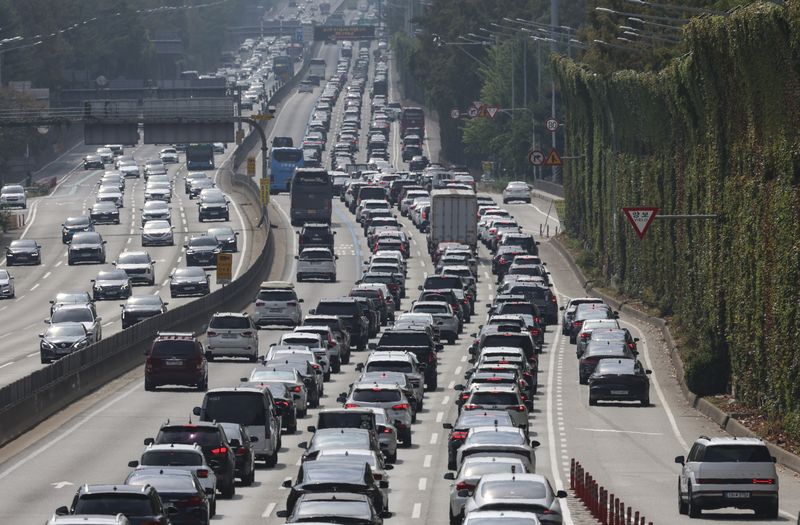
[Financial News] Expressways carrying people home for the holidays can suddenly become congested even when there has been no accident or roadwork. The unexpected cause is a so-called 'phantom traffic jam,' in which a small slowdown by the vehicle ahead is transmitted in a chain reaction to vehicles behind it.
According to researchers on the 24th, a 'phantom traffic jam (Phantom Traffic Jam)' refers to a phenomenon in which a long line of vehicles comes to a standstill despite there being no obvious cause, such as an accident or roadwork. A slight deceleration by one vehicle is passed to the vehicle behind it and gradually develops into a significant drop in speed.
It can begin with something minor. If a driver lightly taps the brakes before changing lanes or entering a tunnel, the vehicle behind may slow down more sharply. The next vehicle then brakes even harder, and differences in drivers' reaction times before applying the brakes compound the effect, causing speed fluctuations to grow farther back in the line.
The same phenomenon has been observed in experiments. In 2008, researchers at Nagoya University had 22 vehicles drive around a circular track at 30 km/h. The vehicles initially maintained a steady distance, but the gaps began to break down after one vehicle slowed, eventually creating a traffic jam as vehicles toward the rear came to a stop. The results showed that even a small change in speed can cause a traffic jam without an accident or obstacle.
Some sections are more prone to this phenomenon. On uphill stretches, vehicles may lose speed without drivers noticing. At tunnel entrances, drivers often slow down unconsciously because the surroundings suddenly become darker. On highway merge sections, frequent lane changes narrow the gaps between vehicles, increasing the likelihood of a chain reaction of deceleration.
The most basic response available to drivers is to leave sufficient space between vehicles and maintain a steady speed. With enough distance from the vehicle ahead, a driver can ease off the accelerator and slow smoothly rather than immediately braking when the vehicle ahead loses a little speed. This absorbs the speed change in the driver's own vehicle and reduces the degree of deceleration passed on to the vehicle behind.
Efforts are also underway to use technology to reduce traffic jams. The Korea Institute of Civil Engineering and Building Technology (KICT) developed the Pace Maker System (PMS), which helps vehicles maintain a steady speed when entering tunnels. LED guidance lights installed along the tunnel walls turn on sequentially in the direction of traffic, allowing drivers to follow the flow of light and maintain their speed.
The system was deployed at Geumnam Tunnel on the Seoul–Yangyang Expressway for about a year. Following its implementation, vehicle speed drops were reduced by more than 10%.
Autonomous-driving technology is also considered a long-term alternative. Autonomous vehicles can continuously measure their distance from the vehicle ahead with sensors and adjust their speed precisely, reducing unnecessary rapid acceleration and hard braking caused by human drivers.
However, it will take time for all vehicles to become autonomous and for the relevant technologies to be deployed on major roads. For now, drivers can reduce abrupt lane changes and unnecessary braking while maintaining sufficient distance from the vehicle ahead.
If a road suddenly becomes congested despite there being no accident or roadwork, the cause may be a small slowdown that began several kilometers ahead. Conversely, one driver's unnecessary braking can also be transmitted in a chain reaction to following vehicles and create a lengthy traffic jam.
[email protected] Han Seung-gon Reporter