An AI Civilization Seen Through a Telescope... Obvious’s Ceramic Paintings [fn Art Snap]
- Input
- 2026-09-25 06:00:00
- Updated
- 2026-09-25 06:00:00
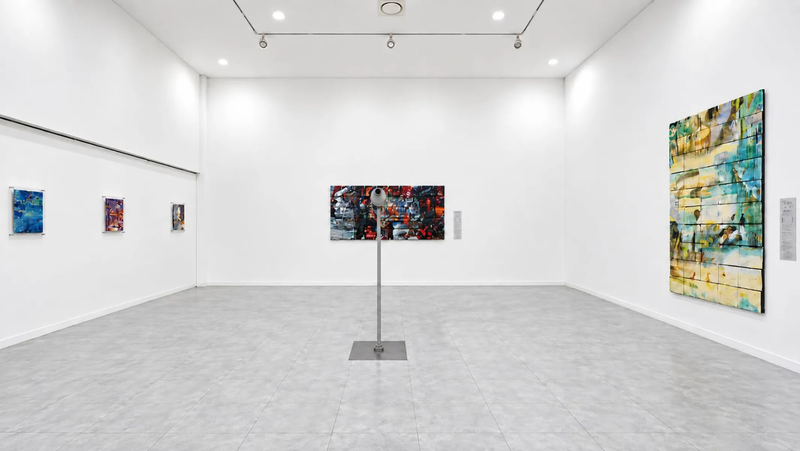
When visited on the 22nd, the fourth floor of Sun Gallery in Jongno-gu, Seoul, was hosting 'The Cycle: Incipit,' a solo exhibition by the French creative trio Obvious. The exhibition translates the memories and myths of a virtual society created as AI agents form relationships with one another into ceramic paintings.■ From the Memories of a Virtual Society to PaintingsObvious, a creative collective that develops AI algorithms to make art, consists of Pierre Fautrel, Hugo Caselles-Dupré and Gauthier Vernier. In 2018, Edmond de Belamy, created using AI, drew attention after selling for $432,500 at Christie's New York. This is Obvious’s second solo exhibition at Sun Gallery, following IMAGINE last year.
The starting point of the work is a virtual society designed by the artists. AI agents endowed with different personalities and desires—that is, programs that make decisions and act in a virtual world—interact with one another and form a community. The stories repeated within it become shared memories and beliefs, eventually developing into myths and rules.
The AI agents record their history and beliefs in words and images. Here, memory is closer to a story that the community accepts as fact. Obvious uses these accumulated materials as the basis for composing the figures and landscapes in its paintings.
When translating these records into images, Obvious deliberately avoids a polished finish. Using its own Lost LoRA algorithm, it trains the composition on frescoes and stops at an unstable stage, leaving errors and distortions behind. The collective embraces these as part of the distinctive aesthetics of AI-generated images.
The Sinopia algorithm then divides the screen into multiple sections and fills them with figures, buildings and traces of events. This is why the works appear abstract from a distance but reveal a collection of countless stories up close. The telescope in the center of the exhibition hall is a viewing tool that helps visitors find and read the small scenes within the images.
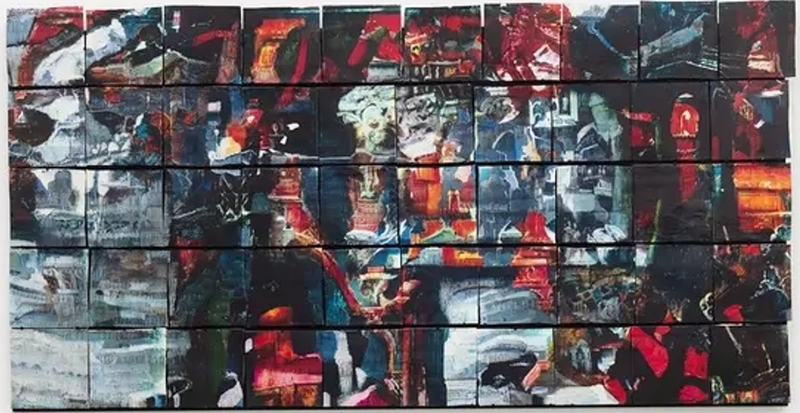
The small ceramic-tile work 'The Archive of Memories,' measuring 20 centimeters by 20 centimeters, is also on display. Visitors can move between the large compositions and small pieces to examine different traces of a virtual civilization.
The clay tiles are bisque-fired at about 1,000°C, coated with translucent glaze and fired again at about 1,200°C. Images generated by AI are then transfer-printed or UV-printed onto the surfaces, followed by finishing work for preservation. In this way, the time of clay and fire is added to the stories contained in digital files.
Handmade tiles differ slightly in their surfaces and forms. The artists do not erase these irregularities. As the errors and distortions in AI-generated images meet the texture of the clay and variations in the glaze, each piece leaves behind a distinct trace. The record of a virtual society formed inside computers becomes tangible matter.
Won Hye-kyung, director of Sun Gallery, said, "Uniqueness is the most important thing in contemporary art," emphasizing the differences created by the production process and materials in AI artworks.
Obvious places AI within the history of expressive tools shaped by clay and fire, pigments and printing techniques. By inscribing stories created by advanced technology onto an age-old material, the collective asks anew who creates and what should be preserved. The exhibition runs through October 2.
[email protected] Jang In-seo Reporter