Tourism Industry Says Jeju Routes Lost 359,000 Seats; Effect of KRW 300.3 Billion Airport Expansion to Be Assessed
- Input
- 2026-09-24 09:14:17
- Updated
- 2026-09-24 09:14:17
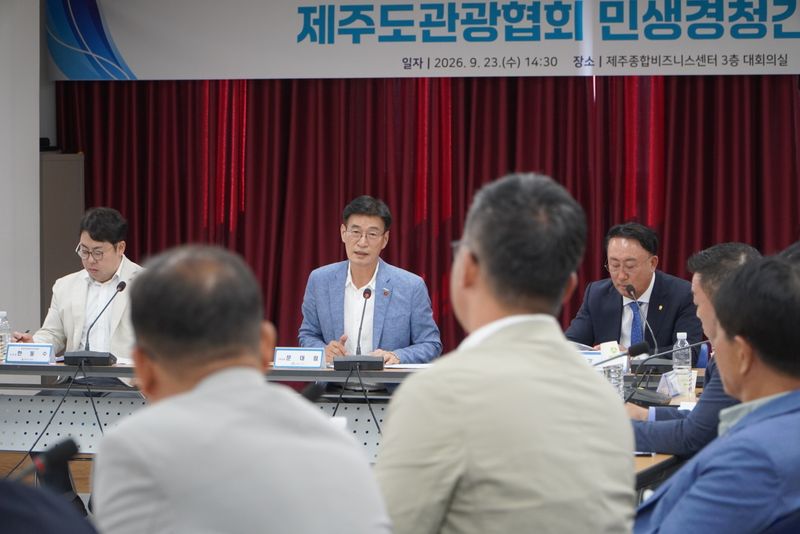
[Financial News, Jeju — Reporter Jeong Yong-bok] The tourism industry claims that seat supply on Jeju routes fell by approximately 359,000 seats from after this year's summer flight season through early September compared with the previous year. Against this backdrop, calls have emerged to assess the actual impact on flight and seat increases of the short-term Jeju International Airport infrastructure expansion project, into which approximately KRW 300.3 billion was invested.
At a public livelihood listening meeting held on the 23rd at the Jeju Comprehensive Business Center by National Assembly member Moon Dae-rim, the Culture, Tourism and Sports Committee of the Jeju Special Self-Governing Provincial Council, and the Jeju Tourism Association, the main issues discussed were reduced supply on Jeju routes, airport infrastructure, and aviation-control staffing.
The tourism industry presented figures showing that seat supply on Jeju routes from after this year's summer flight season through early September fell by approximately 359,000 seats from the same period last year. It called for flight frequencies to be restored and for greater use of large aircraft so that more passengers can be carried even when the number of flights remains unchanged.
Some participants also voiced concern that the deployment of large aircraft could decline if competition weakens following airline consolidation and other developments. They stressed that the issue directly affects not only Jeju tourists but also the mobility rights of Jeju residents, who rely heavily on air services when traveling to the mainland.
Han Dong Soo, chair of the Culture, Tourism and Sports Committee of the Jeju Special Self-Governing Provincial Council, said, "We will seek ways to expand slots and deploy more large aircraft through consultations with aviation experts and discussions among the tourism association and the National Assembly."
Investment in Jeju airport facilities also emerged as an issue for review. According to Moon Dae-rim, approximately KRW 300.3 billion was invested in the short-term Jeju International Airport infrastructure expansion project. Moon said, "No post-project impact assessment showing how much the project actually increased flight operations and seat supply has been identified," adding, "We need to take another look at the effects of the investment."

The short-term Jeju International Airport infrastructure expansion project was undertaken to increase the capacity of the existing airport in response to surging air travel demand. In 2016, the government presented a Jeju airport infrastructure expansion plan that included expanding passenger check-in and security-screening facilities, as well as adding baggage-handling equipment and immigration-screening facilities.
At the time, the project aimed to ease airport congestion and enable the limited facilities to handle more flights and passengers. The issue now being raised, therefore, is the need to quantify how closely the infrastructure investment was linked to actual increases in flights and available seats.
The aviation-control staffing issue was also raised. Moon said, "The Jeju Regional Office of Aviation's Aviation Control Division was found to have seven fewer employees than its authorized headcount." The division handles control planning, control operations, safety management and training, the control tower, and the approach control center.
MOLIT's operating method for domestic summer-season slots was another point of contention. A slot is an allocated time at which an airline may take off or land at an airport. At Jeju International Airport, where processing capacity is limited, the number of slots secured and actually used is directly linked to the supply of flights.
According to Moon, MOLIT implemented the '2026 Summer Domestic Slot Operation Plan' on April 30. Under the plan, for June 1–30 and September 1–October 24, certain domestic flights that are not operated are nevertheless recognized as operating records for future slot allocation.
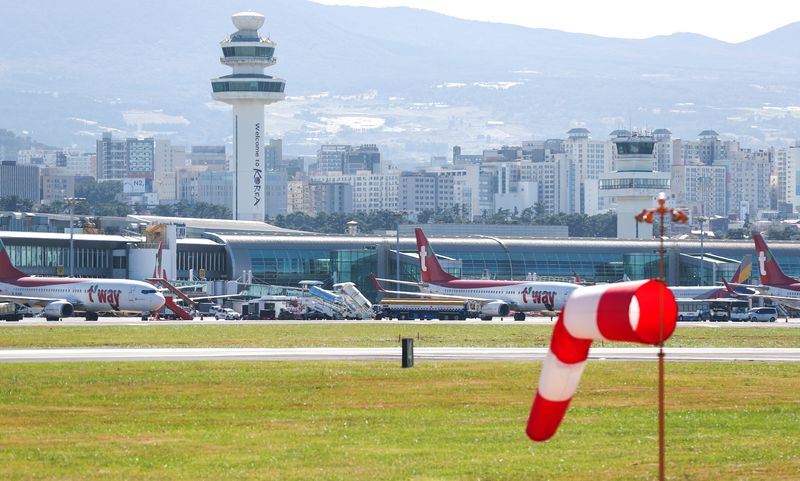
Normally, an airline that does not use its allocated slots sufficiently or does not operate for five or more consecutive weeks may be disadvantaged in the priority allocation of slots for the same season the following year. The measure effectively granted an exception for nonoperation during those periods.
MOLIT rejects the interpretation that the measure increased cuts on Jeju routes. It explained that airlines requested schedule adjustments because of high oil prices stemming from the situation in the Middle East, that the exception was applied while excluding the peak summer season, and that many cuts had already occurred in April, before the measure. Since there have been almost no cuts in September so far, MOLIT maintains that it is difficult to say the slot exception increased cuts on Jeju routes.
Moon said, "We will compare the number of Jeju-route flights allocated to each airline with the flights actually operated, the number not operated, and the status of those nonoperated flights being recognized as operating records to determine the relationship between the decline in supply and slot operations."
Moon said, "We will use operating data to verify whether the government's explanation is correct and call for ways to actually increase seat capacity on Jeju routes." He added, "We will review the need to increase air traffic control staffing and make follow-up investments in Jeju International Airport at the National Assembly's Special Committee on Budget and Accounts."
Seat supply on Jeju routes is determined jointly by airport slots and air traffic control staffing, the number of flights, and the type and seating capacity of aircraft deployed. Ultimately, the starting point for determining the cause of the 359,000-seat decline and the effects of the KRW 300.3 billion investment is the operating record: how many flights were allocated, how many actually operated, and how many seats were supplied.
[email protected] Jeong Yong-bok Reporter