"Korean I fell in love with through K-pop took flight after I met a Korean teacher" [Southeast Asia Focus]
- Input
- 2026-09-24 06:00:00
- Updated
- 2026-09-24 06:00:00
To mark the 100th anniversary of the designation of Hangul Day on the 9th of next month, [Southeast Asia Focus] is visiting Korean-language education sites in Vietnam, Indonesia and India. Over the coming weeks, we will take an in-depth look at the intense Korean-language boom and the current state of Korean-language education in these countries.
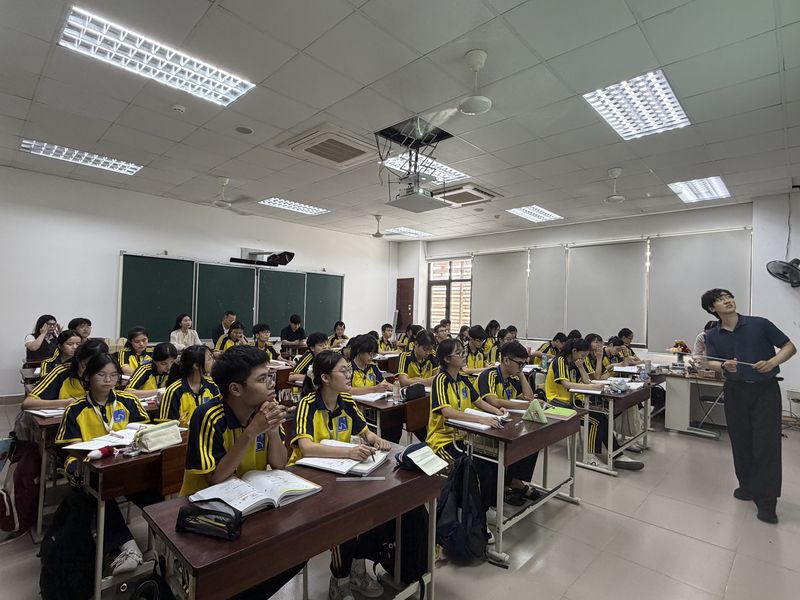
This was the Korean-language classroom for 10th graders—equivalent to the first year of high school in Korea—at Bac Ninh High School for the Gifted in Bac Ninh City on the 23rd. Bac Ninh is a major city in northern Vietnam where Samsung Electronics and other Korean manufacturers have established operations. As Cheon, a teacher dispatched by the Korean Education Center in Hanoi, read the textbook dialogue sentence by sentence, the students immediately read along. Even when faced with unfamiliar Korean sentences, they spoke without hesitation.
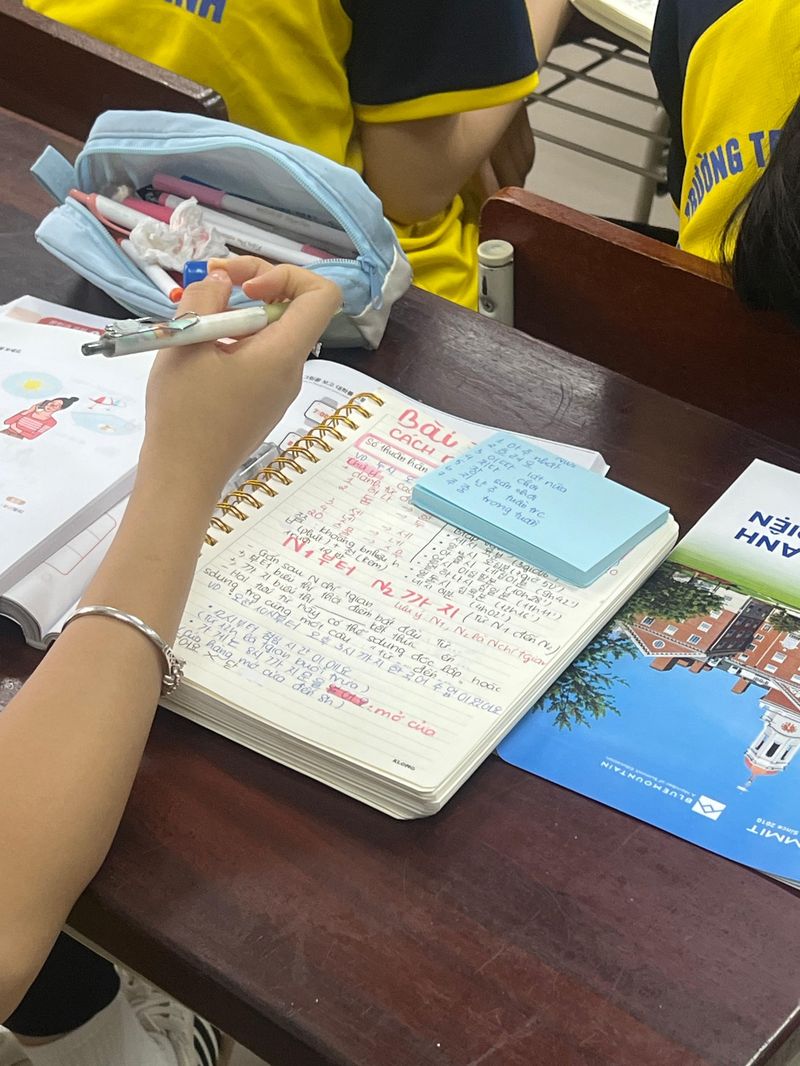
The day's topic was "Weather and Seasons." The students listened to a recorded conversation, guessed the weather and described their favorite seasons and the reasons in Korean. Having started learning Korean only after entering high school, they carefully wrote down every word and explanation Cheon put on the board, as if determined not to miss anything.
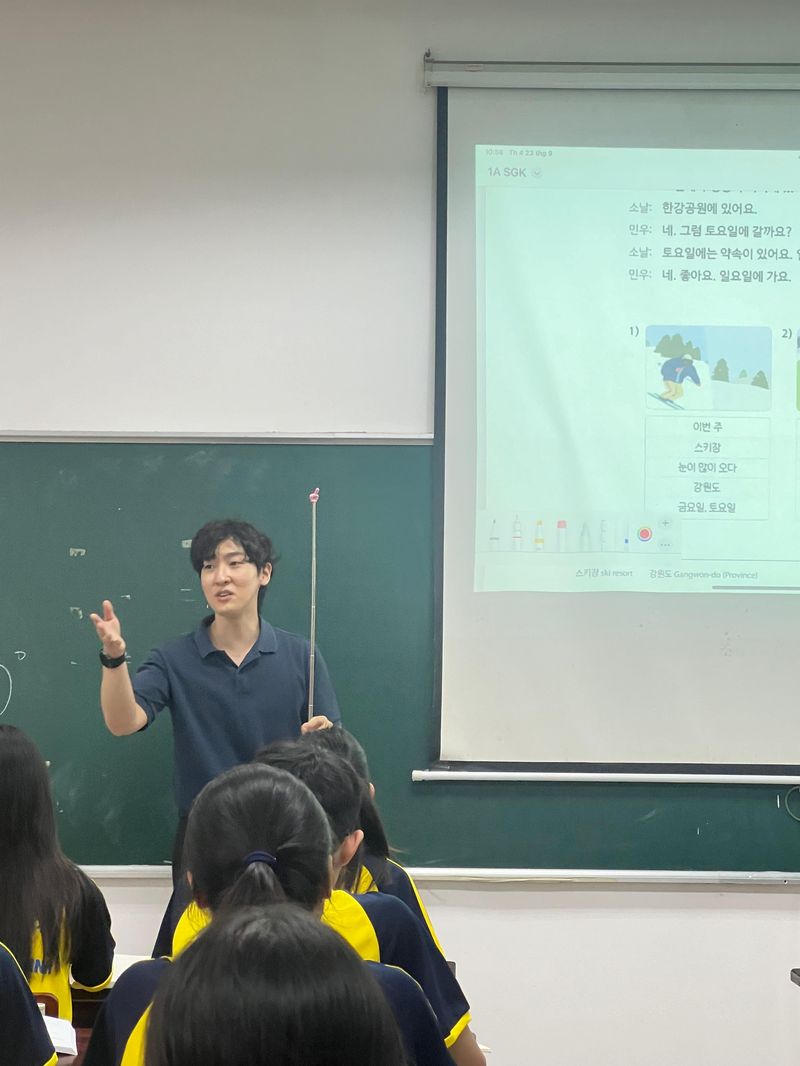
When Cheon asked the question, one student raised a hand. The student answered, "Winter," and then calmly explained the reason in Korean. The class went beyond memorizing textbook expressions; it gave students time to express their favorite seasons, their reasons and aspects of daily life in Korean. Their pronunciation was remarkably clear, making it hard to believe they had first learned Korean consonants and vowels only after entering high school. The students' eyes lit up whenever Cheon asked a question, while laughter and applause filled the classroom when they answered correctly or finished presenting.
The school where Cheon taught that day was established in 1995 and is considered the top school in Bac Ninh Province. Equivalent to a specialized-purpose high school in Korea, it launched its Korean program in 2024 and now operates one class each for 10th and 11th graders. The admissions competition is reportedly fierce, at approximately 4:1 to 5:1.
Students in the Korean program take six hours of Korean classes each week. In addition to Cheon, two local teachers who graduated from the Korean department at the University of Languages and International Studies teach the students and work to strengthen their Korean skills.
Dang Hai Linh, a Korean-language teacher at Bac Ninh High School for the Gifted, said, "The students were interested in Korean and Korean culture, so many of them applied," adding, "The parents' response has also been favorable." She continued, "Listening and speaking are the most difficult skills to improve when learning a foreign language, but I am proud to see the students' abilities improving rapidly since teacher Cheon began teaching them." She also expressed gratitude to the Korean Education Center in Hanoi for dispatching a Korean teacher.
Thirteen male students stood out in the classroom, unlike the language classes that typically have a large majority of female students. Cheon explained, "The vast majority of students learn Korean because of K-pop or K-dramas, so girls make up an overwhelming majority." However, she added, "Many of the boys and some of the girls chose the Korean program because they are thinking beyond cultural content about studying abroad or pursuing more advanced studies, so I teach them Korean with a strong sense of responsibility."
Cheon, who majored in Vietnamese at university, said, "As a native-speaking teacher, I see that Korean and Vietnamese cultures have many similarities as well as differences." She added, "I am also working hard to vividly convey to the students the cultural differences between Korea and Vietnam—which are not easy to learn from dramas or films—as well as the latest developments in Korean culture."
Vietnamese high school seniors take mathematics and literature examinations, then choose two subjects from nine electives, including a foreign language and history, for a total of four subjects in the graduation examination. They enter university based on the results.
Under new regulations, a Test of Proficiency in Korean (TOPIK) certificate can replace the foreign-language subject in the examination starting this year. Specifically, students who have earned TOPIK Level 3 or higher are exempt from the foreign-language examination among the elective subjects. Their TOPIK scores are converted into foreign-language scores and reflected in graduation and university admissions evaluations. This system is difficult to find in other countries.
Vietnam is currently known as a country with a very large number of TOPIK test takers. Of the 566,665 people who took TOPIK worldwide in 2025, 85,896 were Vietnamese students, accounting for 15.2%. Vietnam ranked first among countries other than Korea. Korean classes are currently offered at a total of 169 elementary, middle and high schools in Vietnam, with approximately 33,000 students enrolled.
Kim Hyun-dong, director of the Korean Education Center in Hanoi, said, "The Korean Education Center in Hanoi will actively look for ways to provide support so that students can broaden their interest in Korea rather than simply learn the Korean language." He added, "We will support them so they can access various opportunities, such as studying at Korean universities or finding employment at Korean companies, and we will do our best to help these students grow into talented individuals who will lead Vietnam in the future."[Southeast Asia Focus] is a feature that delivers vivid, in-depth coverage from the region of major issues and behind-the-scenes news in Southeast Asia, which has emerged as a key hub for global supply chains as well as diplomacy and security.[email protected] Kim Jun-seok Reporter