There Are 20,000, but Many Are 'Novice Investigators'... Will Special Judicial Police Officers Stand Alone After the Abolition of Prosecutors' Investigative Command?
- Input
- 2026-09-26 06:30:00
- Updated
- 2026-09-26 06:30:00
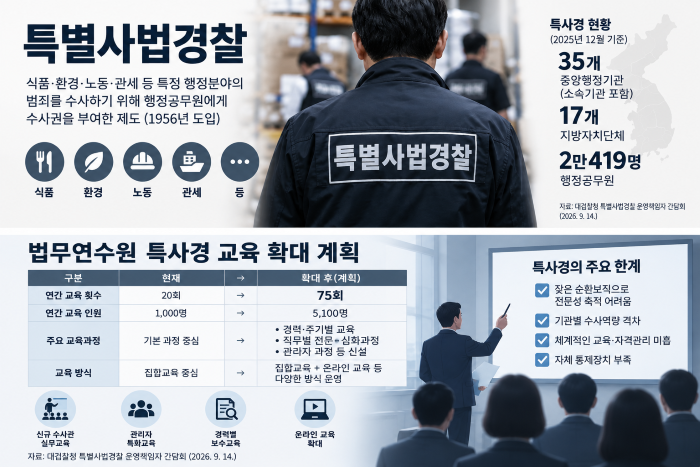
According to the Supreme Prosecutors' Office of the Republic of Korea (SPO) and other sources on the 23rd, a total of 20,419 administrative officials had been designated and were serving as Special Judicial Police Officers at 35 central administrative agencies and 17 local governments as of December last year. Introduced in 1956, the system grants investigative authority over relevant crimes to public officials working in specialized administrative fields, including food, the environment, health, military manpower administration, customs and intellectual property.
When the amended Criminal Procedure Act of the Republic of Korea takes effect on October 2, the relationship between prosecutors and Special Judicial Police Officers will change from command and supervision to mutual cooperation. Instead of prosecutors directing investigations, Special Judicial Police Officers will request "guidance and advice" from prosecutors when necessary. The Ministry of Justice is also moving to revise related laws, including by announcing a legislative notice on the complete revision of the existing rules governing prosecutors' investigative command over Special Judicial Police Officers on the 22nd.
The main concern is the investigative expertise of Special Judicial Police Officers. Lee Geun-woo, a professor of law at Gachon University, said at a criminal policy seminar hosted by the Korean Institute of Criminology and Justice (KICJ) on the 11th, "Most Special Judicial Police Officers have to handle administrative work in their assigned fields in addition to investigative duties. Investigative work is unfamiliar to them, and their assignment cycle is one to two years. Even when a request for supplementary investigation is issued, they end up passing it on to the next person rather than handling it themselves." Lee also suggested restoring prosecutors' investigative command or postponing implementation of the amended Criminal Procedure Act of the Republic of Korea by approximately six months to one year.
Meanwhile, the role of Special Judicial Police Officers is steadily expanding. In Seoul, the proportion of planned and self-initiated investigations by Special Judicial Police Officers rose from 39.2% in 2019 to 60% last year. Their role has expanded beyond simple administrative enforcement to include directly identifying suspected criminal activity and launching investigations.
Some officials in the field argue that the method of cooperation should vary depending on the nature of each case now that investigative command is being abolished. Kang Hee-eun, head of the Economic Investigation Division at the Special Judicial Police Bureau for Citizens' Livelihood in Seoul, said, "I believe simple and standardized investigations, such as counterfeit-goods cases, require little guidance or advice. For new cases or complex cases involving conflicting precedents, however, it would be better to request guidance and advice at an earlier stage, while prosecutors provide advice from the perspective of deciding whether to indict and maintaining the public prosecution."
The government plans to expand training for Special Judicial Police Officers. The Legal Research and Training Institute plans to increase its current annual program from 20 sessions serving 1,000 people to 75 sessions serving 5,100 people. It will also introduce training based on experience and assignment cycles, specialized and advanced courses by job function, and management courses. Kang emphasized, "Practical, case-based training for new investigators, specialized training for managers such as division and team heads, and regular refresher training tailored to each level of experience are important."
Some also argue that the Special Judicial Police Officers' organizations themselves must be professionalized, in addition to expanding training. At the seminar on the 11th, Shin Hyun-ki, a professor of police administration at Hansei University, said, "Special Judicial Police Officers know the administrative work in their respective fields extremely well, but they face an entirely different set of challenges when granted investigative authority and tasked with conducting practical investigations." He proposed considering the enactment of a separate Special Judicial Police Act and the establishment of a Special Judicial Police Agency.
[email protected] Choi Eun-sol Reporter