"From Document Writing to Neighborhood Commercial District Analysis"—Seoul District Governments Accelerate AI-Powered Administration
- Input
- 2026-09-26 07:00:00
- Updated
- 2026-09-26 07:00:00
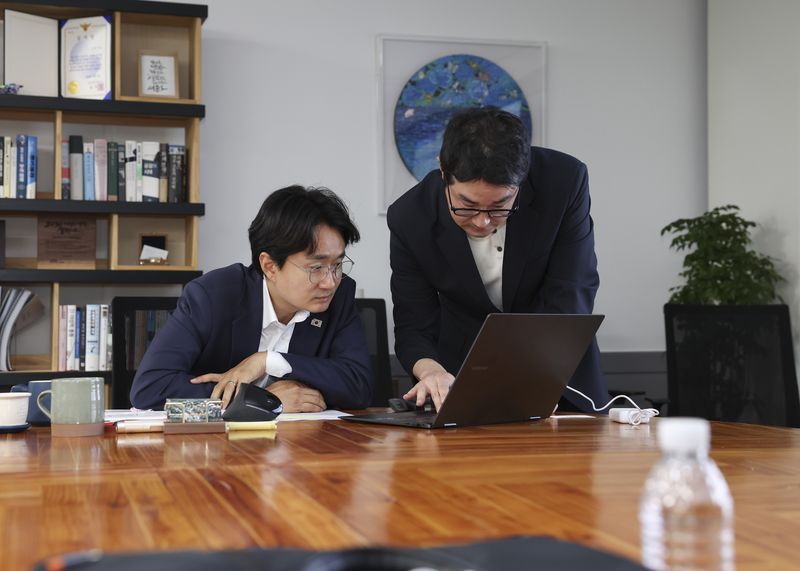
[Financial News] Seoul's district governments are accelerating administrative innovation by using artificial intelligence (AI) and big data. They are improving administrative efficiency by introducing AI for civil servants' document writing and data analysis, while analyzing commercial-area data to develop support measures for small business owners. At the same time, the AI transformation is spreading beyond internal administration to residents' daily lives as districts expand training to help people use AI directly in their everyday activities and work.
Raising Administrative Efficiency with AI and Providing Customized Support for Neighborhood Commercial Districts
According to Seoul's district governments on the 26th, Nowon District was recently selected to participate in the local-government pilot service for OnAI, an intelligent work-management platform promoted by the Ministry of the Interior and Safety. OnAI is a work platform that uses generative AI to support searches for laws and regulations and administrative materials, data analysis, and document writing. It also offers automatic generation and summarization of meeting minutes in conjunction with video conferences, helping reduce repetitive administrative tasks.Nowon District plans to introduce about 500 accounts from October through the end of the year. It will review usage by department and flesh out its operating plan for next year. The pilot service will also include Dobong District and Seodaemun District, along with Nowon District, among Seoul's district governments.
Nowon District has already introduced and operates its own generative AI platform for administrative work. After launching NowonGPT for all employees in March, 1,150 of the district's 1,584 employees had signed up as of this month. That means more than seven out of every 10 employees have joined the AI platform.
The district is also expanding the scope of AI use from internal administration to resident safety management. AI is being used for specialized administrative tasks, including analyzing crowd density in areas with large gatherings and reviewing architectural and civil engineering drawings in conjunction with video-based records management. Nowon District plans to reduce the administrative resources devoted to repetitive tasks through AI and redirect them toward improving services for residents.
More district governments are also turning to data to revitalize their local economies. Gangdong District signed a big data cooperation agreement with the Seoul Credit Guarantee Foundation on the 16th to develop policies tailored to local commercial districts. The agreement aims to establish support policies for small business owners that reflect the characteristics of each commercial area.
The two organizations will jointly use data on sales trends by industry and area, floating population, the number of stores, business opening and closure rates, and rent trends. Based on the data, they plan to identify sectors requiring support by neighborhood and industry and establish management guidance and financial support policies suited to each commercial area's characteristics.
Jung-gu also signed an agreement with the Seoul Credit Guarantee Foundation on the 17th to support local commercial districts and small business owners based on big data. The plan is to analyze business conditions and demand for financial support by area, commercial district, and industry and reflect the findings in small-business policies. The Seoul Credit Guarantee Foundation will analyze the data, while Jung-gu will use it to develop support policies and examine their impact in the field.
Alongside data-driven policy development, Jung-gu is expanding financial support for small businesses. The special guarantee limit this year totals KRW 43.75 billion, and 692 businesses had received KRW 28.2 billion in support as of the end of July. In the fourth quarter, the district will also provide KRW 1.995 billion in loans from its Small and Medium-sized Business Development Fund.
Seocho District is focusing on applying AI to small business owners' actual management activities. At the ninth Food-Service Business Management Academy, which will run for five weeks from October 20, 30 restaurant operators will receive training on automating repetitive tasks with AI and establishing customer management systems.
In particular, the district is working with the local AI company Le Mong to allow participants to use an AI-based delivery-app review management program themselves. Two outstanding participating businesses will also receive AI-based store assessments and consulting on marketing automation. The initiative is intended to reduce the time and burden restaurant operators devote to customer service and marketing while improving the efficiency of store operations.
Expanding AI Education for Residents—from Daily Life to Solving Local Issues
Efforts to expand education so residents can use AI directly are also continuing. Seongbuk District has completed this year's curriculum for the Resident Self-Governance AI Academy, which it operated for all neighborhood resident self-governance committee members as the first such program among Seoul's district governments. All 20 neighborhood resident self-governance councils participated from February through September, with a cumulative total of 1,062 participants attending 45 sessions.The practical training focused on tasks that can be used in resident self-governance activities, including organizing meeting materials with generative AI and creating promotional content, activity videos, and reports. In a satisfaction survey, 95% of respondents said their understanding of AI had improved, while 98% said they would recommend the training to others.
Starting next year, Seongbuk District also plans to operate workshops for identifying resident self-governance agendas with AI. The district intends to expand AI use beyond practical support, such as preparing meeting materials, to analyzing local issues and residents' opinions and identifying resident self-governance agendas.
Seocho District is also working to strengthen residents' ability to use AI. On October 2, it will hold a special lecture at Seocho District Office under the theme "Seocho Residents' Smart Life: Directing Generative AI." The lecture will introduce ways to assign different roles to multiple AI agents and use them in daily life and work.
Support for training AI professionals is also continuing. Seocho District is recruiting scholarship recipients among local university students majoring in AI and ICT fields. It provided KRW 360 million in scholarships to a total of 90 students from last year through the first half of this year, and plans to select 30 additional students in the second half of this year and cover their full tuition.
Seocho District Mayor Jeon Seong-su said, "I hope this scholarship program will serve as a solid foundation for young people pursuing their dreams in AI and ICT to focus on their studies and prepare for the future." He added, "We will continue to provide diverse educational opportunities so residents can turn the changes of the AI era into opportunities."
[email protected] Seong Cho-rong Reporter