Landscape Painting Met Through a Microscope... The Small Life Captured by Lee Lee-nam [fn Art Snap]
- Input
- 2026-09-23 16:30:00
- Updated
- 2026-09-23 16:30:00
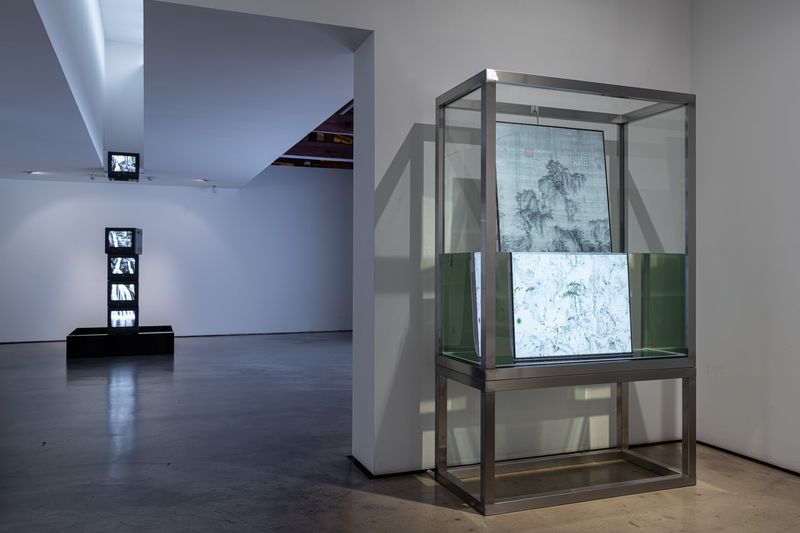
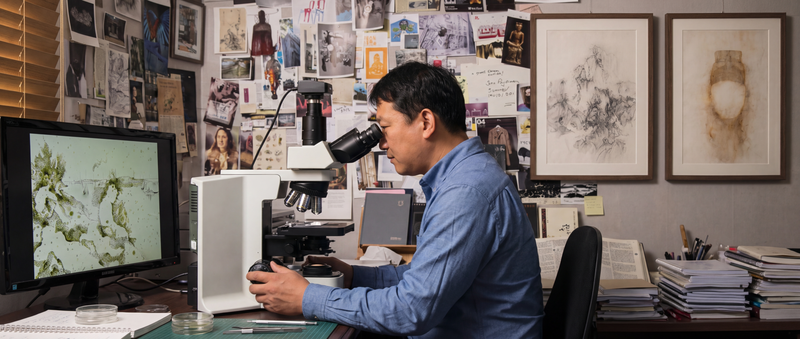
Lee Lee-nam’s solo exhibition “Seeing the Formless, Hearing the Soundless: Painterly Reflections on Life and Existence,” which opened on the 23rd at Hakgojae Gallery in Jongno-gu, Seoul, seeks new landscapes in forms of life invisible to the naked eye. It is his first solo exhibition at Hakgojae Gallery in 17 years since 2009 and features 15 media and installation works.■A Landscape Discovered in a Drop of WaterThe work began at Yongsopokpo Falls in Damyang County, the artist’s hometown. Lee examined water he had collected himself under a microscope. The traces of microorganisms moving, gathering and dispersing within it evoked mountain ridgelines, the flow of rivers, clouds and mist. The waterway stretching from Yongsopokpo Falls to the Yeongsan River became a starting point for revisiting the source of life and his own roots.
The artist, who has added movement and time to classical paintings, shifted his focus this time to the process by which images emerge. Moving beyond his reinterpretation of completed landscapes, he examines how the movements of small living organisms create forms. His gaze, once directed at mountains and rivers, now enters the minute life that makes up those landscapes.
Conversations with artificial intelligence also helped broaden his perspective. Lee treated AI as a dialogue partner that could prompt him to reconsider a human-centered view. The creation of a single image involves different forms of life and matter, as well as environments and technologies, including water, microorganisms, light, temperature, microscopes and cameras.
The exhibition title conveys the idea of “seeing the invisible and hearing the soundless.” It is grounded in the belief that something does not cease to exist simply because humans cannot detect it.
Independent curator Yoon Jae-kap noted in the exhibition foreword, "Although the scale has become smaller, the questions we ask when looking at the world have expanded in more fundamental directions."
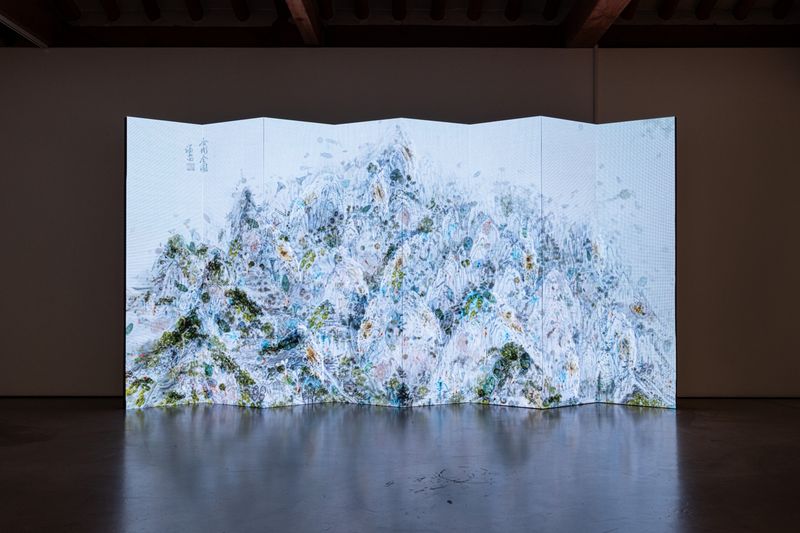
The folding-screen-style “Microscopic Landscape—Inner Mount Kumgang” transforms the forms and movements of microorganisms into an image of Mount Kumgang. Up close, dots, stains and traces of cells emerge; from a distance, they can be read as mountains, ridgelines and valleys. The landscape divides and reconnects according to the folding screen’s structure.
While the water tank divides the screen at the waterline, the folding screen changes the relationship between its sections according to the viewer’s position. Seen together, the two works reveal that not only the subject of microorganisms but also the frame containing the image and the distance from which it is viewed become part of the landscape.
In “One Water, Many Landscapes—Yongso,” footage of waterfall water, forests, rocks and light flows at different speeds across several CRT monitors. Monitors stacked on the floor and others suspended high above guide viewers’ gazes up and down.
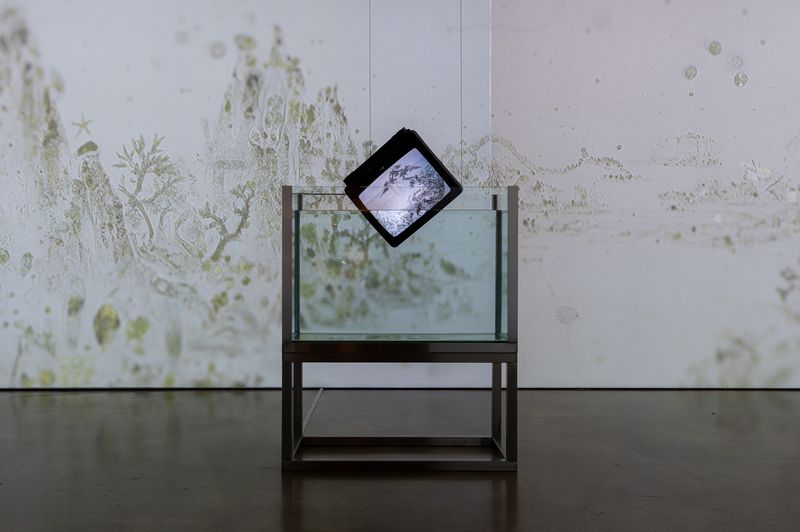
“Move Sound Image—Shared World” combines a CRT television submerged at an angle in a water tank with eight projectors. Memories of war and ruins are layered over the landscape formed by microorganisms, contrasting the coexistence of small forms of life with the destruction left behind by humans. The images and sound extend across the walls and floor.
The exhibition runs through October 24 at the main building of Hakgojae Gallery in Jongno-gu, Seoul.
[email protected] Jang In-seo Reporter