KOSPI holds the 7,000 mark despite 2 trillion won in selling by retail and foreign investors [fn Market Close]
- Input
- 2026-09-23 15:42:43
- Updated
- 2026-09-23 15:42:43
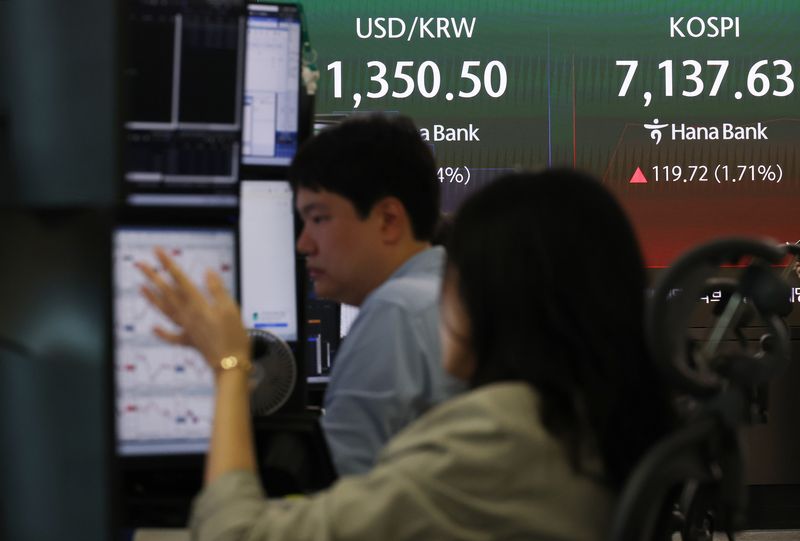
[Financial News] The KOSPI held above 7,000 as large-cap semiconductor stocks, including Samsung Electronics, gained ground despite retail and foreign investors dumping more than 2 trillion won worth of shares.
According to the Korea Exchange (KRX) on the 23rd, the KOSPI Composite Index closed at 7,080.92, up 63.01 points, or 0.90%, from the previous session. The index opened at 7,153.99, up 1.94% from the previous day, but later pared its gains and dipped as low as 7,014.98, down 0.04%, during the session.
On the main board, institutional investors posted net purchases of 454 billion won, while retail and foreign investors recorded net sales of 1.5031 trillion won and 586.2 billion won, respectively.
By sector, medical and precision instruments rose 3.36%, electrical and electronics advanced 1.95%, and chemicals gained 1.28%. Construction fell 5.66%, machinery and equipment declined 3.22%, and IT services dropped 2.40%.
Semiconductor-related stocks were strong among the largest companies by market capitalization. Samsung Electronics preferred shares rose 4.02%, SK Square gained 3.97%, and SK climbed 3.91%. Samsung Electronics advanced 3.25%, Samsung Electro-Mechanics rose 1.41%, and SK hynix gained 1.20%. Shipbuilding, defense, and nuclear power-related stocks, however, weakened. Doosan Enerbility fell 5.55%, while Hanwha Aerospace and HD Hyundai Heavy Industries declined 3.41% and 3.18%, respectively.
The KOSDAQ (Korea Securities Dealers Automated Quotations) closed at 844.48, up 10.10 points, or 1.21%, from the previous session. Retail investors bought 38 billion won, while foreign and institutional investors sold 45 billion won and 2.3 billion won, respectively.
Securities analysts said that whether the agreements reached at the U.S.-China summit are implemented and any changes to semiconductor regulations would be key factors determining sector-specific stock performance.
Kim Seok-hwan, a researcher at Mirae Asset Securities, said, "If the May summit was aimed at establishing strategic stability in U.S.-China relations, this summit is about determining whether existing agreements on tariffs, agricultural products, aircraft, and rare earths are actually being implemented." He added, "Rather than focusing on the index, investors should pay attention to policy changes. Stability in tariff and rare-earth supplies, expanded AI consultations, and changes in U.S. semiconductor regulations targeting China will be key variables for individual sectors."
[email protected] Bae Han-geul Reporter