Aged Stem Cells 'Rejuvenated'—Functions Restored with Five Minutes of Physical Stimulation [Unboxing the Lab]
- Input
- 2026-09-24 06:30:00
- Updated
- 2026-09-24 06:30:00
Do you remember the excitement of opening a delivery box? Amazing discoveries that could change our lives are emerging from university laboratories even as we speak. They are simply wrapped in thick packaging called 'academic papers.' In 'Unboxing the Lab,' we will skip the complex formulas and theories and deliver only the key findings you want to know. Shall we open the box? Today's featured discovery is this study.
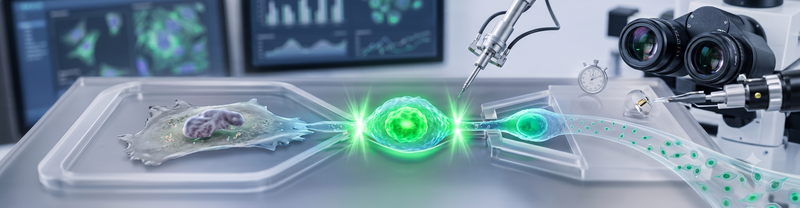
Put simply, this is cell rejuvenation. It does not reverse a person's age. Instead, physical force is applied to long-term-cultured, aged stem cells to make them active again. The research team confirmed that the aged stem cells regained the ability to proliferate and assist wound healing at levels closer to those of early-passage cells.
Stem cells are used to make cell therapy products, but their functions can decline when the same cells are cultured for a long time. The research team believes this technology could be used to restore the function of such stem cells before they are used in cell therapy products.
The device can also process a large number of cells at once. The system developed by the research team can handle about 4.5 million cells per minute, or approximately 270 million cells per hour. That capacity points to the possibility of using it in the manufacturing of cell therapy products, which requires handling large numbers of cells. However, further research is needed to determine whether it can be applied to actual cell therapy manufacturing and how long its therapeutic effects will last.
■Five minutes through a narrow channel... Physical stimulation applied to cells
The research team conducted experiments using stem cells obtained from umbilical cords and cultured for a long time until they reached an aged state. First, the researchers built a device with extremely small channels just wide enough for the cells to pass through. As the cells moved through these channels, they were compressed and deformed, receiving physical stimulation.
The research team named the method 'μ-CPR.' Rather than introducing drugs into the cells or altering their genes, the method applies physical force to them.
The researchers varied the intensity of the stimulation across several levels and observed how the cells changed. If the stimulation was too weak, the effect was insufficient. If it was too strong, it could adversely affect the cells' survival or proliferation. Through these experiments, the team identified an intensity that minimized cell damage while maximizing the rejuvenation effect.
The physical stimulation itself took about five minutes. The researchers then allowed the cells time to stabilize before examining their condition. They used several methods to determine what changes occurred after the cells were exposed to force for a short period.
The first factor examined was how aged the cells were. Characteristics commonly found in aged cells decreased by more than twofold after μ-CPR treatment, falling to levels similar to those of early-passage cells.
By contrast, the amount of proteins indicating stem-cell properties increased. Key proteins rose by 1.8 to 2.5 times compared with pretreatment levels. The team said this showed that the aged stem cells had moved closer to a stem-cell-like state again.
The cells' ability to proliferate on their own and form new cell populations also more than doubled. The cell nuclei, which had enlarged and become disorganized with aging, and the structures that support the inside of the cells also appeared to regain their organization.
The research team examined whether these changes also occurred in other cell types. In addition to stem cells obtained from umbilical cords, the researchers observed similar reductions in aging-related characteristics in adipose-derived stem cells and fibroblasts that make up the skin. Further research is needed to determine how the effects vary by cell type and whether the method can be used in actual treatments.
■Aged stem cells also improve wound healing
The researchers conducted wound-healing experiments to determine whether the cells' actual functions improved, rather than merely changing in appearance.
In cell experiments, the team first confirmed that aged stem cells treated with μ-CPR moved more actively than untreated aged stem cells. The researchers then created wounds on the skin of mice and administered the stem cells.
The researchers created wounds approximately 8 mm in diameter on the mice's skin. They compared the healing process after administering early-passage stem cells, long-term-cultured aged stem cells, and aged stem cells treated with μ-CPR.
No major differences in wound healing were observed among the groups during the first three days. Differences began to emerge on the sixth day. By the ninth day, wounds in mice treated with μ-CPR-treated aged stem cells had healed better than those in mice given untreated aged stem cells. Wound healing at a level similar to that seen with early-passage stem cells was also observed.
This study demonstrates the potential to partially restore some functions of long-term-cultured stem cells whose performance has declined by applying physical force instead of drugs or genetic manipulation. The research team stated that further studies are needed to determine how repeated physical stimulation affects the cells and how long the restored functions remain effective.
[email protected] Man-gi Kim Reporter