KAGI, China’s National Botanical Garden Join Hands to Conserve Wild Plant Seeds
- Input
- 2026-09-23 12:50:23
- Updated
- 2026-09-23 12:50:23
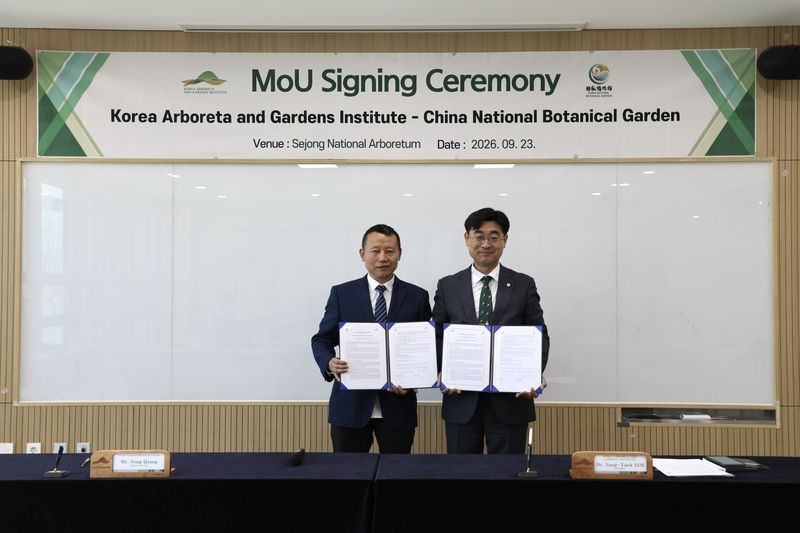
KAGI announced on the 23rd that it had signed an agreement with China’s National Botanical Garden at Sejong National Arboretum to conserve wild plant seeds and biodiversity in East Asia.
Under the agreement, the two sides will cooperate in various areas, including joint research and field surveys on threatened and priority conservation species, workshops and personnel exchanges, and efforts to raise awareness of biodiversity. In particular, they plan to gradually pursue the backup conservation of wild plant seeds held by China’s National Botanical Garden at the Baekdudaegan Global Seed Vault in Bonghwa, North Gyeongsang Province. However, the transfer of seeds will be carried out in accordance with international norms, including the Nagoya Protocol, and the domestic legal procedures of both countries.
Through this agreement, KAGI plans to expand cooperation on conserving plant genetic resources in East Asia and strengthen the international seed conservation network centered on the Baekdudaegan Global Seed Vault.
KAGI President Sim Sang-taek said, "I hope this agreement will expand the role of the Baekdudaegan Global Seed Vault as a safety net that helps protect China’s valuable plant genetic resources," adding, "We will continue cooperation to conserve biodiversity in East Asia based on the expertise and infrastructure of both institutions."
Meanwhile, the Baekdudaegan Global Seed Vault in Bonghwa is one of only two permanent seed storage facilities in the world and the only one dedicated exclusively to wild plants. Built in a tunnel-shaped structure 46 meters underground in a bedrock layer, it shields the seeds from external impacts. KAGI has so far preserved seeds from wild plants overseas in cooperation with countries in Central and Southeast Asia, but this is the first time it has established direct cooperation with China, which possesses one of the world’s highest levels of plant diversity.
[email protected] Kim Won-jun Reporter