Seoul Metropolitan Government: "The Longer the Delay in Reinforcing GTX-A Samseong Station Columns, the More Difficult It Will Be ... MOLIT Must Reach a Decision Quickly"
- Input
- 2026-09-23 14:35:48
- Updated
- 2026-09-23 14:35:48
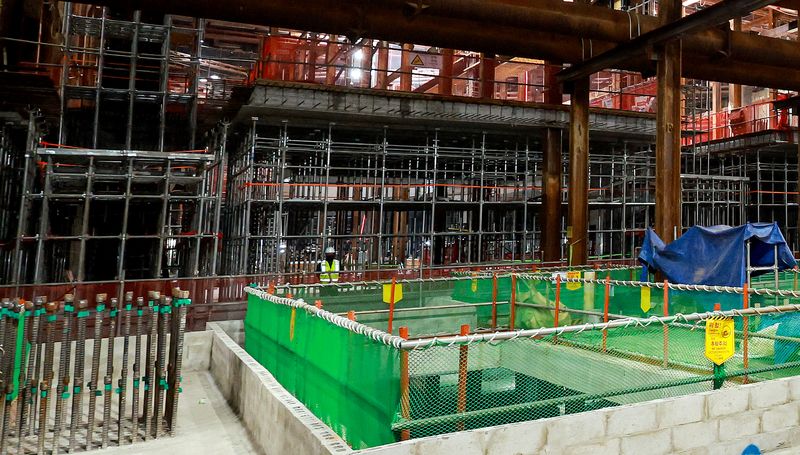
[Financial News] Seoul Metropolitan Government has asked the Ministry of Land, Infrastructure and Transport (MOLIT) to promptly finalize a reinforcement method in connection with the missing rebar at GTX-A Samseong Station.
On the 23rd, Seoul Metropolitan Government said it had delivered the interim results of an emergency detailed safety inspection and the findings of an external expert consultation for Section 3 of the Yeongdong-daero Underground Space Complex Development to MOLIT and Korea National Railway on the 11th. It also requested an early decision on the reinforcement method and the prompt implementation of GTX-A trains passing through Samseong Station without stopping.
According to Seoul Metropolitan Government, the interim results of the emergency detailed safety inspection for Section 3 of the Yeongdong-daero project showed that the condition and safety of all structures constructed to date were rated "A." A review of the structures' load-bearing capacity, based on construction completed through the upper slab of Basement Level 2, also found that they met the allowable standards.
Experts assessed that the later reinforcement is carried out, the less effective the same steel plate will be. Steel plates attached to the columns share only the additional loads imposed after installation. Because they cannot share loads already placed on the columns before installation, thicker steel plates will be needed to achieve the same level of reinforcement if work progresses further above before the columns are reinforced.
An expert review found that when 22-mm steel plates are used, the strength after reinforcement would be equivalent to 123% of the original design strength immediately after construction of Basement Level 5 is completed. However, the figure would fall to 118% upon completion of Basement Level 4M, 113% upon completion of Basement Level 3, and 105% upon completion of Basement Level 2.
Construction of Basement Level 3 is currently under way in Section 3. Seoul Metropolitan Government believes that if the decision on the reinforcement method is delayed further, the longer reinforcement work could affect the schedule for the main construction of the Yeongdong-daero complex development.
MOLIT, however, maintains that additional review is needed before deciding on the reinforcement method. A service commissioned by Korea National Railway to review the suitability of the column reinforcement is scheduled to continue through December 31, while the government joint inspection period has been extended by four months, from July 20 to November 20.
Seoul Metropolitan Government is concerned that if the method is decided only after all reviews, including the service, are completed, the actual start of reinforcement work could be pushed into next year. It therefore says it will accept any method MOLIT chooses, including filling the columns with high-strength mortar, and begin the work immediately.
The city also requested the prompt implementation of GTX-A trains passing through Samseong Station without stopping. Maximum vibration velocities recorded in train vibration measurements conducted in May and July were 0.069 cm/s and 0.049 cm/s, respectively, well below the relevant standard of 0.3 cm/s. External experts determined that, given these vibration levels, trains could pass through without stopping while column reinforcement work proceeded at the same time.
A Seoul Metropolitan Government official said, "As structural safety at the current construction stage has been confirmed, the reinforcement method needs to be finalized promptly. We plan to begin the column reinforcement work immediately once the method is decided."
Meanwhile, delays in finalizing the reinforcement method and resuming comprehensive test operations are expected to trigger a dispute over who will bear any additional costs going forward. Seoul Metropolitan Government maintains that responsibility for the missing rebar on the part of the contractor and construction supervisor should be determined separately, but that additional costs, including compensation for operating losses caused by delayed decision-making after structural safety was confirmed, should not be imposed on the city or its residents.
[email protected] Choi A-young Reporter