"Korea Ranks First Worldwide in Energy Storage System Patent Applications"
- Input
- 2026-09-27 12:00:00
- Updated
- 2026-09-27 12:00:00
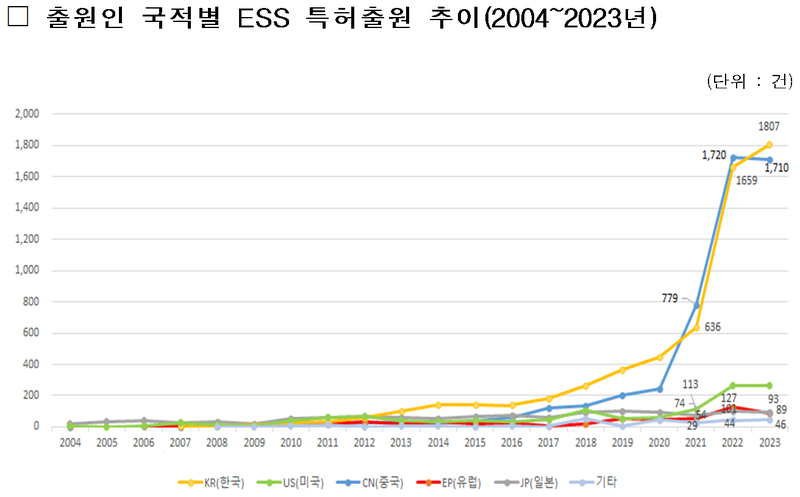
The Ministry of Intellectual Property said on the 27th that an analysis of trends in grid-scale ESS patent applications filed with the five IP offices (IP5)—Korea, the United States, China, Europe and Japan—over the past 20 years (2004–2023) showed that the total number of applications grew approximately 125-fold, from 32 in 2004 to 4010 in 2023.
By applicant nationality, Korea ranked first by a wide margin with 6030 applications (41.3%). China followed with 5176 (35.4%), ahead of the United States with 1283 (8.8%), Japan with 1220 (8.4%) and Germany with 250 (1.7%). Korea also recorded the highest average annual growth rate in applications over the past three years (2021–2023), at 68.6%, well ahead of the United States (53.1%), China (48.2%), Germany (33.3%) and Japan (12.1%), further widening the gap.
The rankings by company also confirmed the dominant technological edge of Korean companies. LG Energy Solution ranked first globally with 4605 applications, followed by China’s CATL in second place with 2653 and Samsung SDI in third with 242. LS ELECTRIC (114 applications, seventh) and Samsung Electronics (78, eighth) also made the list, putting four Korean companies among the top 10.
By specific technology, 'energy storage safety and management technologies,' which control battery conditions and thermal and fire risks, accounted for more than half of all applications, with 7705 (52.8%). They were followed by 'long-duration storage technologies' for storing and supplying electricity over extended periods (5,338 applications, 36.5%) and 'power conversion and grid integration technologies' (1562, 10.7%). The figures show that improving safety to reduce fire risks—the biggest weakness of ESS—is at the center of technology development.
Park Jae-hoon, director general of the Electrical and Telecommunications Examination Bureau at the Ministry of Intellectual Property, said, "As renewable energy expands and electricity demand changes, the importance of ESS, which can store and supply electricity when needed, is growing. We will support efforts to strengthen the foundation for our companies to enter overseas power-grid markets by quickly and accurately securing rights to outstanding technologies, building on the technological and patent capabilities they have accumulated."
Meanwhile, the global volume of new ESS installations is expected to grow from approximately 241 GWh last year to 710 GWh in 2030. At the end of June, the Korean government also unveiled the 'Electricity Nation Vision for the AI Era' to address large-scale power demand from data centers and semiconductor complexes, presenting the expansion of ESS and pumped-storage hydropower as measures to strengthen power-system flexibility.
[email protected] Kim Won-jun Reporter