AI Emerges as a Key Issue Shaping the International Order... Countries Put Forward Their Positions
- Input
- 2026-09-23 10:56:32
- Updated
- 2026-09-23 10:56:32
[Financial News] Artificial intelligence (AI) has emerged as a key issue that will shape the next international order.
Major countries used the UN forum to assert their interests and positions over who will lead the technology and establish the rules of the AI era.
The high-level week of the general debate at the 81st United Nations General Assembly opened at the UN headquarters in New York on Sept. 22 (local time), with leaders from around the world gathering to discuss international issues. AI emerged as a central agenda item.
In his address to the general debate, U.S. President Donald Trump made clear that he opposed international regulations that could stifle AI development and intended to protect U.S. technological leadership.
He said, "The United States categorically rejects any attempt to control AI," adding, "I will not stifle the growth of a technology that will be bigger than the Industrial Revolution."
Trump also said that existing judicial systems could be used if AI created risks. "We will monitor it closely through the Department of Justice," the president said.
Trump, who has repeatedly described as "exaggerated" recent warnings that AI could pose an existential threat to humanity, also declared that future U.S. government documents would use the term "super intelligence" instead of AI.
France Proposes 'a Third Way'
Chinese President Xi Jinping, whose country is engaged in fierce competition with the United States for AI dominance, did not attend the UN General Assembly. China was represented by Vice President Han Zheng.
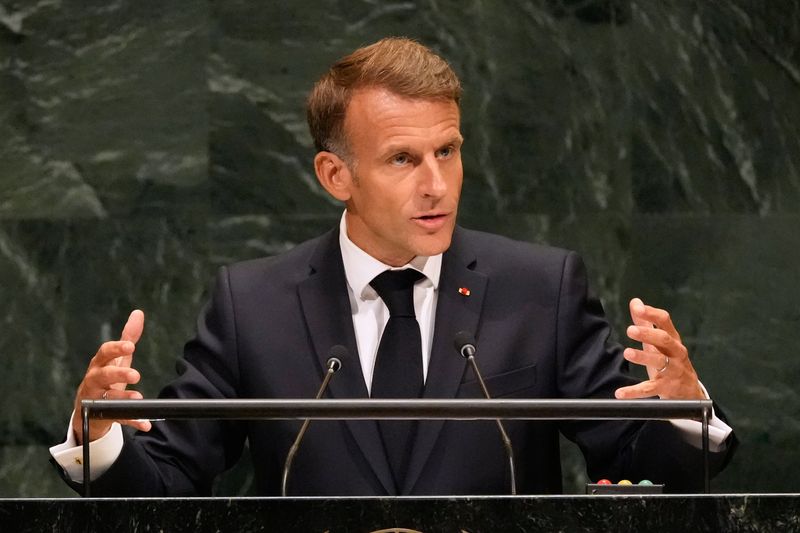
By contrast, French President Emmanuel Macron proposed 'a third way' in which other countries would pool their computing resources and investment capacity to jointly develop open AI models, thereby avoiding technological dependence on the two AI powers, the United States and China.
He said, "I hope no one becomes a vassal of a great power. We must work together to build open-source frontier models and cutting-edge models." AFP interpreted the "great powers" as referring to the United States and China.
The proposal is seen as an effort by Europe and other middle powers to jointly build technological resources and create an independent AI ecosystem as the United States and China compete for dominance in advanced AI models, semiconductors and computing infrastructure.
UN Secretary-General António Guterres, whose term ends at the end of this year, compared the race for AI dominance with the dangers posed by nuclear weapons during the Cold War and called for international safeguards.
UN Secretary-General Proposes Building a 'Multilateral AI Risk-Management Framework'
He said, "During the Cold War, rival powers recognized the need to manage shared existential risks." Whereas nuclear weapons were the focus at that time, "AI today demands the same sense of purpose and urgency," he stressed.
Addressing the major powers leading the AI field, including the United States and China, he said, "The governments with the most powerful AI capabilities bear the greatest responsibility to humanity" and must establish channels for dialogue, transparency, trust and cooperation.
Going further, he proposed creating a 'multilateral AI risk-management framework' with an independent oversight system. He also made clear his opposition to so-called 'killer robots' that use AI to select and attack targets autonomously, saying, "Life-and-death decisions must never be entrusted to machines."
Meanwhile, the United Nations Security Council (UNSC), which comprises 15 member states, will hold a meeting on Sept. 23 under the theme 'The Future of AI and International Security.' The meeting comes as calls to slow the pace of AI development have emerged over the risks associated with it, particularly around U.S.-based OpenAI and Anthropic.
[email protected] Lee Seok-woo, international affairs correspondent Reporter