'Largest Ever' ESS Bidding Begins... LG Ensol Aims for Revenge on Home Ground
- Input
- 2026-09-23 13:35:09
- Updated
- 2026-09-23 13:35:09
■ Global Powerhouse Slumps at Home
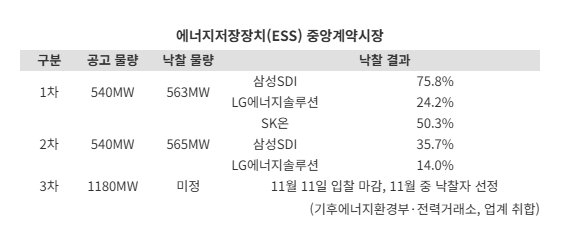
According to the battery industry on the 23rd, the Ministry of Climate, Energy and Environment and the Korea Power Exchange announced yesterday the third round of bidding for the ESS Central Contract Market, totaling 1,180 MW, comprising 1,100 MW on the mainland and 80 MW in Jeju. This is more than double the scale of the first round (563 MW) and the second round (565 MW).
The evaluation factors are mostly similar to those of the second round. The weighting of price and non-price factors remained at 50:50, and the 25 points for industrial and economic contribution, 25 points for fire and facility safety, and 14 points for technical capability also remained unchanged. The only change in scoring was for the grid connection item, where the 10 points for 'output control level,' which was previously assessed quantitatively, were integrated into 'contribution to grid stabilization.'
Industry attention is focused on the volume LG Energy Solution will secure. The volume supplied by LG Energy Solution remained at 136 MW (24.2%) in the first phase and 79 MW (14.0%) in the second phase. The combined market share for the first and second phases is 19.1%, the lowest among the three companies. In the first phase, Samsung SDI, which brought ternary (NCA) batteries produced in Ulsan, swept up more than 75%, while in the second phase, SK On turned the tables with 284 MW (50.3%). Samsung SDI ranks first in cumulative share (55.8%), followed by SK On in second (25.2%).
This stands in contrast to its overseas performance. LG Energy Solution is the only company outside of China to have established a mass production system for LFPs for ESS. Production began in Nanjing, China in 2024 and in Michigan, USA last June, and its global order backlog exceeds 100 GWh.
■ The key is the amount of 'domestic materials' used
The industry analyzes that the outcome will be decided by the localization of materials and safety. This announcement cites certificates of origin for cathode materials, anode materials, separators, and electrolytes, as well as the annual production capacity of cell and packaging factories, as examples of proof when assessing contributions to the domestic industry. Once the installation of equipment is complete, they will also examine whether the production location of the actual installed products matches the bidding documents."Assuming the condition of domestic production is the same, the deciding factor is whether they can specifically present how much domestic parts are used, and even which suppliers they use," said an industry insider. Another official added, "Unless there are significant changes to the evaluation criteria, technological capability, safety, and domestic production capacity will be the three most important factors," noting that "supply chain linkages with domestic material suppliers are key."
LG Energy Solution stated that through the first and second rounds, it confirmed that not only price but also safety, product performance, supply stability, and contribution to the domestic industry and economy are comprehensively important. Accordingly, ahead of the third round, the company is pursuing domestic LFP production in Ochang and the localization of four key materials, while also improving lifespan performance compared to existing products and advancing battery management systems (BMS) and AI-based safety diagnostic technologies.
Competitors are also moving quickly. SK On is in the process of converting 3 GWh of its Seosan plant (total 7 GWh) to LFP for ESS and has set a target for deliveries in the first half of next year. On the 17th, it also signed a 160 billion won supply contract for LFP cathode materials with L&F. Samsung SDI is using NCA produced in Ulsan for both the first and second phases and is sourcing a significant portion of its materials and components domestically.
Meanwhile, as the volume has doubled in this bid, there is interest in whether the pattern of one company taking half will be repeated. While some predict that the volume will be divided due to the limitations of domestic production capacity, others believe that the outcome remains to be seen given the reversals seen in the results of the first and second rounds.
"An industry official stated, 'Since bidding results and volume allocation are determined by the evaluation process and the proposals from each bidder, it is difficult to predict the competitive landscape or outcomes,' adding, 'This is a time when comprehensive competitiveness—including products, supply chains, safety, and operational efficiency—has become more important than competing solely on price.'"
[email protected] Kim Dong-chan Reporter