"My Scar Keeps Getting Bigger": Understanding Keloids Properly [Woo Soo-han's Skin Note]
- Input
- 2026-09-23 11:00:00
- Updated
- 2026-09-23 11:00:00
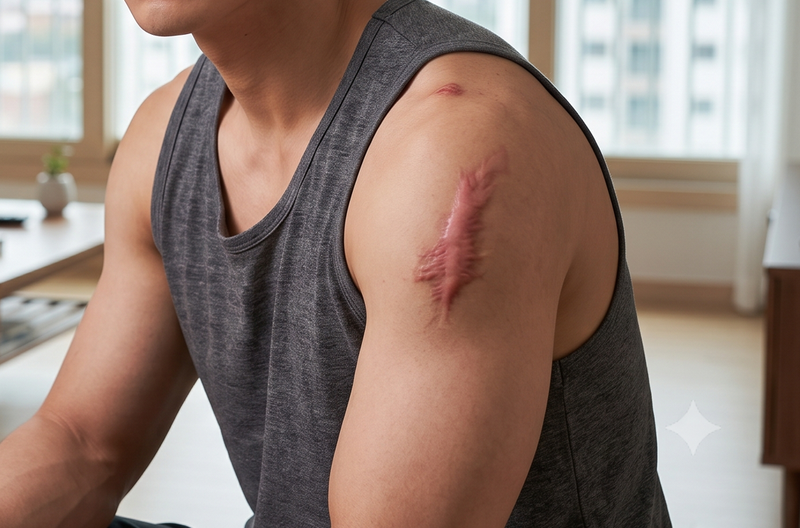
[Financial News] It is natural for a wound to leave some degree of a mark. When the skin is damaged, the body produces collagen and other substances to repair the damage and fill the injured tissue. Over time, red scars generally become lighter and softer.
However, in some cases, a wound has already healed but the scar continues to thicken and harden, or grows beyond the area of the original wound into the surrounding skin. Raised scars are often all called keloids, but hypertrophic scars and keloids should actually be distinguished from one another.
Not Every Raised Scar Is a Keloid
As a wound heals, new tissue is formed and then reorganized in a repeating process. If this process does not proceed normally, the scar can become thicker than the skin's surface and protrude. The two main types are hypertrophic scars and keloids. Although hypertrophic scars may become red, firm and raised, they generally grow within the boundaries of the original wound. In some cases, they become flatter or lighter over time.
Keloids, by contrast, are characterized by growth beyond the boundaries of the original wound into the surrounding healthy skin. Even if the initial wound was small, the scar may gradually grow larger over time, and it rarely shrinks on its own. Therefore, rather than diagnosing a keloid solely because a scar is raised, it is important to check whether it continues to grow beyond the original wound.
Even a Small Ear-Piercing Wound Can Become a Keloid
Keloids do not occur only after major surgery or severe trauma. They can develop after relatively minor skin injuries, including surgery and burns, as well as ear piercings, vaccinations, acne or folliculitis. In some cases, they form after such a minor inflammation or wound that the patient does not remember it. The ears, upper chest, shoulders, upper back and area around the jaw are particularly prone to keloids. By contrast, they are relatively uncommon on the palms of the hands and soles of the feet.
There are also significant individual differences in susceptibility to keloids. After the same surgery, one person may be left with only a thin scar, while another may develop a thick, growing scar. Anyone who has previously developed a keloid at the site of a wound or piercing should inform their medical provider of this history before undergoing a new procedure or surgery.
Why, then, do keloids develop? When the skin is injured, the body begins the wound-healing process to repair the damaged area. During this process, fibroblasts become activated and produce collagen and various components of the extracellular matrix to fill the damaged tissue. In a normal wound, once healing has progressed to a certain point, fibroblast activity decreases. Some of the collagen and extracellular matrix that have been produced are broken down and rearranged through a remodeling process. This is why a scar that was initially red and firm gradually becomes softer and flatter over time.
In keloids, however, this process is not properly regulated. Even after the wound has healed, signals related to wound healing continue, and fibroblast activity does not decrease sufficiently, causing collagen and other components of the extracellular matrix to continue forming. The process of breaking down and rearranging the newly formed tissue is also disrupted, which can lead to excessive accumulation of scar tissue. Put simply, a normal scar moves on to the stage of organizing and finishing the "repair work" after filling the wound, whereas a keloid continues the repair work excessively even after the wound has healed. As a result, the scar can grow beyond the original wound into the surrounding healthy skin.
It is still difficult to explain with a single cause why this reaction occurs in some people. Multiple factors are known to play a role, including genetic predisposition, inflammatory responses and tension on the skin. In particular, people who have previously developed keloids are more likely to develop them again after a new skin injury.
If a Scar Keeps Growing, Get It Checked Early
Scars are easily viewed as simple marks left after a wound heals. However, the types of scars and the processes through which they develop are more varied than many people realize. If a scar continues to thicken and harden after the wound has healed, or grows beyond the boundaries of the original wound into the surrounding skin, a keloid may be suspected.
Keloids may grow again even after treatment, and once they have become large, treatment can be difficult. For this reason, it is better to have a progressing scar evaluated early rather than leave it unattended for a long time. Above all, people who have previously developed a keloid should understand how their skin responds to wounds. Even seemingly minor skin injuries, such as a small piercing or acne, can mark the beginning of a keloid.
Therefore, if a scar is gradually growing or accompanied by itching and pain, it is advisable to obtain an accurate diagnosis and choose a treatment suited to the type and condition of the scar rather than simply wait and think, "It will disappear with time."

/Woo Soo-han, chief director of THE HEAL MAPO
[email protected] Kim Hyun-sun Reporter