Amid the Burden of 2028 College Admissions Reform, 83% of Applicants Changed Their Early-Admissions Strategies This Year
- Input
- 2026-09-23 09:33:11
- Updated
- 2026-09-23 09:33:11
[Financial News] Ahead of the 2028 college admissions system reform, more than eight in 10 applicants who applied through this year's early-admissions process changed their application strategies because of concerns about changes to the admissions system. Concerns about having to adapt to the new system if they retook the entrance exam played a major role. While many opted for safer universities and programs where admission was more likely, some instead applied to more competitive options, revealing that different strategies were adopted simultaneously.
According to the results of a survey released by Jinhak on the 23rd, 3,064 of the 3,706 applicants to the 2027 early-admissions program, or 82.7%, said that the 2028 college admissions reform had influenced their early-admissions strategies this year. The largest share, 48.9%, said it had had a very significant impact, followed by 33.8% who said it had had some impact. Only 11.2% said it had had little impact, while 2.8% said it had had no impact at all.
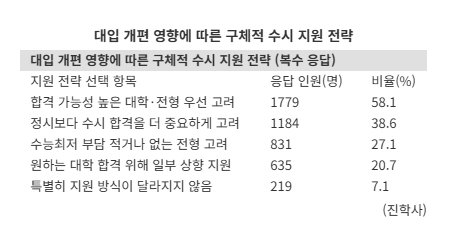
The main strategy applicants adopted in response to the admissions reform was to favor safer choices. Among the 3,064 respondents who said the reform had influenced their strategies, 1,779, or 58.1%, said they gave greater consideration to universities and programs where admission was more likely. Multiple responses were allowed.
Meanwhile, 38.6% said they placed greater importance on being admitted through early admissions rather than regular admissions. Another 27.1% said they gave greater consideration to programs with a lower or no minimum College Scholastic Ability Test requirement. At the same time, 20.7% said they applied to some more competitive options in an effort to gain admission to their preferred universities this year.
The burden of the college admissions reform taking effect in the 2028 academic year lies behind applicants' focus on securing admission through this year's early-admissions process. Starting in 2028, the high school grading system will shift from a nine-tier scale to a five-tier scale, while elective subjects in the Korean language, mathematics and inquiry sections of the College Scholastic Ability Test will be eliminated. For students who have studied under the current system, retaking the entrance exam would mean taking on the risk of adapting to a new system.
Woo Yeon-cheol, head of the Jinhak Institute for Admissions Strategy, said, "The 2028 college admissions reform has become a factor prompting students to consider the possibility that they may not achieve their desired results this year." He added, "This means they have more variables to weigh than in previous years, as they must consider both their chances of being admitted through early admissions this year and the changed admissions environment they would face if they retook the entrance exam."
Woo continued, "Although the largest share of respondents said they gave greater consideration to universities and programs where admission was more likely, 20.7% also said they applied to some more competitive options." He explained, "The impact of the college admissions reform did not uniformly lead to safer applications. Rather, it appears to have produced different strategies depending on applicants' current academic performance, competitiveness in regular admissions and likelihood of trying again."
[email protected] Kim Man-gi Reporter