Raised the 'purity' of semiconductor upcycle exposure: Hanwha Asset Management proposes three ETFs
- Input
- 2026-09-23 09:48:02
- Updated
- 2026-09-23 09:48:02
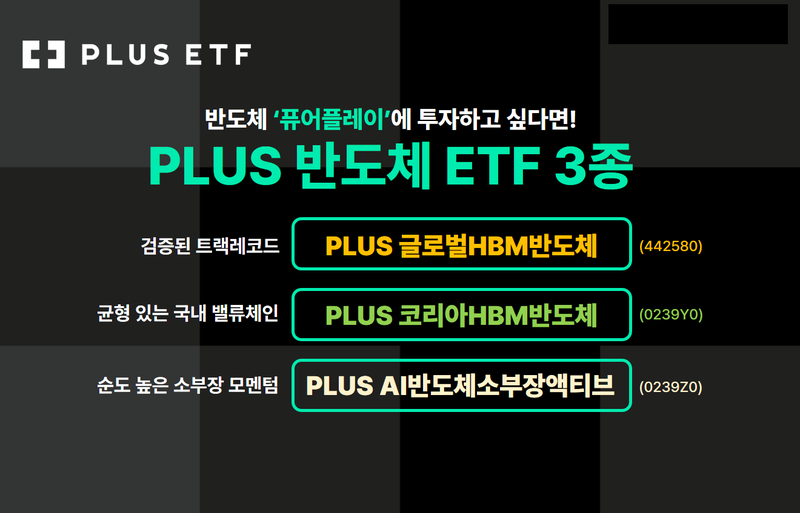
[Financial News] As expectations grow for a recovery in the semiconductor industry, exchange-traded funds (ETFs) that focus on companies with high semiconductor revenue exposure are drawing attention. The products target different segments, ranging from leading memory-chip manufacturers and the domestic semiconductor value chain to materials, parts and equipment companies, offering ways to respond to the semiconductor cycle. Hanwha Asset Management announced on the 23rd that it is proposing three semiconductor ETFs as investment solutions: the Hanwha PLUS Global HBM Semiconductor ETF, the PLUS Korea HBM Semiconductor ETF and the PLUS AI Semiconductor Materials, Parts and Equipment Active ETF.
The three products are characterized by portfolios centered on so-called pure players, whose semiconductor revenue accounts for a large share of their earnings. Samsung Electro-Mechanics and SK Square, which are classified as semiconductor-related stocks but have substantial non-semiconductor businesses, were excluded. The strategy is designed to limit the dilution of the benefits of an improving semiconductor market across other business lines.
The Hanwha PLUS Global HBM Semiconductor ETF invests approximately 80% of its portfolio in the three major global memory-chip companies—Samsung Electronics, SK hynix and Micron Technology—as well as SanDisk. The remainder is allocated to front-end equipment stocks such as Applied Materials and Lam Research, and back-end equipment stocks including Teradyne and HANMI Semiconductor.
As of the 18th, the fund posted a six-month return of 51.1% and a one-year return of 292.4%. Its returns over the past three years and since listing were 674.0% and 947.8%, respectively, while its net assets totaled KRW 1.6776 trillion.
The PLUS Korea HBM Semiconductor ETF invests across the domestic semiconductor value chain, allocating 50% to Samsung Electronics and SK hynix and the remaining 50% to eight domestic materials, parts and equipment stocks. Within the materials, parts and equipment segment, front-end equipment accounts for 31.25% and back-end substrates for 18.75%. This structure captures the way memory-chip manufacturers' expanding AI investments are spreading to equipment and substrates.
The PLUS AI Semiconductor Materials, Parts and Equipment Active ETF invests exclusively in domestic semiconductor materials, parts and equipment companies. Its key investment targets include LB Semicon, INTEKPLUS, ISU Petasys, ISC, TES, Hansol Chemical and PSK HOLDINGS. The fund is managed using an active strategy, with its managers adjusting the allocation between front-end and back-end processes according to the stage of semiconductor production.
Geum Jeong-seop, head of Hanwha Asset Management's ETF Business Division, said, "The benefits of the semiconductor cycle are expected to gradually spread from leading memory-chip companies to materials, parts and equipment companies." He added, "Because there are many companies in the materials, parts and equipment sector and their technologies, customers and order structures are complex, active ETFs can be an effective investment vehicle by allowing portfolio managers to immediately incorporate their research into investment decisions."
[email protected] Bae Han-geul Reporter