Hanwha Aerospace, KAI join forces to integrate domestic weapons with KF-21
- Input
- 2026-09-23 09:43:14
- Updated
- 2026-09-23 09:43:14
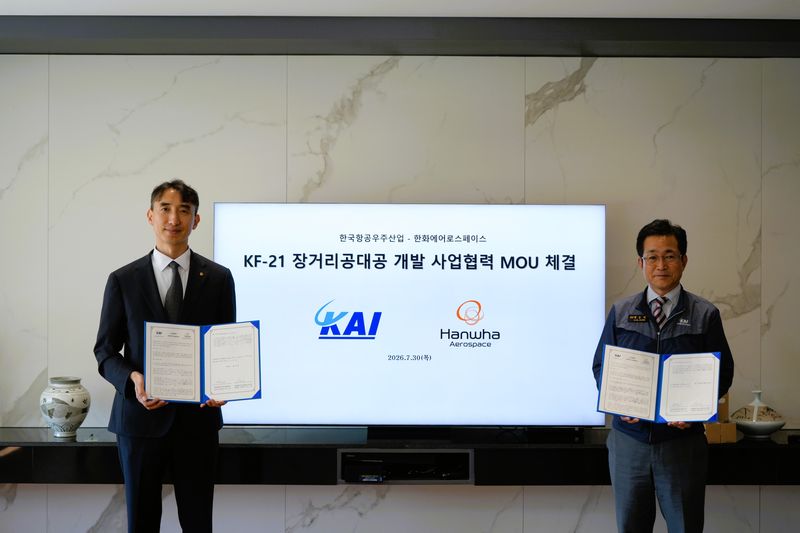
[Financial News] Hanwha Aerospace and Korea Aerospace Industries (KAI) are strengthening cooperation to integrate domestically developed aircraft weapons, including a long-range air-to-air guided missile, with the KF-21 Boramae.
Hanwha Aerospace announced on the 23rd that it had signed an MOU with KAI for mutual cooperation to ensure the success of the long-range air-to-air guided missile system development project. Under the agreement, the two companies will jointly cooperate on developing the long-range air-to-air guided missile and support the stable development, integration, and deployment of domestically developed aircraft weapons and the KF-21.
The two companies' cooperation in the aviation sector has continued to expand this year. In February, they signed an agreement in Seoul on joint cooperation in future core projects to strengthen the global competitiveness of the Korean defense industry. They agreed to cooperate on joint international marketing of domestically developed aircraft and on sharing suppliers' supply chains. Later that month, at the World Defense Show (WDS) in Riyadh, Saudi Arabia, they signed an MOU on cooperation in the aircraft weapons business, broadening their partnership to include aircraft-weapons integration and joint export marketing.
Hanwha and KAI have also cooperated on key systems and components throughout the KF-21's development and production. The KF-21, which completed system development in June, is equipped with aircraft engines, landing gear, and flight-control and control systems supplied by Hanwha Aerospace. Hanwha Systems participated in developing the Active Electronically Scanned Array (AESA) radar, target-tracking equipment including EO-TGP and IRST, and the mission computer (MC).
Hanwha Aerospace is continuing to invest in securing the technologies needed to participate in the long-range air-to-air guided missile system development project. It is taking part in a government-led project to develop interconnection design technology for air-to-air guided missiles integrated with aircraft, with the goal of securing the relevant technology by the first half of next year.
The company is also building up its capabilities in solid ducted ramjet engines, one of the core technologies for long-range air-to-air guided missiles. Since 2021, Hanwha Aerospace has carried out five of six related projects, including projects involving supersonic air-to-air guided missiles and supersonic cruise target aircraft.
Hanwha Aerospace has accumulated more than 20 years of technology and know-how in solid ducted ramjet propulsion systems and missile system components, along with more than 40 years of experience in solid propulsion systems. The company is regarded as the only domestic firm capable of handling the entire process in-house, from synthesizing propellant raw materials to manufacturing key components.
A Hanwha Aerospace official said, "Based on our accumulated technology and experience, we will make an all-out effort to successfully develop the long-range air-to-air guided missile domestically, as it is directly linked to the core competitiveness of domestically developed fighter aircraft." The official added, "We will also contribute to strengthening the competitiveness of domestically developed aircraft weapons through continued cooperation among companies."
[email protected] Jung Won-il Reporter