Daegu Duryu Park to Get a 20,000-Seat Sports and Performance Complex Domed Stadium
- Input
- 2026-09-23 10:13:36
- Updated
- 2026-09-23 10:13:36
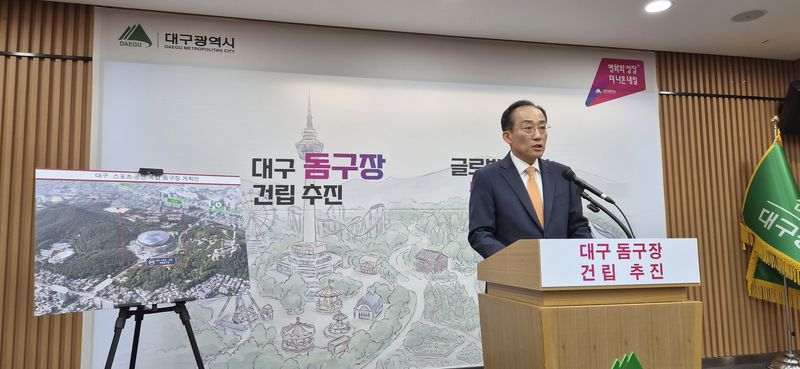
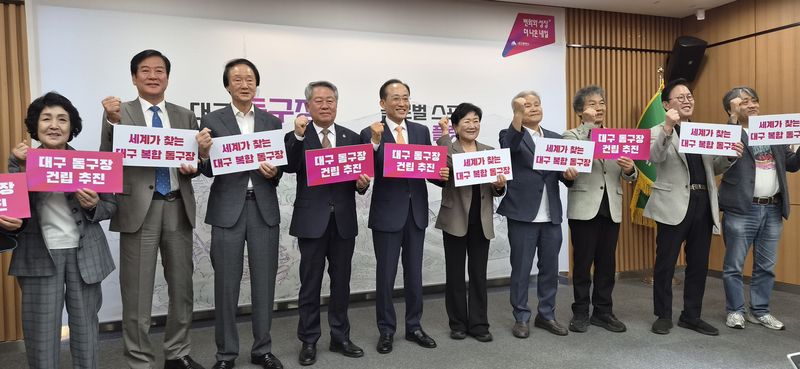
[Financial News, Daegu — Kim Jang-wook] A 20,000-seat sports and performance complex domed stadium will be built at the Universiade Tennis Court in Daegu Duryu Park, Dalseo District, Daegu Metropolitan City.
Mayor Choo Kyung-ho held a media briefing at the Dongin Government Building on the 23rd regarding the plan to move ahead in earnest with the construction of the sports and performance complex domed stadium.
At the briefing, Mayor Choo announced that the city would move ahead in earnest with the construction of a sports and performance complex domed stadium capable of regularly hosting large-scale performances and international competitions. The total project cost will be 500 billion won, and the stadium will have 20,000 seats, with capacity for up to 28,000.
Mayor Choo announced the city’s intention to participate in the government’s public call for projects, led by the Ministry of Culture, Sports and Tourism (MCST). He also expressed a strong determination to successfully carry out the domed stadium project by attracting private investment through bold regulatory innovation.
The city has been reviewing the government’s support plan for domed stadium construction and preparing its application since the first half of this year. On the 21st, the Ministry of Culture, Sports and Tourism officially announced plans to select one large-scale and one medium-sized facility from among all metropolitan local governments and provide partial national funding. The city now plans to publicly announce its intention to participate in the project and accelerate its efforts to secure selection.
Mayor Choo emphasized, "The construction of the domed stadium will help overcome the limitations of the region’s sports and performance infrastructure, create high-value jobs, and revitalize the tourism industry, providing new momentum for the local economy."
He added, "This project has been included as one of the key commitments of the ninth popularly elected administration. With an opportunity now open to secure national funding through the MCST’s public call for projects, we will make every effort to achieve the best possible result. I also ask the 2.4 million citizens to unite their hopes and support."
The city determined that selecting a site with a competitive edge over those in other cities and provinces would be crucial to securing actual selection in the public call and ensuring sustainable operation. After carefully reviewing public transportation access, land acquisition costs, project feasibility, and potential synergies with surrounding infrastructure, it selected the Daegu Duryu Park Universiade Tennis Court and adjacent land as the final candidate site.
The candidate site has excellent access to public transportation, including subways and buses, and can be used as city-owned land without separate acquisition procedures or costs. If the project is selected at the end of this year, the city plans to immediately begin a feasibility study and regulatory easing procedures, complete detailed design services in 2029, and start construction in 2031.
In particular, the project is expected to create powerful synergies by being organically linked not only with existing infrastructure such as nearby E-World, but also with the city’s ongoing efforts to secure designation as a national urban park. The site could become more than a simple stadium or performance venue, serving instead as a nature-friendly urban space for relaxation and culture.
The city plans to minimize the use of city funding by relying primarily on national funding and private investment. To that end, it will encourage the development of profitable ancillary facilities, including hotels, shopping malls, and convention facilities within the domed stadium. It also plans to undertake bold regulatory reforms to allow substantial easing of the building-to-land and floor-area ratios, accelerating efforts to create an environment attractive to private investors.
[email protected] Kim Jang-wook Reporter