Wall Street Bets on Further Oil Price Declines as Brent Crude Put-Option Trading Hits Record High
- Input
- 2026-09-23 10:33:11
- Updated
- 2026-09-23 10:33:11
[Financial News] As international oil prices fell below $100 amid expectations of recovering crude supplies from the Middle East, trading in crude-oil options positioned for further declines surged to an all-time high. Sentiment strengthened that global oil prices, which approached $110 per barrel last week, would fall further.
In particular, expectations of diplomatic progress over the Strait of Hormuz—including the restart of key pipelines in Saudi Arabia and an unexpected direct meeting between the United States and Iran on the sidelines of the UN General Assembly on the 22nd (local time)—eased concerns about supply disruptions. This prompted investors who had bet on higher oil prices to adjust their positions. Industry sources and foreign media reported that trading volume in Brent crude put options reached approximately 764,000 contracts that day, the highest level on record. Trading designed to hedge against a price decline surged following the recent sharp rise in oil prices.
Put-option trading concentrated... More than 110,000 contracts bet on Brent crude falling to $70 per barrel
Brent crude's November contract ended the day down 1.1% at $99.25 per barrel. The price of Brent crude, the global benchmark for oil prices, fell below $100 for the first time since the 8th, when it stood at $97.92. Compared with its approach toward $110 per barrel at one point last week, it has given back a substantial portion of its gains.
Put options, which can generate profits or reduce risk when prices fall below a specified level, dominated activity in the options market.
For the December contract, more than 110,000 contracts were traded to hedge against Brent crude falling to around $70 per barrel. For the November contract, 40,000 contracts were traded in anticipation of a decline to the $92-$93 range, while 38,500 contracts were traded for the next February contract in anticipation of a fall to around $69-$70. These trades accounted for at least half of the total.
Expectations for higher oil prices also weakened rapidly in other options-market indicators. Premiums for Brent crude call options contracted to their lowest level since June. This means the cost of hedging against the risk of higher oil prices has fallen accordingly.
Signs of technical overheating also eased. Brent crude, which remained in overbought territory for most of last week based on its nine-day relative strength index (RSI), has recently moved out of the overbought zone as prices declined.
"It will take days to recover 40%; six to eight weeks for a full restart"
Saudi Arabia has resumed operations of the East-West Pipeline, a key piece of oil infrastructure that was shut down following a drone attack. As a result, crude oil exports through Yanbu Port on the Red Sea coast are expected to resume within a day.
Saudi Aramco is working to raise transport volumes to around 4 million barrels per day. Foreign media outlets forecast, "It will take several days to reach 40% of the total capacity, and six to eight weeks for a full restart." After the Strait of Hormuz was blocked, Saudi Arabia had been rerouting 4 million barrels of crude oil per day through this pipeline to Yanbu Port, equivalent to about 4% of global supply.
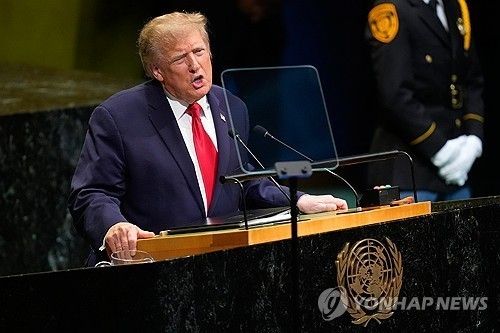
President Trump emphasized that more crude oil than ever before was passing through the strait under the protection of the U.S. military. Kpler reported that Ras Tanura Port in eastern Saudi Arabia had handled its highest number of shipments since the war with Iran began, with six very large crude carriers departing with 12 million barrels of crude oil.
United States and Iran make contact at UN Headquarters... Trump: "Very productive talks; further meetings planned"
Meanwhile, the United States and Iranian delegations met at the United Nations Headquarters in New York on the same day, holding talks on the occasion of the UN General Assembly. The United States was represented by presidential envoy Steven Charles Witkoff and Jared Kushner, Trump's son-in-law. Iran's representative was Foreign Minister Abbas Araghchi, Iran's state broadcaster IRIB reported. Iran sent a small delegation to New York that included President Masoud Pezeshkian and Foreign Minister Abbas Araghchi.
President Trump said, "It was a very good meeting," adding, "Iran has two choices. One is total destruction, and the other is the potential to become great. Iran can become a great country." Although Trump pressured Iran by presenting two options, the market placed greater weight on the possibility of a diplomatic resolution.
President Trump emphasized, "We had a very productive meeting, and additional meetings are scheduled in the very near future," adding, "We'll see what the outcome is. But one thing is clear: reaching an agreement is in Iran's interest as well."
Trump also stressed while meeting the leaders of Middle Eastern countries, "Either we reach an agreement, or this will end very, very quickly," adding, "It will end so quickly that your heads will spin."
[email protected] Lee Seok-woo, international affairs correspondent Reporter