United Nations General Assembly (UNGA) Spars Over 'AI Dominance': 'We Must Unite Against the U.S. and China'
- Input
- 2026-09-23 10:13:15
- Updated
- 2026-09-23 10:13:15
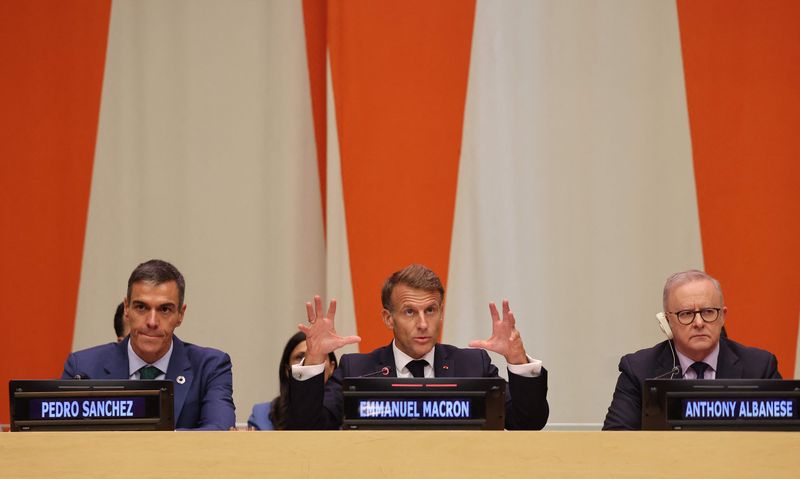
[Financial News] As debate over AI regulation and technical standards intensifies in the United States, leaders from around the world gathered at the UNGA have also entered the AI debate. The United States has stressed that it will not relinquish its AI leadership, while France has argued that the remaining countries should join forces to avoid becoming subordinate to the AI powers.
U.S. President Donald Trump took the podium as the second speaker and delivered a speech lasting about 38 minutes during the general debate at the high-level meeting of the 81st UNGA, held on the 22nd at UN Headquarters in New York, United States. He stressed his opposition to industry-wide international regulation aimed at preventing AI misuse. Trump said, "The United States categorically rejects any attempt to control AI," adding, "I will not stifle the growth of a technology that will become bigger than the Industrial Revolution." He said AI-related issues could be handled through the existing legal system and stated, "We will monitor this closely through the Department of Justice." Trump also declared that the U.S. government would use the term 'superintelligence (SI)' instead of AI in its documents going forward.
Chinese President Xi Jinping, whose country rivals the United States in AI, will not address this UNGA. Instead, he will hold a summit with Trump on the 24th. China is expected to send Vice President Han Zheng as its representative to the UNGA, where he will deliver a general debate speech between the 24th and 26th.
On the 22nd, French President Emmanuel Macron said countries other than the United States and China, which lead in AI, should unite to prepare for a two-power system. In his UNGA speech that day, he did not mention the United States or China directly, but said, "I hope no one becomes a vassal state of a great power." He continued, "We must work together to build open-source frontier models and cutting-edge models."
In this context, U.S. AI company OpenAI said in a post on its website on the 21st, "We believe that the United States should work with countries around the world to lead efforts to establish technical standards for cutting-edge AI." OpenAI proposed linking AI safety institutes already established in 10 countries worldwide, including South Korea, into a network. OpenAI Chief Executive Officer (CEO) Sam Altman is scheduled to attend a UNSC meeting on the 23rd and brief members on AI and international security.
UN Secretary-General António Guterres, whose term ends later this year, likened the race for AI dominance to the threat posed by nuclear weapons during the Cold War and called for international safeguards.
On the 22nd, he said, "During the Cold War, rival countries recognized the need to manage a shared existential risk." He stressed that while nuclear weapons were the focus at the time, "today, AI demands the same sense of purpose and urgency." Guterres urged the United States, China and other countries leading the AI industry to establish channels for dialogue, trust and cooperation. He proposed creating a "multilateral AI risk-management framework" with an independent oversight system.
[email protected] Park Jong-won Reporter