President Lee: "Peace on the Korean Peninsula Is an Issue Discussed by the Two Koreas, the United States and China" ... Proposes Multilateral Dialogue
- Input
- 2026-09-23 06:47:35
- Updated
- 2026-09-23 06:47:35
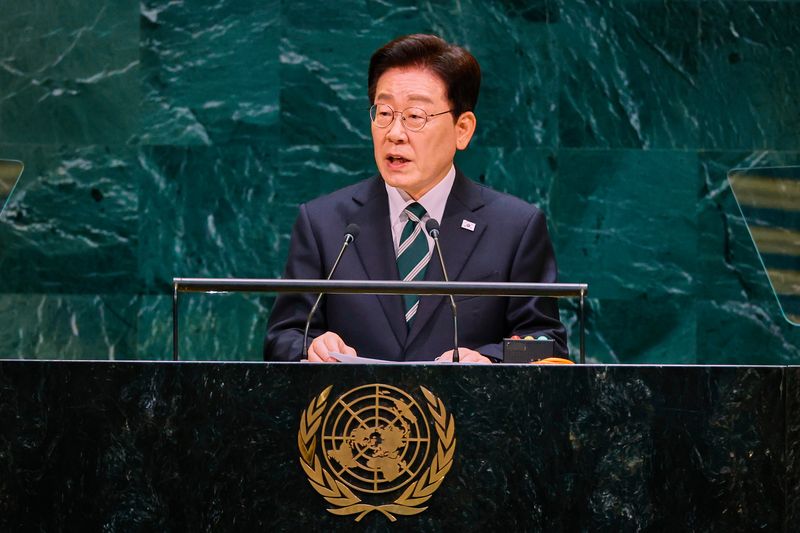
President Lee, who was visiting New York to attend the UN General Assembly, said in a keynote address at United Nations Headquarters on the 22nd, "I am convinced that dialogue to establish a peace regime on the Korean Peninsula will provide a highly useful framework not only for normalizing relations among the parties concerned, but also for promoting joint growth through multilateral cooperation and stability and cooperation in Northeast Asia."
President Lee further developed the concept of multilateral dialogue that he presented in his Liberation Day address. He said, "The most fundamental task is to end the long-standing war on the Korean Peninsula and establish a peace regime," adding, "A peace regime on the Korean Peninsula is a core task whose necessity the two Koreas, as well as relevant countries including the United States and China, have long shared and discussed."
In particular, he proposed restarting United States–North Korea dialogue and expanding it into discussions on a peace regime among the relevant countries. President Lee stated, "The Republic of Korea will work to lay the groundwork for the long-stalled United States–North Korea dialogue to resume promptly and develop into dialogue among the parties concerned aimed at ending the war on the Korean Peninsula and transitioning to a peace regime." The intent is to develop dialogue between the United States and North Korea into dialogue among the relevant parties aimed at ending the war on the Korean Peninsula and transitioning to a peace regime. It was also notable that President Lee directly referred to the two Koreas, along with the United States and China, as the "relevant countries" in discussions on a peace regime in his keynote address.
President Lee also noted, "I am convinced that dialogue to establish a peace regime on the Korean Peninsula will provide a highly useful framework not only for normalizing relations among the parties concerned, but also for promoting joint growth through multilateral cooperation and stability and cooperation in Northeast Asia."
President Lee proposed a phased approach to North Korea's nuclear and missile issue. He stated, "I believe we can halt the advancement of North Korea's nuclear and missile capabilities, reduce them in the medium term, and move toward a nuclear-free Korean Peninsula in the long term." Rather than immediately demanding complete denuclearization, the proposal calls for first stopping any further advancement of North Korea's nuclear and missile capabilities, then reducing them, and ultimately moving toward a nuclear-free Korean Peninsula.
President Lee also presented three blueprints for peaceful coexistence on the Korean Peninsula: inclusive peaceful coexistence based on mutual respect; stable peaceful coexistence in which there is no need to fight; and responsible peaceful coexistence that contributes to world peace.
President Lee said, "We will respect North Korea and cooperate where cooperation is possible, including on the international stage," adding, "I hope pathways will open for joint cooperation at the level of the international community in areas such as health, disasters and climate crises." He also said, "We will seek joint growth through cooperation, based on mutual respect for the systems of the two Koreas and recognition of our differences," and emphasized, "I believe that restoring even basic communication channels and building trust will be the first step toward stable peaceful coexistence."
He added, "As a party to peace on the Korean Peninsula and a peacemaker, our government will do everything in its power to open and sustain the path to dialogue."
President Lee also highlighted the need for a joint response to the global energy and logistics supply-chain crisis, citing maritime blockades in the Strait of Hormuz and the Red Sea. He said, "The repeated maritime blockades in the Strait of Hormuz and the Red Sea recently have starkly shown how severely people's daily lives around the world can be affected when key routes for energy and logistics are weaponized," and stressed, "Free and safe passage through international straits is a right guaranteed by international law and a firm foundation supporting the global economy. Attacks on merchant ships and acts threatening the lives and safety of seafarers cannot be justified for any reason."
President Lee said, "The Republic of Korea will make active use of existing cooperation mechanisms, including the International Energy Agency (IEA), while further strengthening energy supply-chain cooperation so that supply-chain crises do not spread into crises for the global economy and people's livelihoods," and proposed a "coalition of constructive contributing countries" as a new concept for international cooperation. He said, "We cannot simply sit back and wait until all countries agree on a single solution," adding, "The necessary and most realistic approach now is for countries with the capacity and will to provide global public goods to join hands first and expand the space for cooperation." He explained, "I would like to call this a coalition of constructive contributing countries."
He continued, "This is not a proposal to create a new exclusive organization or exclusive group," adding, "While respecting the existing international order and the functions of the United Nations (UN), it means that countries should cooperate in a flexible and open manner in areas where each has its own strengths and gradually expand the scope of that cooperation."
[email protected] Choi Jong-geun Reporter