Trump: "Action, Not Words"—Puts 'Peace Through Strength' Front and Center at UN
- Input
- 2026-09-23 06:06:26
- Updated
- 2026-09-23 06:06:26
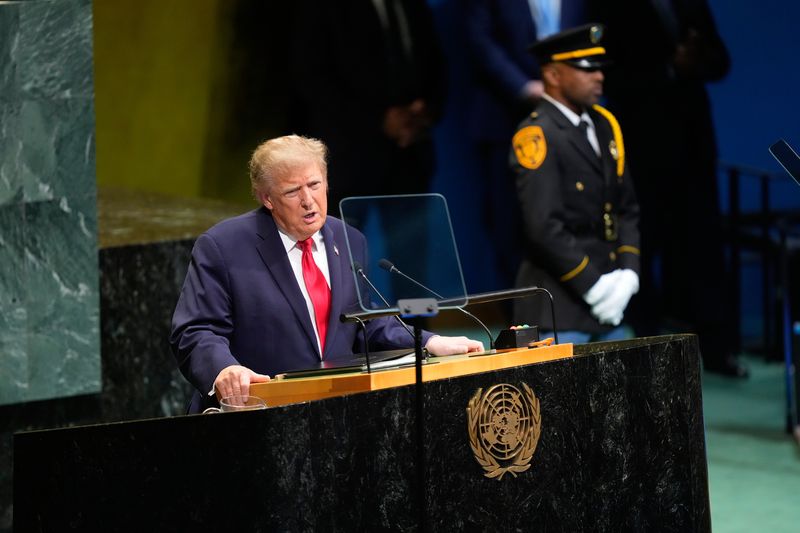
【Financial News, New York = Reporter Lee Byung-chul】 U.S. President Donald Trump warned Iran at the United Nations General Assembly that it would be annihilated if it refused to abandon its nuclear weapons program. Yet just hours after making the threat, Trump said the United States and Iran were engaged in actual negotiations and that their relationship was progressing. Iran, meanwhile, offered to reopen the Strait of Hormuz if the United States eased its military pressure. The focus is now on whether the nearly seven-month-long war can shift from military confrontation to negotiations through the UN General Assembly.
"Deal or Annihilation"—After the Speech, "Relations Are Progressing"
In his speech at the general debate of the 81st United Nations General Assembly at United Nations Headquarters in New York on September 22 (local time), Trump effectively presented Iran with an either-or choice. "I have a major decision to make," he said. "Will Iran make a deal so that it can rise again and become a far greater country than before, or will I annihilate the Islamic Republic of Iran?"
At the same time, Trump left the door open to negotiations. "I believe we will make a deal right after the midterm elections," he said, "because there is no reason they would not make a deal." He also urged the international community to economically isolate Iran. As Trump stressed the legitimacy of military action and war against Iran, most members of the Iranian delegation walked out of the chamber during the speech.
The atmosphere changed after the speech. Following a meeting with Andy Burnham, prime minister of the United Kingdom, Trump told reporters, "They want to talk to us," adding, "They talked to us today, too, and relations are progressing." He went on to say that he believed the United States and Iran would ultimately reach an agreement. However, he made clear that Washington's position on not allowing Iran to possess nuclear weapons had not changed.
Iran also left open the possibility of resuming negotiations. A senior Iranian official told Reuters that Iran could reopen the Strait of Hormuz to vessels traveling to and from the Gulf within seven days if the United States eased its military pressure and lifted the blockade of Iranian ports. Iran reportedly conveyed the proposal to the United States through a mediator last week.
The United States also publicly confirmed that dialogue remained possible. U.S. Secretary of State Marco Rubio appeared on the National Broadcasting Company (NBC)'s Today program and said, "We are open," adding, "We are definitely open if there is a possibility it could lead to a positive outcome." He emphasized, however, that "Iran can never have a nuclear weapon." In a separate Fox News interview, Rubio said Trump was willing to meet "anyone," including President Pezeshkian, but noted that Iran's ultimate decision-maker is its supreme leader.
Claiming to Be a 'Peace Broker' While Displaying Military Power
Trump's roughly 35-minute speech combined a diplomatic approach that cast him as a 'peace-making president' with a willingness to actively use U.S. military power when necessary. "When others talked, I acted," Trump said. "When others talked about peace, I made peace, and when others ignored threats, I confronted them."
Trump said Russia and Ukraine were exhausted by the war and again mentioned the possibility of ending the conflict. Regarding Cuba, he said its communist government would eventually collapse and claimed, "Freedom will come to Cuba." After Trump described Cuba as a 'completely failed country' and referred to regime change, the Cuban delegation also left the chamber in protest.
Trump also presented cooperation on oil development with Venezuela as an achievement that could lower U.S. energy prices. In Greenland, he proposed expanding the U.S. military presence. Trump said that day that he planned to conclude a security agreement with Denmark and Greenland and build two large U.S. military bases in Greenland. Regarding artificial intelligence (AI), he proposed using the term 'super intelligence' instead of 'artificial' in government documents.
Ultimately, the speech emphasized military and economic pressure on Iran and Cuba, offered mediation in the war in Ukraine, and presented the expansion of U.S. military and economic influence in Greenland and Venezuela as achievements.
[email protected] Reporter Lee Byung-chul Reporter