President Lee: "Strait of Hormuz blockade would cause a major shock" ... Proposes 'solidarity of constructive contributing countries'
- Input
- 2026-09-23 05:17:52
- Updated
- 2026-09-23 05:17:52
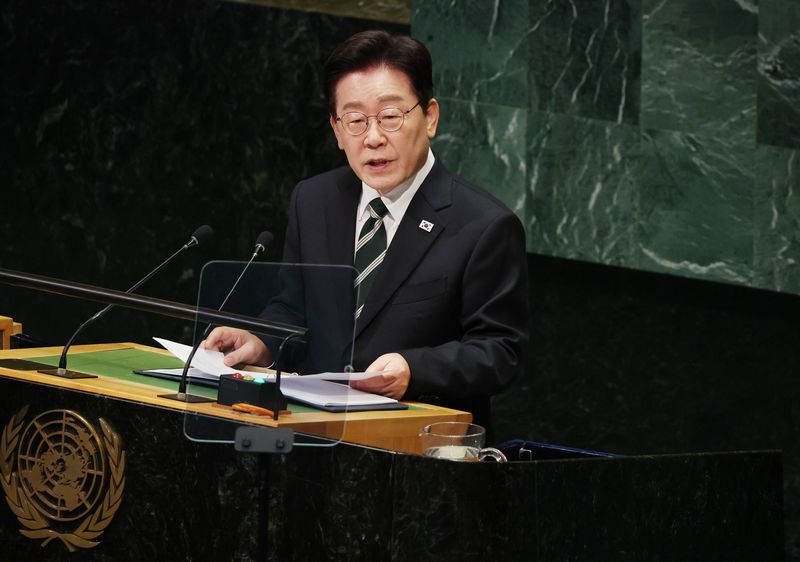
Speaking at the 81st United Nations General Assembly at United Nations Headquarters that day, President Lee said, "The repeated maritime blockades in the Strait of Hormuz and the Red Sea recently have shown in stark terms how severely people's daily lives around the world can be affected when key energy and logistics routes are weaponized."
President Lee also emphasized that free navigation through international straits is a fundamental principle the international community must uphold. He said, "Free and safe passage through international straits is both a right guaranteed under international law and a firm foundation supporting the global economy," adding, "Attacks on merchant ships and actions that threaten the lives and safety of sailors cannot be justified for any reason."
He added, "The Republic of Korea will actively utilize existing cooperation frameworks, including the International Energy Agency (IEA), while further strengthening energy supply-chain cooperation so that a supply-chain crisis does not escalate into a global economic crisis affecting people's livelihoods."
President Lee said that such a global crisis would be difficult to resolve through the efforts of individual countries alone and proposed a new form of international cooperation.
President Lee said, "We cannot simply sit idly by until all countries agree on a single solution. The necessary and most realistic approach now is for countries with the capacity and willingness to provide global public goods to join hands first and expand the space for cooperation." He explained, "I would like to call this a 'solidarity of constructive contributing countries.'"
President Lee said, "This is not a call to create a new exclusive organization or group. Rather, while respecting the existing international order and the functions of the UN, it means that countries should cooperate flexibly and openly in areas where each has its own strengths and gradually expand the scope of that cooperation."
He added, "When the fruits of cooperation achieved in this way, both separately and together, accumulate, we will be able to restore our confidence in multilateralism by moving beyond geopolitical competition, stalemate, and fragmentation."
[email protected] Choi Jong-geun Reporter