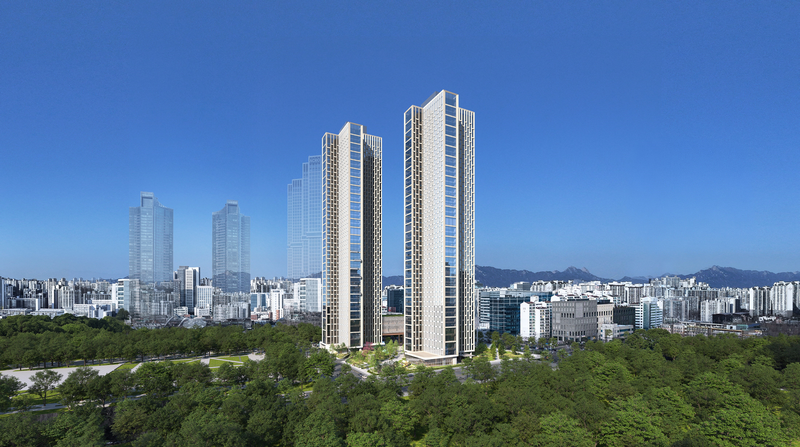
Bird’s-eye view rendering of the Ttukseom District Special Planning Area IV mixed-use building. Provided by the Seoul Metropolitan Government [Financial News] A large-scale mixed-use complex combining residential, lodging and cultural facilities will be built near Seoul Forest Station, while the National Medical Center will be reborn as a national essential healthcare hub in the heart of the city.
The Seoul Metropolitan Government said on the 23rd that the 17th meeting of the Architectural Committee, held the previous day, approved three projects: construction of the mixed-use building in Ttukseom District Special Planning Area IV; construction of the National Medical Center and Central Infectious Disease Hospital; and remodeling of the Munjeong Geonyeong Apartment Complex.
First, Ttukseom District Special Planning Area IV around Seoul Forest Station in Seongsu-dong 1-ga, Seongdong District, where the project has been delayed for a long time, will be developed into a mixed-use space combining residential, lodging and cultural functions, taking advantage of its location near the Han River and Seoul Forest. The development will consist of eight basement levels and 49 above-ground floors, with 383 housing units, a 622-room lodging facility and a 903-seat performance venue. The venue’s location was adjusted to connect it with nearby cultural spaces, and a publicly accessible viewing area will be created on the 46th floor. A public pedestrian passage linking Seoul Forest Station with the surrounding area and publicly accessible open spaces will also be created to improve pedestrian convenience. Construction is scheduled to resume in the second half of 2026.
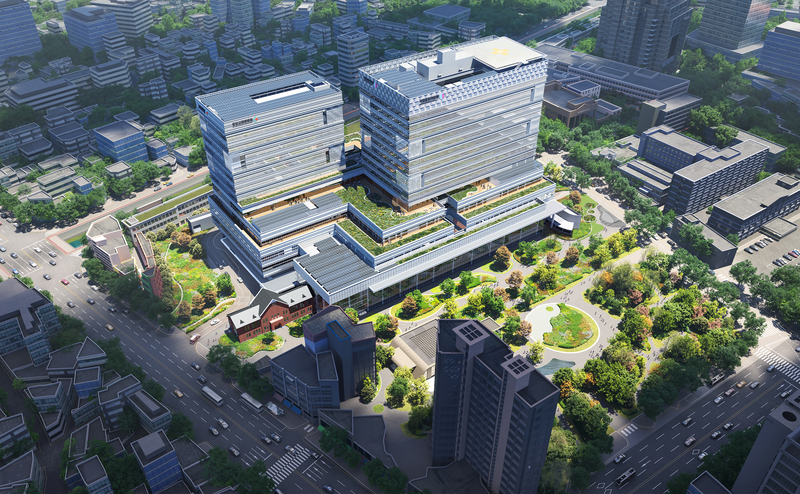
Bird’s-eye view rendering of the National Medical Center. Provided by the Seoul Metropolitan Government Next, the National Medical Center, completed in 1958, will embark on a modernization project to become the country’s coordinating institution for essential healthcare. The facility will be built in the Bangsan-dong area of Jung-gu, with four basement levels and 16 above-ground floors, totaling 776 beds: 526 at the National Medical Center, 100 at the Central Trauma Center and 150 at the Central Infectious Disease Hospital. Each facility will operate independently under normal circumstances, but their circulation routes have been systematically separated so they can be flexibly reconfigured and used in coordination during emergencies such as infectious disease outbreaks or disasters. In addition, Gyeongseong Elementary School, a modern-era architectural heritage asset, will be preserved and used as an exhibition space and for other purposes. A public pedestrian passage connecting to Hullyeonwon Park will also be created to strengthen engagement with local residents.
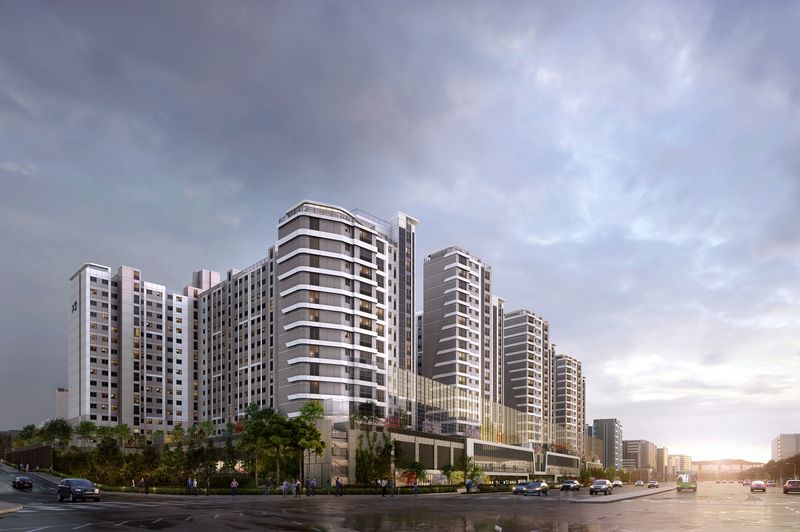
Perspective rendering of the Munjeong Geonyeong Apartment Complex remodeling project. Provided by the Seoul Metropolitan Government Meanwhile, the Munjeong Geonyeong Apartment Complex in Munjeong-dong, Songpa District, will be transformed through remodeling, increasing from 545 to 610 households. The remodeled complex will have five basement levels and 16 above-ground floors, with green building and zero-energy standards applied. Community facilities such as a small library and fitness center will be opened to local residents, while a public pedestrian passage separating vehicle and pedestrian routes will be established to eliminate the complex’s isolation from surrounding areas. The project is being advanced with groundbreaking targeted for April 2029, apartment sales scheduled to begin in May of the same year, and completion targeted for April 2032.
[email protected] Jeon Min-kyung Reporter