Netflix Viewing History Can Even Predict Your Future 10 Years From Now... 'AI Saju' After MBTI
- Input
- 2026-09-25 08:00:00
- Updated
- 2026-09-25 08:00:00
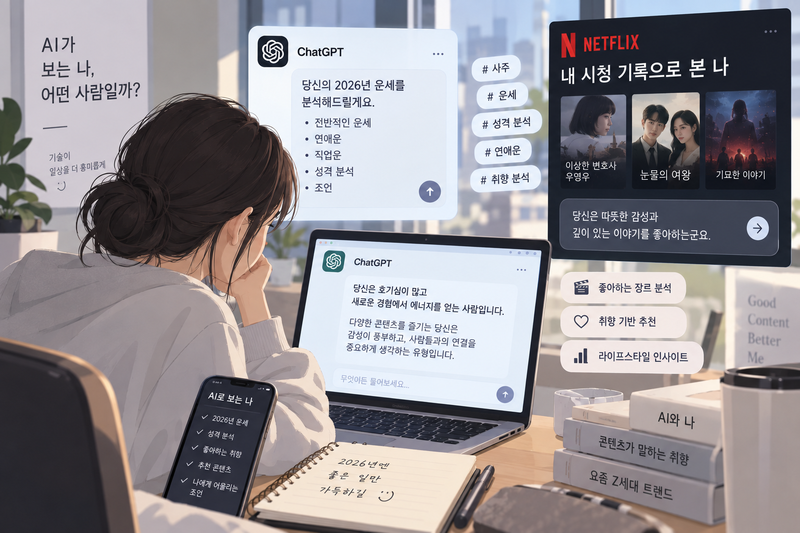
[Financial News] What kind of answer would I get if I fed an AI the movies and dramas I have watched on Netflix over several years? New ways of using AI have recently emerged, including checking the rest of one's yearly fortune or imagining what one will be like 10 years from now based on viewing history. Going beyond 'AI saju,' in which users enter their birth dates to receive a saju fortune reading, the trend of using AI to examine one's personality and future through personal digital traces, such as viewing history, is spreading as a form of 'AI self-exploration.'
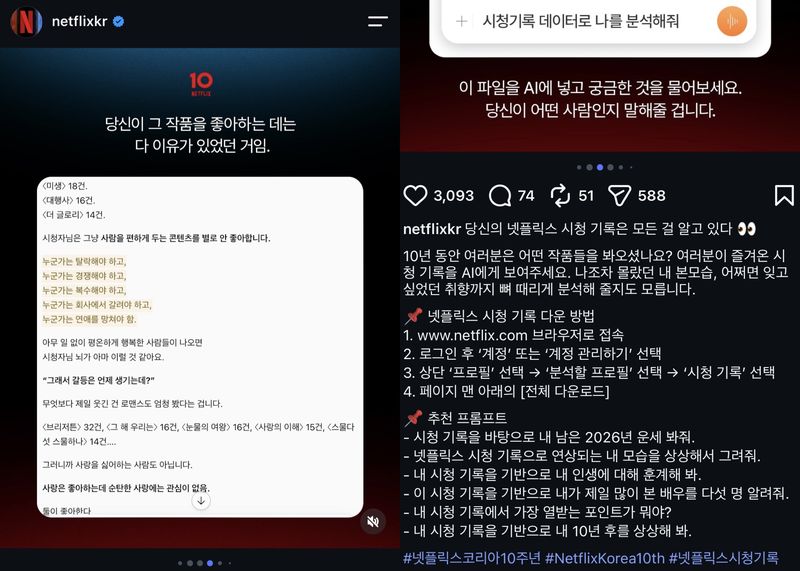
According to the IT industry on the 25th, the data entered into AI has recently expanded beyond birth dates and saju charts to include individuals' digital usage records. OTT viewing history is a representative example. Netflix recently shared prompts on Instagram that use users' viewing histories to analyze their fortunes, what they will be like 10 years from now and their preferences with AI.
Netflix says users can download their complete viewing histories accumulated on their profiles through Netflix's browser interface. Those who have used the service for a long time can receive records of movies, dramas and variety shows watched over several years all at once. After attaching the Excel file containing this information to an AI tool, users can ask it to "read my fortune for the rest of 2026 based on my viewing history," "imagine what I will be like 10 years from now," or "draw an image of me as suggested by my viewing history."
Younger generations are particularly likely to consume fortune-telling as a form of content. According to Embrain Trend Monitor's '2026 Survey on Perceptions of Fortune-Telling,' people in their 20s had the highest rate across all age groups of having encountered fortune-telling content in the past year, at 71.0%, while the figure for teenagers reached 62.5%. The most common channels through which people encountered such content were YouTube (60.4%), social media (38.6%) and OTT platforms (34.0%), in that order.
The main appeal of using AI appears to be that it allows people to interpret saju or astrology easily without specialized knowledge. Users can enter their birth date and time, whether they were born under the solar or lunar calendar, their gender and birthplace, and ask AI to interpret the information according to saju-based Four Pillars astrology. Alternatively, they can check their saju chart in an application such as a manseryeok app, attach a screenshot to AI and request an interpretation. They can then immediately receive readings on their personality, financial prospects, career prospects and romantic prospects.
The subjects of analysis are not limited to saju-based Four Pillars astrology. Social media users are also sharing prompts that employ Zi Wei Dou Shu and Western astrology, as well as Thai astrology, which is relatively unfamiliar in South Korea.
Behind the search for fortune-telling lies a desire to reduce uncertainty about the future and gain psychological stability or clues for making decisions. According to Embrain Trend Monitor, the main reasons people use fortune-telling services were "to relieve anxiety" (54.2%), "to obtain information about which direction to take" (33.8%) and "simple curiosity" (32.1%). Generative AI is more accessible than conventional fortune-telling, and users can change their questions as they wish or receive results repeatedly, which is also believed to be contributing to the trend.
However, AI-generated saju, astrology and personality or future analyses are not scientifically validated predictions, so they should be approached as entertainment content. Even when the same information is entered, the results may vary depending on the AI model or prompt. Users should be especially cautious when entering personal information such as birth dates, birth times and viewing histories, including by checking how each AI service uses and stores the data.
[email protected] Choi Hye-rim Reporter