Wonju-si Selected for Aging Industrial Complex Competitiveness Enhancement Project; 312.4 Billion Won to Be Invested Over Four Years
- Input
- 2026-09-22 17:15:06
- Updated
- 2026-09-22 17:15:06
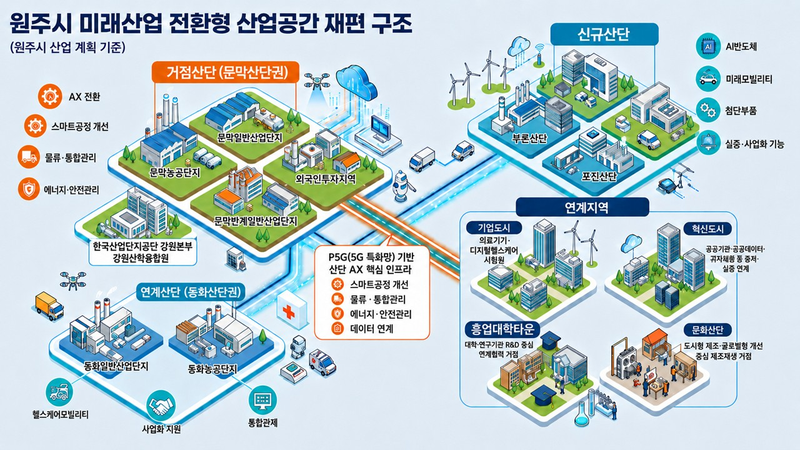
【Financial News, Wonju = Reporter Kim Ki-seop】The aging industrial complexes in the Munmak area of Wonju will be transformed into smart green industrial complexes encompassing future mobility, artificial intelligence (AI) semiconductors, and digital healthcare.
According to Wonju-si on the 22nd, the city was finally selected as a district for the 2027 Competitiveness Enhancement Project for Aging Hub Industrial Complexes, jointly overseen by the Ministry of Trade, Industry and Energy (MOTIE) and the Ministry of Land, Infrastructure and Transport (MOLIT). The city will now launch a full-scale project to reorganize its aging industrial complexes around future industries by improving infrastructure and industrial conditions and pursuing manufacturing innovation and a transition to future industries.
The project goes beyond improving industrial-complex infrastructure and conditions. It aims to strengthen regional industrial competitiveness through a comprehensive push for manufacturing innovation, industrial advancement, talent development, and transitions in energy, the environment, and safety. Wonju-si will invest a total of 312.4 billion won over four years from 2027 to 2030, including projects linked to various government ministries. Using the Munmak area as a hub, the city will connect the Donghwa area and new industrial complexes while creating a future-industry ecosystem that combines AI semiconductors and digital healthcare with future mobility, its primary industry.
To achieve this, the city will implement 39 detailed projects based on four specialized strategies and eight action strategies. The centerpiece is the four-pronged transformation of industrial complexes, represented by AX, NX, YX, and GX. AX refers to manufacturing innovation through the application of AI and digital technologies; NX to industrial transformation through the convergence of existing manufacturing and future industries; YX to training young people and specialized talent; and GX to an eco-friendly transition in energy, carbon, safety, and environmental management. Through these efforts, the city plans to address the structural limitations of aging industrial complexes, boost companies' productivity and competitiveness, and fundamentally transform the industrial complexes as a whole.
The city has also set key performance indicators designed to measure tangible changes. Its targets include an AX transition rate of 62.5%, the development of 16 future-industry convergence items, the planning of eight joint projects, the training of 600 core personnel, an eco-friendly transition rate of 50%, and an average energy reduction rate of 3%.
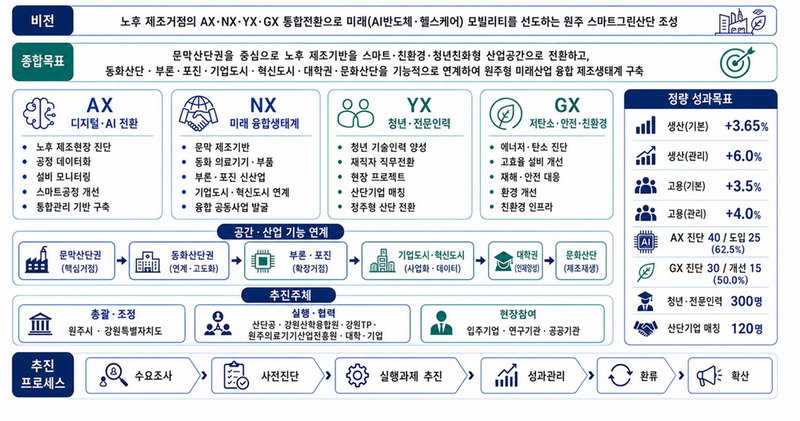
The project will center on Munmak General Industrial Complex, Munmak Agricultural and Industrial Complex, Bangye General Industrial Complex, and the Munmak Foreign Investment Zone, while linking Donghwa General Industrial Complex, Donghwa Agricultural and Industrial Complex, and the Automotive Parts Industrial Complex as connected complexes. It will also include the Buron and Pojin New Industrial Complexes, Enterprise City, Innovation City, and Heungeop University Town as connected areas, organically linking industrial, research, and talent-development functions. Including the connected areas, the ecosystem already involves 340 companies and about 9,000 workers. This is expected to generate broad industrial innovation across Wonju, extending beyond improvements to individual industrial complexes and connecting the city's industrial base as a whole.
Through the project, the city plans to establish a virtuous cycle spanning research and development, manufacturing and demonstration, talent development, and commercialization. It will create a smart manufacturing innovation belt centered on Munmak and Donghwa. Building on this foundation, Wonju-si intends to strengthen the competitiveness of existing manufacturing while enhancing links among future industries such as future mobility, AI semiconductors, and digital healthcare, thereby developing the area into a future-industry hub for Gangwon State.
Wonju Mayor Koo Ja-yeol said, "We will create a smart manufacturing innovation belt linking Munmak and Donghwa, establishing a virtuous cycle that spans research and development, demonstration, and commercialization." He added, "We will transform aging manufacturing hubs into innovation hubs for future industries and develop them into a leading industrial-complex model that drives Gangwon's future industries."
[email protected] Kim Ki-seop Reporter