Up to KRW 20 Billion in Follow-Up Funding for Education Development Special Zones... Four Jeju Institutions Join Forces
- Input
- 2026-09-22 16:39:10
- Updated
- 2026-09-22 16:39:10
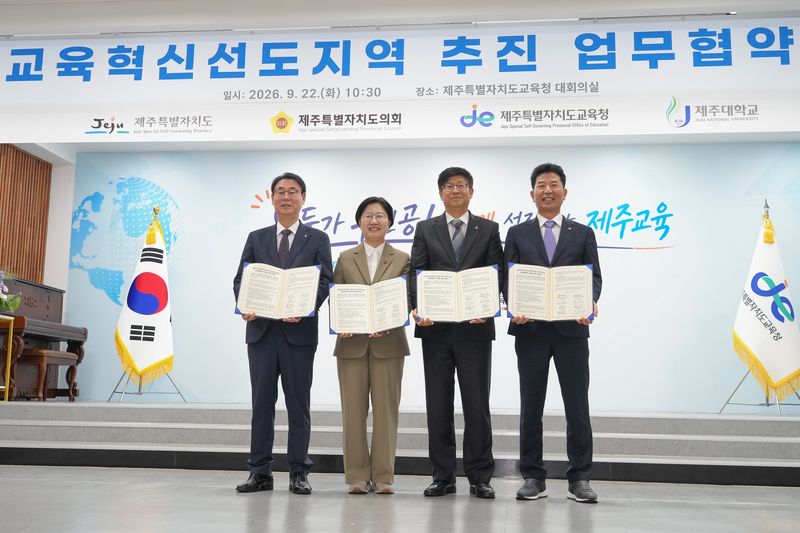
【Financial News, Jeju—Reporter Jung Yong-bok】Jeju Island, the Jeju Special Self-Governing Provincial Council, the Jejudo Office of Education and Jeju National University have joined forces to secure a follow-up national program for Jeju's Education Development Special Zone, whose three-year pilot operation ends this year. The Ministry of Education plans to select around 40 regions nationwide as new Educational Innovation Leading Regions and support them for up to five years. This will put the continuity of existing education programs and Jeju's education model back under government review.
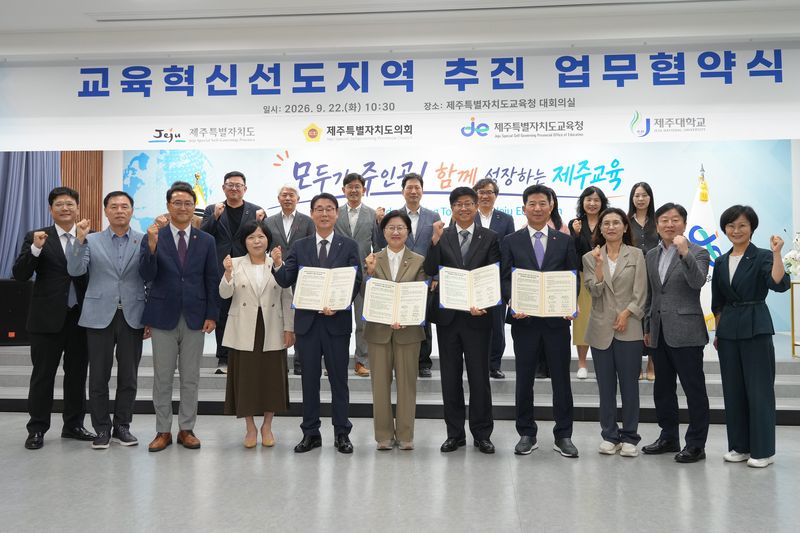
The four institutions, including Jeju Island and the Jejudo Office of Education, signed an agreement to promote the Educational Innovation Leading Region project on the 22nd in the main conference room of the Jejudo Office of Education. Participants included Jeju Superintendent of Education Ko Eui-suk, Jeju Special Self-Governing Provincial Council Speaker Song Young-hoon, Jeju National University President Yang Deok-soon and Jeju Island Deputy Governor for Administrative Affairs Park Cheon-su.
The Educational Innovation Leading Region program is a Ministry of Education initiative in which key local stakeholders, including education offices, local governments and universities, directly design education models suited to local conditions. It is intended as a follow-up policy that carries forward the results of the Education Development Special Zone pilot program, which ends this year, while addressing population decline, the growing number of small schools and educational disparities between regions.
The Ministry of Education plans to select around 30 Type 1 regions facing population decline and around 10 Type 2 non-metropolitan or capital-area border regions, for a total of 40 regions. The proposed support is KRW 2 billion per year for up to five years, or KRW 10 billion in total, for general regions. For Type 2 regions selected at the metropolitan level, the proposed support is KRW 4 billion annually. If Jeju Province, which has no basic local governments, is selected at the metropolitan level, it could receive up to KRW 20 billion over five years.
The application is particularly important for Jeju because the pilot period of its existing Education Development Special Zone program ends this year.
When Jeju was selected as a first-round pilot region for the Education Development Special Zone program in 2024, the entire province was designated as a leading region. Jeju was the only province-level metropolitan local government to organize its entire territory as a single Education Development Special Zone. It has pursued public education reform by bringing together Jeju-style autonomous schools, International Baccalaureate (IB) education, local talent development, digital education innovation, student care and school safety.
With the pilot program ending this year, how to continue the existing initiatives after 2027 has also emerged as a major issue.
At an education administration hearing held by the Jeju Special Self-Governing Provincial Council on the 9th, questions were also raised about whether Education Development Special Zone initiatives—including school safety police officers, one sport per person, global competency schools and Kkumnang—would continue and how funding would be secured. The Jejudo Office of Education said it would use its own budget, cooperative projects with Jeju Island and special grants while also applying for the Educational Innovation Leading Region program to secure national funding.
The agreement among the four institutions was also concluded during this transition between programs. The signatories will jointly work on preparing the operational proposal and plan for an Educational Innovation Leading Region, consulting, identifying education innovation models suited to Jeju's conditions, reducing educational disparities, strengthening the competitiveness of local talent development and supporting education policies through local government.
Rather than addressing educational issues only within schools, the initiative seeks to create a local education ecosystem by combining the personnel, facilities and policy tools held by Jeju Island, the education office, universities and the council.
In Jeju, differences in school size and educational conditions between the urban areas of Jeju City and the township and rural areas are significant. Because the challenges facing small schools also vary by area, reducing educational disparities is expected to be a major pillar of the application plan.
JNU's participation is linked to connecting local students' university enrollment after high school with professional training and settlement in the region. The Educational Innovation Leading Region program goes beyond elementary and secondary education by connecting universities and industry with school curricula. Its key goal is to develop a talent pipeline in which people learn, find jobs and settle locally.
The agreement signed by the four institutions also defines an Educational Innovation Leading Region as "a system that supports local educational development and the development and settlement of local talent through cooperation among key local stakeholders, including local governments, education offices and universities."
Jeju can also use its experience with education policies secured through the existing Education Development Special Zone program in its application.
Jeju-style autonomous schools, IB education, English Education City, education linked to local universities and special education provisions under the Jeju Special Act are educational resources that distinguish Jeju from other regions. However, the operational proposal must specify which existing special-zone initiatives will continue under the new system and what data and policies will be used to present educational disparities between eastern and western Jeju, as well as between township and rural areas and urban districts.
Competition among local governments nationwide has also begun. North Chungcheong Province has entered all 11 of its cities and counties in the application process, while Wonju and Yangju have formed consultative bodies involving local governments, education offices, universities and industry to prepare their operational plans. The Ministry of Education plans to select the Educational Innovation Leading Regions by the end of this year after reviewing the applications.
Jeju Island and the Jejudo Office of Education plan to use the agreement as a basis to prepare detailed projects reflecting local characteristics and jointly apply for the Ministry of Education's program.
Jeju Superintendent of Education Ko Eui-suk said, "We will reduce educational disparities based on region and create an educational ecosystem where children can receive a quality education wherever they live."
Jeju Island Deputy Governor for Administrative Affairs Park Cheon-su said, "Educational innovation suited to Jeju's conditions is possible when the administration, educational institutions and universities pool their resources." He added that he would strengthen administrative support and cooperation.
The key challenge for Jeju's application is to determine which Education Development Special Zone initiatives ending this year should be continued and how to redesign existing policies to align with the new government's goals of reducing educational disparities and helping local talent settle in the region.
[email protected] Jung Yong-bok Reporter