"What Changed Matters More Than How Much Was Spent"—SK Group's CSES Measures CSR Outcomes with AI
- Input
- 2026-09-22 15:42:22
- Updated
- 2026-09-22 15:42:22
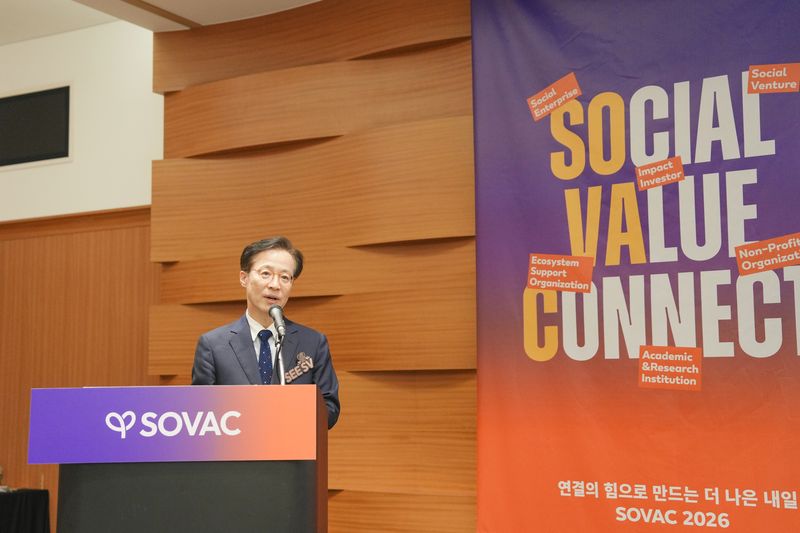
[Financial News] CSES, established by SK Group, has unveiled 'SEE SV,' an AI-based platform that measures and evaluates companies' corporate social responsibility (CSR) activities using data. The platform is designed to assess CSR program outcomes based not on 'how much was invested,' but on 'what social changes were created.'
CSES held a session titled 'The Future of CSR Drawn by Artificial Intelligence (AI): Moving Beyond Awareness to Change Behavior' at the '2026 Korea Social Value Festa' at the COEX Convention & Exhibition Center in Seoul on the 22nd. It unveiled and demonstrated the CSR measurement and evaluation platform 'SEE SV'.
Jung Ah-reum, a director at CSES's V-Lab, which has led the development of the SEE SV platform, emphasized that CSR outcome measurement should go beyond simply checking results and lead to the planning and decision-making for subsequent programs. Jung said, "SEE SV is focused not on 'measurement for the sake of measurement,' but on using measurement results again in planning and resource allocation for subsequent programs to drive changes in corporate behavior."
While conventional CSR performance management has focused on outputs such as budgets, the number of programs and the number of beneficiaries, SEE SV was designed to connect planning, implementation and outcomes and measure and manage the changes experienced by beneficiaries and society.
The new indicator system consists of three categories—planning, implementation and outcomes—and 18 detailed indicators in total. It provides integrated qualitative, quantitative and monetized measurement. Taking into account the diversity of CSR programs, CSES developed six evaluation types based on program maturity and scope of impact. The platform also allows required and optional indicators to be used flexibly according to program characteristics and user needs. In addition, it developed and applied monetization principles tailored to CSR based on its existing measurement expertise.
A key feature of 'SEE SV' is that it does not use a structure in which AI performs calculations and people simply approve them. Instead, AI presents the evidence and proposed assessment, while people make the final judgment. The platform also accumulates users' revisions and confirmed results, best practices and CSES's existing measurement data as accurate and reliable 'golden data.' By continuously improving AI prompts and recommendation criteria through user feedback and data, the platform aims to enhance analytical accuracy and evaluation quality over time.
CSES said, "The platform is expected to lower the barriers to CSR performance management, which has been difficult to access because of the burdens of expertise, time and cost. It will enable more companies and organizations to plan CSR programs based on data and manage outcomes more efficiently."
CSES plans to use the unveiling of 'SEE SV' as a starting point for building a data ecosystem that continuously measures and manages CSR outcomes. It will first pursue a beta launch of the platform by the end of this year and operate a proposed 'CSR Outcome Measurement and Evaluation Consultative Body.' The group will continuously incorporate the experiences and opinions of diverse stakeholders, including companies and nonprofit organizations (NPOs), into the platform.
Through this effort, CSES plans to create a system in which data is continuously accumulated and used throughout the planning, implementation and outcome-management processes of CSR programs, rather than being limited to one-time evaluations. In the long term, it aims to develop the platform into an 'SV Measurement and Evaluation Hub' that can be used not only by companies but also by NPOs, social enterprises and the public sector, thereby supporting outcome management and resource allocation to help solve social problems.
Na Seok-kwon, head of CSES, said, "SEE SV is not a tool for generating a one-time score for a year-end report. It is a 'trust infrastructure' that uses AI technology to transparently visualize the previously vague outcomes and impact of CSR programs, and uses data as a compass to create better decisions and tangible changes in behavior," adding, "When corporate resources, the on-the-ground experience of NPOs and government policies come together on a single transparent data foundation, our social contribution ecosystem can achieve true 'co-evolution' and evolve together."
He added, "We hope the unveiling of this platform will serve as a bold turning point, moving beyond mere 'awareness' of the need for data toward 'action' that delivers tangible solutions to social problems."
[email protected] Im Su-bin Reporter