Smoke Detector Distribution to Expand to 8.97 Million Households in Older Homes; Electrical Inspections to Become Mandatory
- Input
- 2026-09-22 16:00:00
- Updated
- 2026-09-22 16:00:00
[Financial News] The government plans to expand the distribution of smoke detectors to 8.97 million households that need early fire warnings. Installation will be extended to the 4.44 million general households currently excluded from support, and smoke detectors will also be available at Nonghyup Hanaro Mart nationwide starting next year.
The distribution of automatic fire-extinguishing devices will be expanded in older apartment buildings without sprinklers, while electrical safety inspections will become mandatory from 2027. Given the difficulty of newly installing sprinklers in older homes, the government will expand relatively low-cost detection and fire-extinguishing equipment, along with safety inspections.
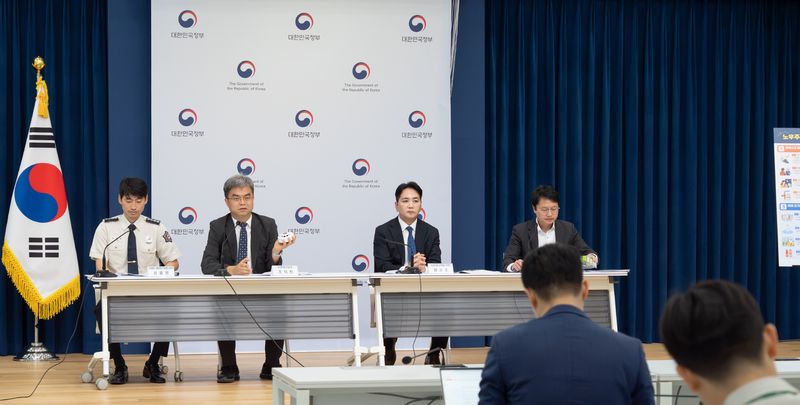
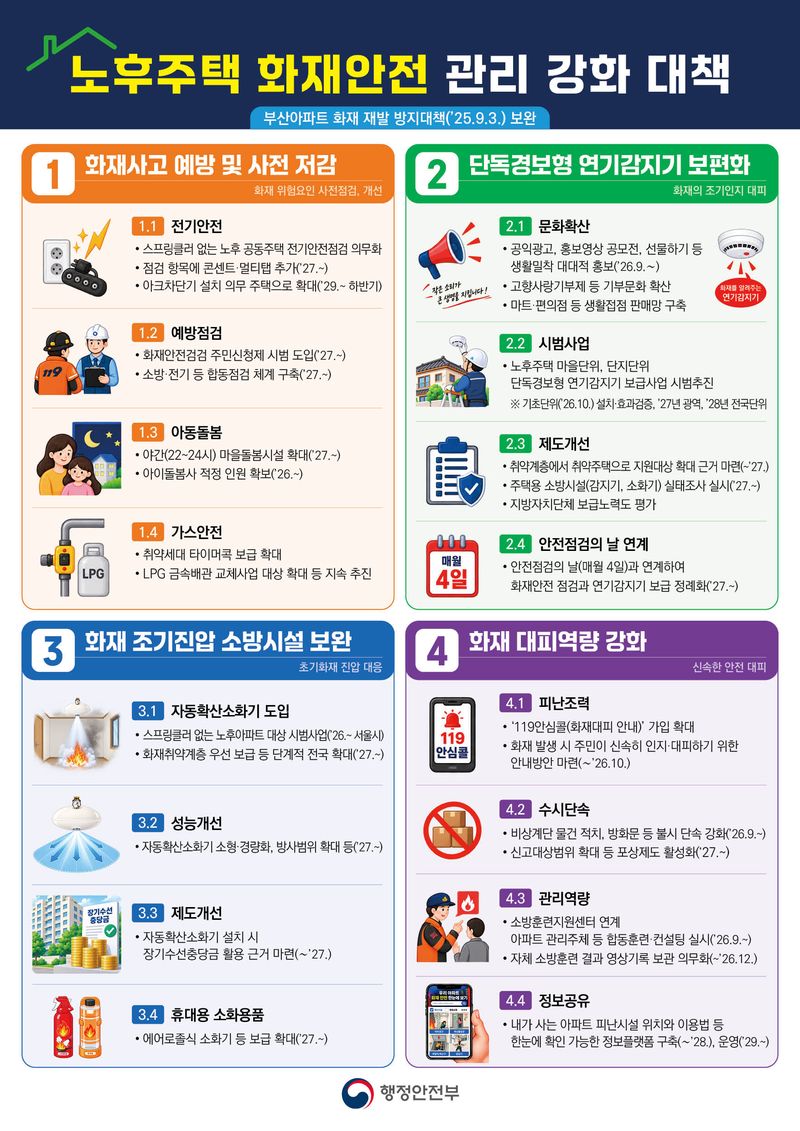
The government announced the "Measures to Strengthen Fire Safety Management in Older Homes" on the 22nd in coordination with relevant ministries. The announcement comes as a follow-up measure after casualties continued this year at locations including Eunma Town Apartments and multi-family housing in Eunpyeong District, despite the government’s measures to prevent a recurrence following apartment fires in Busan last June and July that killed four children.
Smoke Detectors to Be Extended to 4.44 Million Households Outside the Support Program
The core of the measures is to strengthen fire-response capabilities in existing older homes where sprinkler installation is difficult. Sprinklers require substantial costs for piping and other construction, making them difficult to add to older homes. The government will improve fire detection and initial suppression capabilities by expanding the distribution of relatively inexpensive smoke detectors and automatic fire-extinguishing devices.
About 8.97 million households need standalone smoke alarms. The National Fire Agency (NFA) currently supports 4.53 million households, focusing on fire-vulnerable groups such as people receiving public assistance, people with severe disabilities and older adults living alone. The remaining 4.44 million general households are outside the support program. The government will strengthen its support system so that installation can be extended to these households as well.
A smoke detector costs about 8,000 won per unit, detects fires more quickly than a heat detector and emits an 85-decibel alarm, helping sleeping residents recognize a fire quickly and evacuate. According to the government, 72 percent of deaths in residential fires are caused by suffocation from smoke inhalation rather than flames.
However, the government will not provide smoke detectors free of charge in bulk to all 4.44 million general households. Instead, it will combine voluntary installation by residents and donations while expanding the network of stores where the devices can be purchased.
A pilot project will begin this October in Naju and Gurye County, South Jeolla Province, before expanding to the regional level in 2027 and nationwide in 2028. Starting next year, Nonghyup Hanaro Mart stores nationwide will sell fire-extinguishing supplies such as smoke detectors, with sales outlets later expanded to large retailers and convenience stores.
The government will also encourage local government participation. Starting in 2027, local governments’ efforts to distribute smoke detectors will be reflected in disaster management evaluations. The aim is to extend installation to general households not only through direct distribution by the central government but also through distribution programs operated by local governments.
Automatic Fire-Extinguishing Devices to Expand to Local Governments; Electrical Inspections to Become Mandatory in Older Homes
Facilities for initial fire suppression will also be strengthened. The distribution of automatic fire-extinguishing devices, which spray extinguishing agents automatically when a fire breaks out, will be expanded in stages, primarily in older apartment buildings without sprinklers. Each unit costs about 30,000 won.After a pilot project involving 39,000 households in Seoul this year, the program will be expanded next year through distribution projects linked to local governments. Starting in 2028, government funding will support its nationwide expansion. By 2027, the government will also establish a legal basis allowing apartment long-term repair reserve funds to be used to install automatic fire-extinguishing devices inside individual units.
The obligations of residents in older multi-family housing will also change. Starting in 2027, older multi-family housing without sprinklers will be included among properties subject to mandatory electrical safety inspections. Inspections will cover not only existing wiring but also household electrical fire risks, including overloading of outlets and power strips. A joint inspection system will also be established to examine electrical and firefighting safety together and provide safety consulting.
The mandatory installation of arc-fault circuit interrupters, which detect electrical arcs and cut off power, will also be expanded. The requirement, currently applied to logistics warehouses and traditional markets, will be gradually extended to homes by 2029. The "Resident-Requested Fire Safety Inspection Program," which allows residents to request inspections directly, will be piloted next year in Jeju Special Self-Governing Province and Incheon.
For older adults and people with disabilities who have difficulty evacuating, the government will expand enrollment in the 119 Safe Call service to quickly provide information about fires and evacuation methods. By 2028, it will also establish an information platform where residents can check the locations of evacuation facilities in each apartment complex and learn how to use them.
Yun Ho-jung, minister of the Ministry of the Interior and Safety, said, "To ensure that repeated fires in older homes no longer result in tragic loss of life, we will thoroughly implement these measures by reducing fire risks in advance and ensuring that fires are reported and addressed swiftly when they occur."
[email protected] Lee Bo-mi Reporter