What Will a Basic Society Look Like in the AI Era? ... "Fair Opportunities and Medical Care Regardless of Financial Means"
- Input
- 2026-09-22 16:31:29
- Updated
- 2026-09-22 16:31:29
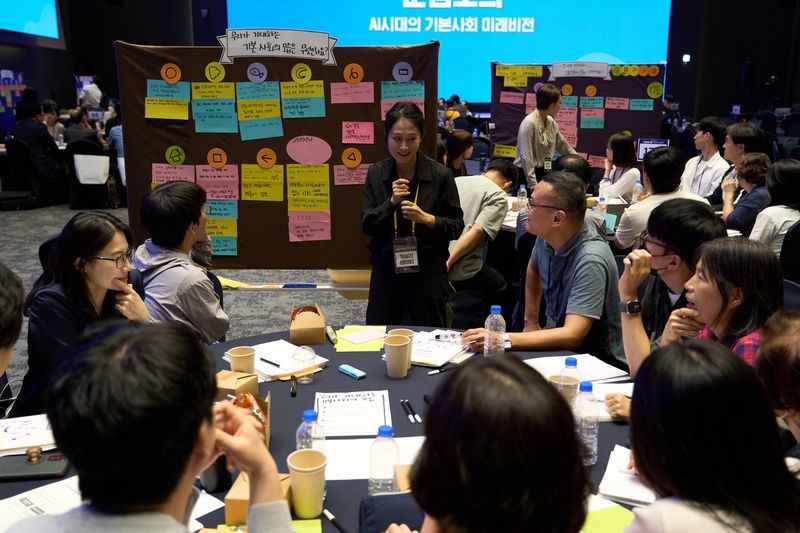
[Financial News] A society that guarantees fair opportunities, a society where people can receive medical care regardless of their financial means, and a society that provides education to help people respond to change were identified by the Citizens’ Deliberative Panel as key visions for a basic society.
The Presidential Committee on Basic Society said on the 22nd that 223 members of the Citizens’ Deliberative Panel took part in the "Public Deliberation on a Basic Society amid the Artificial Intelligence (AI) Transition," held on the 19th and 20th. They produced a "Future Vision Statement for a Basic Society" reflecting the discussions.
The statement was compiled by organizing 687 visions proposed by 20 discussion groups according to similar themes, then selecting 27 goals that received at least 80% support in a preference vote. "A society that guarantees fair opportunities" and "a society where people can receive medical care regardless of their financial means" each received 96% support, while "a society that provides education to help people respond to change" received 95%. Other visions included "a society where future generations can pursue their dreams and enjoy opportunities to grow" at 94% and "a society where disparities in medical care between regions have been eliminated" at 92%.
The panel also discussed policies needed to prepare for the sweeping AI transition. In the employment sector, participants proposed intergenerational experience-sharing programs in which young and older people exchange knowledge. In income security, they discussed establishing an education system that reflects long-term life transitions rather than focusing solely on short-term vocational training.
In basic services, participants suggested gradually expanding universal free medical care and introducing additional welfare measures for medical personnel in regional areas. Regarding funding, they discussed prioritizing fiscal efficiency before imposing new tax burdens, as well as taxing companies that profit from AI.
In surveys conducted before and after the deliberations, the share of respondents who agreed that "expanded AI adoption could worsen income inequality in our society" rose from 79% to 85%. Agreement with the statement that "there is a need to seek a new social compact, such as a basic society" also increased from 88% to 91%.
The committee plans to submit the deliberation results to the Policy Agenda Planning Group, which includes 20 representatives of the Citizens’ Deliberative Panel and 20 experts, so they can be developed into policy proposals. The policy proposal document will undergo another round of review and verification by the 223 panel members in late October.
Kang Nam-hoon, vice chair of the Presidential Committee on Basic Society, said, "We will do our utmost to accept the opinions shared by citizens during the deliberation process as the will of the sovereign people and turn them into concrete policies."
[email protected] Lee Bo-mi Reporter