Government Says Grants Increased by 7.2 Trillion Won; Superintendents Say Increase Is Only 2.4 Trillion Won Including Supplementary Budget
- Input
- 2026-09-22 14:53:56
- Updated
- 2026-09-22 14:53:56
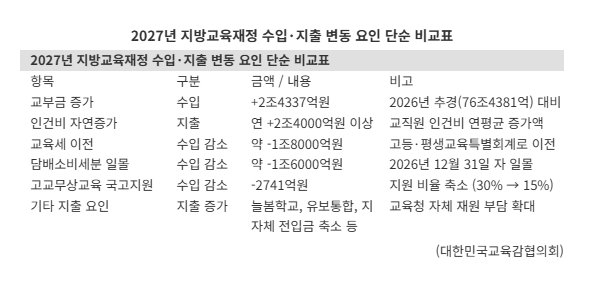
[Financial News] The government has budgeted next year's local education finance grants at 78.8718 trillion won, an increase of 7.2031 trillion won, or 10.1%, from this year's initial budget. However, compared with this year's 76.4381 trillion won after including the supplementary budget, the increase amounts to only 2.4337 trillion won, or 3.2%. Geun-sik Chung, chairman of the Korean Council of Superintendents of Education, urged on the 22nd, "The government and the National Assembly must transparently disclose changes in revenue and expenditure and the resulting fiscal impact for each metropolitan and provincial office of education so that changes in local education finance before and after the institutional reforms can be assessed objectively. They must also establish mid- to long-term funding measures to ensure the stable operation of education."
The council maintains that it is difficult to conclude that the fiscal conditions of metropolitan and provincial offices of education have improved simply because the size of the grants has increased. Chung said, "To assess the actual conditions of local education finance, we must look beyond the increase in grants and comprehensively examine the transfer of education tax revenue, reforms to the grant formula, the expiration of existing revenue sources, changes in the national government's financial responsibilities, including free high school education, changes in transfers from local governments, additional burdens arising from national policy programs and new policies, and the decline in funds."
The council expects the increase to fall short even of the natural rise in personnel costs for education staff. Personnel expenses have increased by more than 2.4 trillion won annually on average in recent years, and a substantial increase is expected in 2027 as well. Because the central government determines civil servant pay levels and teacher staffing levels, metropolitan and provincial offices of education have limited room to make adjustments on their own.
The funding structure itself will also shrink. Approximately 1.8 trillion won in education tax revenue currently allocated to primary and secondary education will be transferred to the Special Account for Support of Higher and Lifelong Education under the government's reform plan. As a result, the education tax funding directly allocated to primary and secondary education will effectively disappear. The approximately 1.6 trillion won local education tax derived from tobacco consumption tax will also expire on December 31 this year. The national treasury support ratio for free high school education will fall from 30% in 2026, or 578.5 billion won, to 15% in 2027, or 304.4 billion won. This special provision is scheduled to end on December 31, 2027, and without separate measures afterward, the burden on education offices could grow further.
Spending continues to rise. National policy programs launched with central government funding, such as Neulbom School and after-school programs, have repeatedly continued to operate with education offices' own funds after that support ended, or have seen their cost-sharing ratios changed. New policies, including the integration of early childhood education and childcare, could also increase the burden on education offices if pursued without separate funding. Unpaid or delayed statutory transfers from local governments, as well as reductions in non-statutory transfers, are also cited as factors adding to the burden.
The funds that education offices have used to absorb these burdens are also declining. The total funds held by metropolitan and provincial offices of education nationwide have been falling rapidly from 20.2 trillion won in 2022, and some education offices are even considering issuing local bonds.
[email protected] Kim Man-gi Reporter