"Can the President Request a Re-nomination?"... Cho Hee-dae Rejects Cheong Wa Dae Request (Updated)
- Input
- 2026-09-22 14:36:06
- Updated
- 2026-09-22 14:36:06
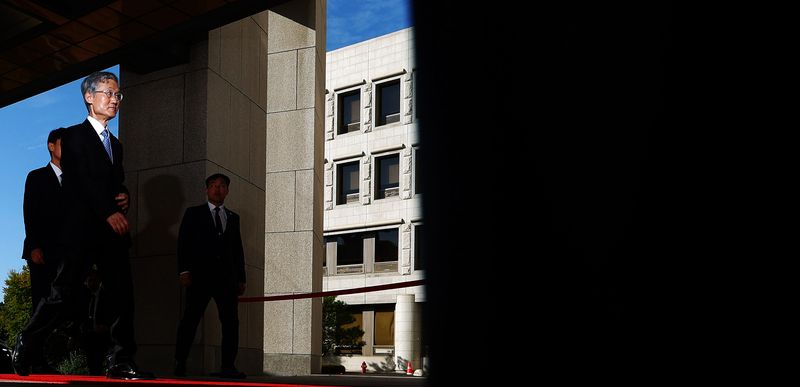
According to legal circles on the 22nd, Cho said in a media notice at noon that he could not comply with Cheong Wa Dae's request to re-nominate a candidate to succeed former Supreme Court Justice Rho Tae-ak. He explained, "The only document related to this request for re-nomination is the 'Request for Re-nomination of a Supreme Court Justice Candidate' dated the 28th of last month. It does not state specific reasons for requesting a re-nomination or the constitutional grounds for doing so, and I cannot find any other specific constitutional grounds or reasons that would justify the request for re-nomination." Cho then cited Article 82 of the Constitution, stating, "The President's acts of state under the law shall be carried out in documents countersigned by the Prime Minister and the relevant Cabinet member."■ "Neither the Power to Recommend Nor the Power to Appoint Is Superior"Article 104, Paragraph 2 of the Constitution stipulates that Supreme Court justices are appointed by the President with the consent of the National Assembly upon the recommendation of the Chief Justice. The Chief Justice's written recommendation and the President's request for a re-nomination are both unprecedented under the current Constitution.
Some observers say that the boundaries between the two powers had never previously been examined because no such precedent existed. A presiding judge at a district court explained, "In the past, recommendations were made through the courtesy and mutual understanding of the two parties—the Chief Justice, who made the recommendation, and the President, to whom it was addressed. As a result, a situation in which the power to recommend and the power to appoint came into conflict never arose, and their boundaries were not clearly defined. The current controversy has emerged because there had been no discussion of whether these are separate powers that can be exercised independently by each party or whether the parties must consult one another within a single procedure."
The prevailing interpretation in legal circles is that, since the two powers are distinct, the President must have grounds for refusing to accept the Chief Justice's recommendation. A professor at a law school in the Seoul metropolitan area said, "The President's request for a re-nomination is an act that infringes on the Chief Justice's inherent power to recommend, in a situation where two independent authorities are in conflict. Since neither the power to recommend nor the power to appoint can be considered superior, if the President is dissatisfied with the Chief Justice's recommendation, he can exercise his appointment power and refuse to make the appointment."■ Ruling Party: "Criticism of Judicial Administration"... Dispute Over the Circumstances Behind the Written RecommendationThe ruling party maintains that the request for a re-nomination was part of a fact-finding process, not an infringement on the power to recommend. A senior ruling-party lawmaker argued, "This does not infringe on judicial independence; it is criticism of judicial administration." The lawmaker added, "Noh Gyeong-pil, head of the National Court Administration and a Supreme Court justice, testified before the Legislation and Judiciary Committee of the National Assembly that he called the candidates selected through the Committee of Recommendation of Supreme Court Justice Candidates and asked whether they agreed to reconstituting the committee. If that was not pressuring the candidates to resign, what was it?" The lawmaker continued, "It could constitute an abuse of authority, and it is something that the National Assembly can question the head of the National Court Administration and the Chief Justice about through a parliamentary audit or other means."
The two sides also disagree over the method of recommendation. The recommendation of Judge Son Bong-gi of the Daegu District Court, a presiding judge and a 24th-class graduate of the Judicial Research and Training Institute, was made in writing. The Supreme Court of Korea says the written recommendation was made after prior consultations with Cheong Wa Dae officials because President Lee Jae Myung, an 18th-class graduate of the Judicial Research and Training Institute, did not provide the customary opportunity for a meeting. Noh appeared before the Legislation and Judiciary Committee on the 19th of last month and said, "We asked Cheong Wa Dae for a meeting between the Chief Justice and the President, but we were not given the opportunity." Asked who proposed the written recommendation method, he replied, "It was a method decided upon in agreement and consultation with the senior secretary for civil affairs."
Cheong Wa Dae denied this but acknowledged that communication had taken place between the judiciary and Cheong Wa Dae. Sung Ki-hong, Cheong Wa Dae's senior public relations secretary, appeared on the YouTube channel OhmyTV on the 21st and said, "We did discuss general matters concerning the recommendation of Supreme Court justices, but there was absolutely no consultation regarding specific recommendation methods, such as whether to make the recommendation in writing."
On the 18th of last month, Cho recommended Judge Son Bong-gi for appointment from among the four candidates recommended by the Committee of Recommendation of Supreme Court Justice Candidates to succeed former Justice Rho. Ten days later, on the 28th of last month, Cheong Wa Dae requested a re-nomination, calling it a unilateral written recommendation made without substantive consultation. Cho rejected the request 25 days later.
[email protected] Kim Dong-gyu Reporter