Competition for 'university mergers' rises, but restructuring 'stagnates'
- Input
- 2026-09-22 14:15:28
- Updated
- 2026-09-22 14:15:28
On the 22nd, Kim Taek-hyeong, an associate research fellow at the Korean Educational Development Institute (KEDI), announced the results of an analysis regarding "University Mergers and Consolidations: What Has Changed?" The analysis covers changes before and after mergers and consolidations across 54 universities in 27 cases that were available for analysis out of the 37 university mergers and consolidations carried out between 2000 and 2026.
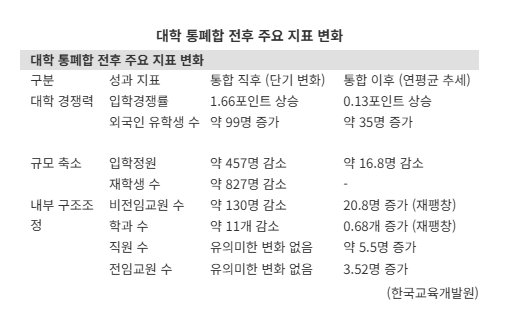
The analysis results showed that the admission competition rate rose by 1.66 points immediately after the merger and continued to rise by an annual average of 0.13 points thereafter. The freshman enrollment rate also increased by 2.51 percentage points, and the number of international students increased by about 99, followed by an annual average increase of about 35.
The size of the university decreased. Immediately after the merger, the admission quota decreased by about 457 and the number of enrolled students by about 827, and the admission quota continued to decrease by an average of about 16.8 students per year thereafter.
■ Return to the state just before the integration of departments and non-tenure track faculty
On the other hand, internal restructuring did not continue. Immediately after the merger, the number of non-tenure faculty decreased by about 130 and the number of departments by about 11, but subsequently, the number of non-tenure faculty increased by an annual average of 20.8 and the number of departments by an annual average of 0.68. Subsequently, the number of staff increased by an annual average of about 5.5 and the number of full-time faculty by 3.52.
"Associate Research Fellow Kim explained, 'The difference in the speed of change between enrollment quotas and internal organizations was due to the fact that targets that are easy to reduce differed from those that require time for adjustment.' He stated, 'While the reduction of admission quotas is relatively easy because university mergers and consolidations are often carried out on the premise of quota reduction, adjustments to faculty and departments can take time as they are heavily influenced by the interests of internal university members.'"
Departments may shrink immediately after consolidation as similar or overlapping departments are reorganized, but then increase again to respond to new educational demands or diversification of majors. "This brief shows that while external scale changes relatively quickly, internal functions or organizational restructuring are difficult to maintain without continuous management," said Associate Research Fellow Kim.
However, the increase in the number of departments and faculty members cannot be viewed solely as the disappearance of the effects of restructuring. This is because the decrease in enrolled students has reduced the number of students per faculty member, which can improve educational conditions, and there is also the aspect of departments increasing as new majors are created.
■ Limitations of National/Public and Dual-System Integration
The restructuring effects were relatively small for national and public universities and universities undergoing dual-campus mergers. It was difficult for national and public universities to adjust departments and personnel in the short term due to demands for job security for faculty and staff and the retention of local campuses. Dual-campus mergers also involve maintaining existing campuses, so there is a possibility that a significant portion of departments and administrative organizations will remain. However, there is also the aspect of preserving the university's community functions, such as ensuring local residents' access to higher education and fostering local talent.
By consolidation method, there were 17 cases of 'unified consolidation' integrated into a single university and 10 cases of 'dual consolidation' maintaining existing campuses. Relatively distinct changes were observed in unified consolidation, such as increased competition rates, decreased admission quotas, and department reorganization, whereas the effects of dual consolidation on competition rates and enrollment reductions were relatively limited.
Associate Research Fellow Kim explained, "After the merger, it is necessary to view the reorganization of similar and overlapping departments, functional specialization by campus, and the integration of administrative organizations, finances, and assets as key evaluation indicators."
In the actual integration process of Kangwon National University (KNU) and Gangneung–Wonju National University, a 'Top-Class Integrated Department' initiative is being pursued to enhance departmental competitiveness. Associate Research Fellow Kim explained, "Along with strengthening departmental competitiveness, it is important to determine how to reallocate and continuously manage the resources secured during the integration process."
However, this study focused on quantitative changes before and after the merger and did not analyze employment, research performance, fiscal soundness, or regional economic and social effects. KEDI suggested that it is necessary to further verify the effects of the merger in the future through comparisons with non-merged universities.
[email protected] Kim Man-gi Reporter