Gwangju Metropolitan City to Begin Construction of Honam Semiconductor Cluster in 2027; First Mass Production Targeted for June 2030
- Input
- 2026-09-22 13:28:35
- Updated
- 2026-09-22 13:28:35
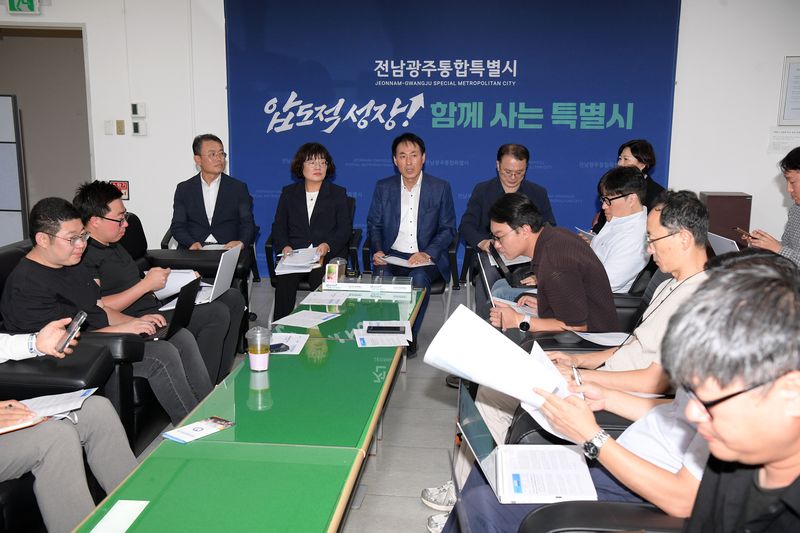
【Financial News, Jeonnam-Gwangju = Hwang Tae-jong, Reporter】The Jeonnam-Gwangju Integrated Special City (Gwangju Metropolitan City) is mounting an all-out drive to complete site preparation for the Honam Semiconductor Cluster in 2027, begin construction of two memory fabs in 2028, and start first mass production in 2030.
Kihong Kim, head of Gwangju Metropolitan City's Semiconductor Industry Support Division, announced the key progress and plans for the Honam Semiconductor Cluster at a press roundtable held at Gwangju City Hall on the 22nd.
The Honam Semiconductor Cluster project involves the government, Gwangju Metropolitan City, Samsung Electronics, and SK hynix building at least four memory fabs on approximately 2.5 million pyeong of land at the former Gwangju military airport site. The target is to begin first mass production in June 2030.
Regarding the 'site,' the military airport location was finalized on July 6, followed by its designation as a candidate site for a national industrial complex on July 29 and the selection of Korea Land and Housing Corporation (LH) as the preliminary project operator on July 30. To carry out site development covering approximately 630,000 pyeong, including the planned relocation site for ammunition depots where construction can begin first in 2027, the city is pursuing a proposal to establish a special exemption for preliminary activities within development-restricted zones.
Regarding 'power,' a working-level consultative body was formed and launched on July 29. On August 12, Gwangju Metropolitan City, the Ministry of Climate, Energy and Environment, Korea Electric Power Corporation (KEPCO), Samsung Electronics, and SK hynix signed the 'Semiconductor Mega Project Power Supply Agreement.' On September 1, a Cabinet meeting approved an exemption from the preliminary feasibility study for the power grid project. Construction of the transmission lines will begin in June 2027, with 3.1 GW to be supplied in the first phase and 6.3 GW ultimately by December 2028.
Regarding 'water supply,' the Cabinet approved an exemption from the preliminary feasibility study on August 25. The 'Dongbok Dam Expansion Win-Win Consultative Council' was formed on September 18, and discussions are underway to hold a briefing for local residents on the Dongbok Dam expansion in October. The plan is to supply 150,000 tons per day in the initial phase, rising to 1.06 million tons per day ultimately, by December 2028.
To improve 'settlement conditions,' the city will establish a Semiconductor City Settlement Team. In the short term, it will improve living conditions for construction workers, while in the medium and long term it will identify measures to improve residential conditions and establish and implement plans.
For 'talent development,' the city will establish a phased training system covering advanced personnel responsible for semiconductor research and design as well as practical workers for on-site operations. In particular, it will create an environment in which local talent can settle in the region and build a talent ecosystem that connects talent development with long-term settlement.
Kihong Kim, head of the Semiconductor Industry Support Division, said, "To achieve the target of first mass production in June 2030, we will accelerate the construction of key infrastructure as much as possible and spur the development of the cluster by actively utilizing integrated fiscal support funds."
He added, "Centered on the Pan-Citizen Promotion Committee launched on August 24, we plan to broaden public support through forums, talk concerts, media outreach, and policy briefings."
[email protected] Hwang Tae-jong Reporter