Epson Moves Beyond Its Printer Image, Aims for 50% of Revenue from B2B by Growing Robotics and Inkjet Businesses
- Input
- 2026-09-22 14:33:58
- Updated
- 2026-09-22 14:33:58
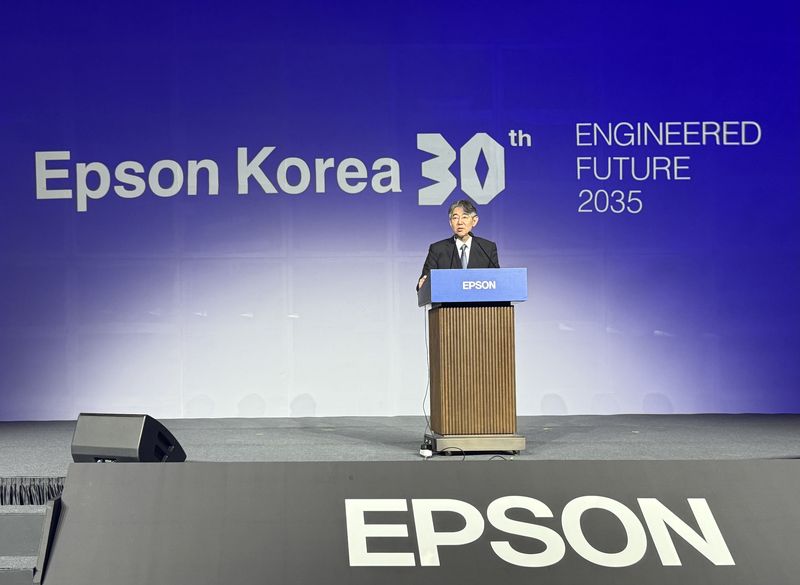
[Financial News] Epson, known for its printers and projectors, is expanding its industrial business by leveraging its precision technologies. It plans to make robotics, industrial inkjet systems and microdevices new growth drivers, raising the industrial business's share of total revenue from the current 33% to 50% by 2035. In Korea, the company plans to target automation demand in advanced manufacturing sectors such as semiconductors and electronics while expanding technological cooperation with local companies.
Junichi Yoshida, president of Seiko Epson, held a media briefing marking the 30th anniversary of Epson Korea at the InterContinental Grand Seoul Parnas in Seoul's Gangnam District on the 22nd. "Epson has a strong image as a printer company, but behind that image are core technologies that support its products. We will accelerate growth in industrial sectors by leveraging our precision technologies," he said.
This was the first time Yoshida had visited Korea since taking office. At the briefing, he unveiled Epson's long-term vision, ENGINEERED FUTURE 2035, which will guide the company over the next 10 years, along with its first medium-term management plan for 2026 to 2028.
The strategy centers on extending Epson's technology philosophy of efficiency, compactness and precision—built up over more than 80 years—into industrial applications. While maintaining its existing printing business as a stable source of revenue, Epson will focus on high-value-added businesses such as robotics, industrial inkjet systems, microdevices and advanced materials. Through these efforts, it plans to raise the industrial business's contribution to profit from the current 45% to 70% by 2035.
By 2028, Epson plans to redesign its organization, global facilities and supply chain while improving asset efficiency, including fixed costs and inventory. The company aims to achieve ¥26 billion in earnings improvement over three years. At the same time, it will invest a total of ¥280 billion in growth and strategic areas such as Precision Innovation and industrial robotics. Its targets for 2028 are a return on invested capital (ROIC) of at least 8%, a return on equity (ROE) of at least 10% and a return on sales (ROS) of at least 8%.
In Korea, Epson is expanding its industrial business with a focus on advanced manufacturing sectors such as semiconductors and electronics. Jun Morofushi, president of Epson Korea, said, "In Korea's robotics business, we are expanding our customer base beyond manufacturing into areas such as healthcare and food, focusing on SCARA robots and other products in which Epson has strengths." He added, "We are also proposing solutions to customers in the electronics and semiconductor sectors, where Korea has strengths." Epson is also strengthening its support system with local partners so it can provide on-the-ground assistance from pre-deployment setup through after-sales support. The company is also deepening technological cooperation, including by investing in Korean companies that use inkjet technology.
[email protected] Hye-rim Choi Reporter