Jeju Bids to Host Global AI Hub; Government to Solicit Candidate Sites in October
- Input
- 2026-09-22 11:21:08
- Updated
- 2026-09-22 11:21:08
【Financial News, Jeju—Reporter Jeong Yong-bok】The selection of a site in South Korea for the Global AI Hub that Jeju is seeking to host will begin in earnest next month. With the government set to solicit and evaluate candidate sites in October, targeting an opening in 2027, local governments across the country—including Jeju—are moving from conceptual bids to an actual competition for the site.
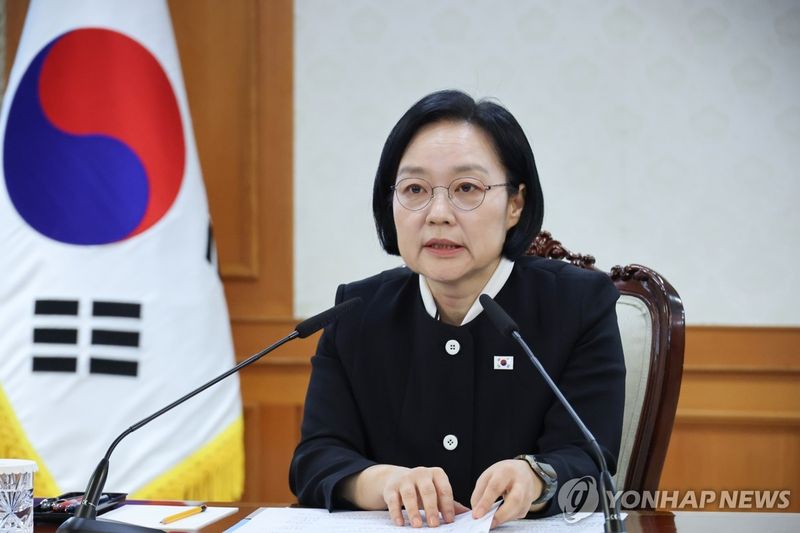
According to the Office for Government Policy Coordination on the 22nd, Prime Minister Han Seong-sook held the first meeting of the Global AI Hub Steering Committee at the Government Complex-Seoul on the 21st to discuss progress on the hub’s establishment and the basic plan for selecting its site. The government plans to gather public input through a public hearing and other channels in October before soliciting and evaluating candidate sites. It also outlined plans to select a location suitable for international organization personnel to reside and carry out joint projects.
The Global AI Hub is fundamentally different from a large-scale AI data center construction project. It is an international campus-style, multilateral AI cooperation platform where the government, international organizations, multilateral development banks, businesses, universities and research institutes collaborate in one place.
The hub will apply AI to international issues that individual countries or institutions cannot address alone, such as climate, health, food and jobs. It will also connect the AI capabilities and projects of different international organizations. The government plans to identify global joint projects centered on the hub and establish systems for cooperation on related technologies and policies.
The foundation for participation is already in place. During the first half of the year, the government signed letters of intent (LOIs) for cooperation with nine international organizations, including the International Labour Organization (ILO), International Organization for Migration (IOM), International Telecommunication Union (ITU), United Nations Development Programme (UNDP), United Nations Environment Programme (UNEP), United Nations High Commissioner for Refugees (UNHCR), United Nations Children’s Fund (UNICEF), World Food Programme (WFP) and World Health Organization (WHO).
The World Bank, Asian Development Bank (ADB), Inter-American Development Bank (IDB), European Bank for Reconstruction and Development (EBRD) and Central American Bank for Economic Integration (CABEI) also participated in the vision declaration ceremony in May.
With the government officially setting the site-selection schedule, Jeju’s bid is moving from the “request” stage to the “proposal competition” stage.
On June 25, while still governor-elect, Jeju Governor Wi Seong-gon met candidates for UN secretary-general who visited the Jeju Forum for Peace and Prosperity and asked them to support Jeju’s bid to host the Global AI Hub. The previous day, he also delivered letters seeking support for Jeju’s bid to National Assembly member Cha Ji-ho, secretary of the Global AI Hub Hosting Committee, and Moon Chung-in, chair of the International Peace Foundation.
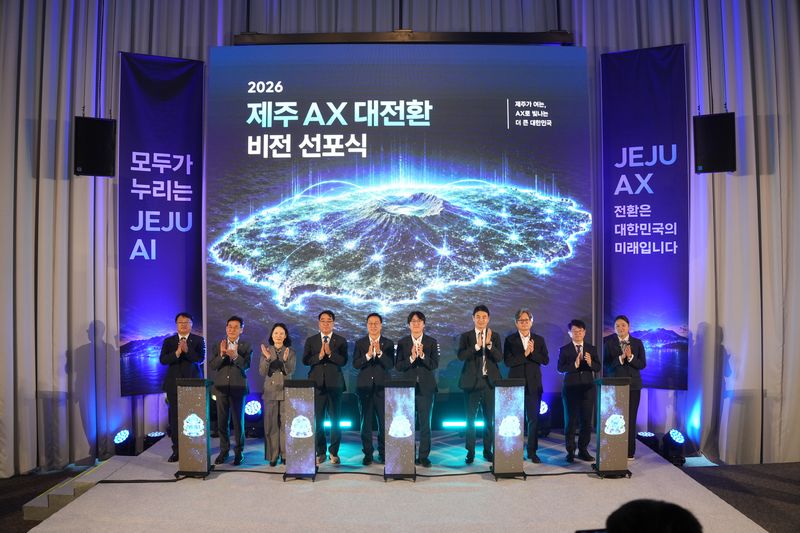
After taking office, Wi made the bid an official government proposal. At the Jeju AX Transformation Vision Declaration Ceremony held at Kakao Space Dot One in Jeju City on the 11th, Governor Wi asked Ha Jung-woo, vice chair of the National AI Strategy Committee under the President, to support the creation of the Global AI Hub in Jeju.
He also proposed drawing up a comprehensive plan for a joint campus linking Jeju with the four institutes of science and technology, giving Jeju priority in the allocation of national graphics processing unit (GPU) infrastructure, exempting the Jeju AX transformation project from a preliminary feasibility study, and designating Jeju as a full-cycle demonstration area for AI government.
Jeju’s separate plan for a 40-MW green AI data center could also serve as a regional AI asset when the hosting proposal is assembled.
Jeju Province is designing the Jeju AX transformation project, which would combine a renewable energy-based AI data center with a self-controlling power grid, with the data center sized at 40 MW based on incoming power capacity. The plan calls for an “integrated power-and-computing operations model” that concentrates AI computing when renewable power generation is high, while applying AI to energy, space, biotechnology, tourism, safety and primary industries.
Jeju Province is conducting planning work to link the project to a large-scale national project from 2028 through 2032. However, the 40-MW green AI data center and the Global AI Hub are currently separate projects. While the Global AI Hub is an international cooperation platform involving international organizations and development banks, the Jeju AX transformation project is a regional AI transition initiative combining AI computing infrastructure with demonstrations in local industries.
The site competition is not limited to Jeju. Busan, Incheon, Gwangju and North Gyeongsang Province have expressed interest, while in Gyeonggi Province, Goyang City, Osan, Seongnam-si, Paju and Siheung-si have each begun preparing bids by highlighting their international conference infrastructure, airport access, AI and biotechnology industries, and universities and research institutions. Goyang City launched a pan-citizen bid committee on the 7th and began a campaign to collect 100,000 signatures.
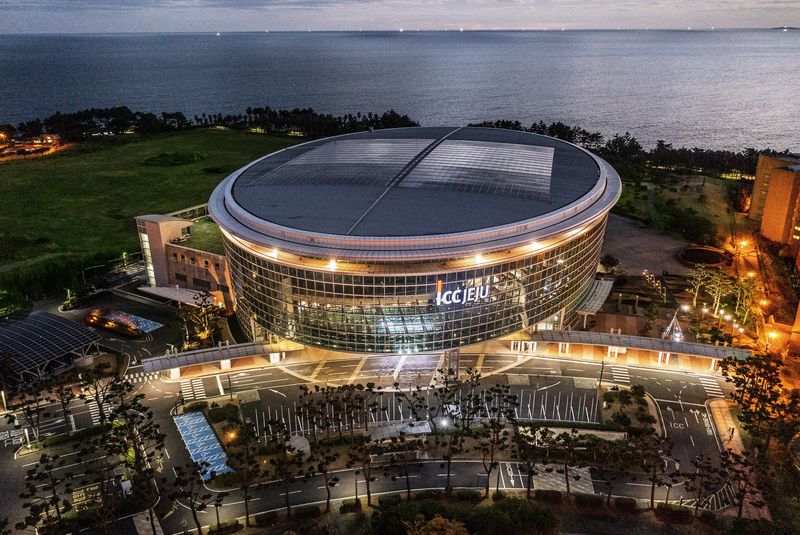
The assets Jeju can put forward have a different profile from those of other candidate sites. It can connect its renewable and distributed energy demonstration environment with AI computing, and it has experience hosting international conferences centered on International Convention Center Jeju (ICC JEJU). Its experience in international exchanges, including the Jeju Forum for Peace and Prosperity, can also support its case for becoming a partner city for international organizations.
Jeju’s next task is to turn its intention to host the hub into a concrete site proposal. Once the government discloses the application requirements and evaluation criteria in October, Jeju will need to present a candidate site, space for resident international organizations, settlement support, AI research and demonstration infrastructure, and a division of roles with the central government in line with the evaluation framework.
A key point in evaluating Jeju’s proposal will be how it explains the connection between the separate 40-MW green AI data center and distributed energy demonstration environment that Jeju is pursuing and the Global AI Hub’s international cooperation functions.
Prime Minister Han Seong-sook described the Global AI Hub as “a focal point and cooperation platform for realizing a human-centered global AI basic society in which all humanity can share the benefits of advances in artificial intelligence.” The government plans to step up cooperation among relevant ministries, including the Ministry of Finance and Economy, Ministry of Science and ICT, and Ministry of Foreign Affairs, with the hub’s opening targeted for 2027.
[email protected] Jeong Yong-bok Reporter