President Lee: "Sanctions on North Korea should be exchanged for a halt to the development of nuclear weapons and ICBM technology"
- Input
- 2026-09-22 10:58:58
- Updated
- 2026-09-22 10:58:58
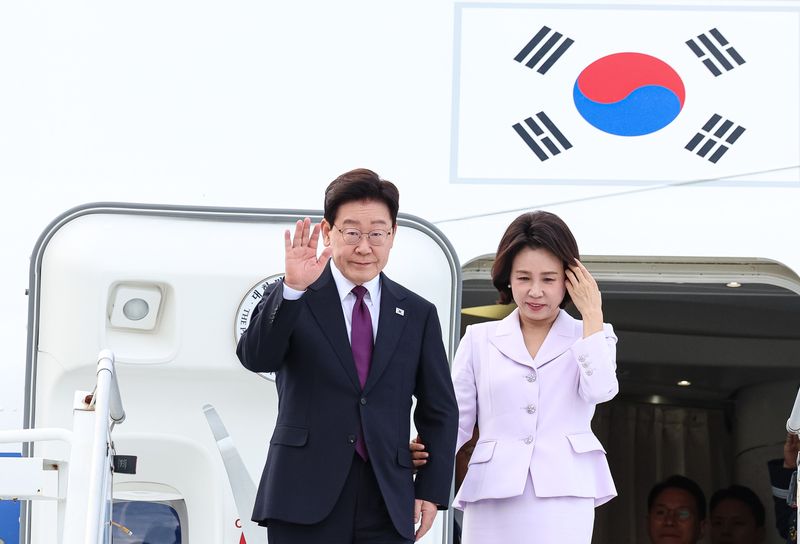
In an interview with The New York Times (NYT) published on the 21st (local time), President Lee, who was visiting New York to attend the United Nations General Assembly, made the remarks and called for a phased approach: North Korea's nuclear weapons and ICBM programs should first be frozen, followed by a corresponding easing of sanctions on North Korea.
President Lee said, "If we set denuclearization as the goal under the current circumstances, it is certain that we will achieve nothing."
In an interview with The Associated Press (AP), President Lee also offered a more detailed explanation of the same proposal. "To change the direction of a moving vehicle, you must first bring it to a stop," he said. "A phased approach—beginning with a halt, followed by reduction and dismantlement—is a realistic way to effectively resolve the North Korean nuclear issue."
He added, "Given that North Korea's nuclear and missile capabilities have already advanced to a considerable level, waiting until complete denuclearization can be achieved all at once is not a realistic solution," explaining, "In the meantime, North Korea's nuclear capabilities will continue to advance, and the threat will grow even greater."
The point is that, rather than immediately making complete denuclearization the sole goal of negotiations, the two sides should first halt the expansion of North Korea's nuclear and missile capabilities, build trust through reciprocal measures, and move toward reducing nuclear weapons and ultimately achieving denuclearization.
In the NYT interview, President Lee also discussed North Korea's nuclear weapons production capacity, saying, "According to our estimates, North Korea may have the capability to produce an additional 10 to 20 nuclear weapons each year, or may in fact be producing them."
He continued, "Once North Korea judges that it has secured enough nuclear weapons and missiles to guarantee the survival of its regime, it will be tempted to export them to make money," adding, "That would be a truly dangerous moment."
He also emphasized the role of U.S. President Donald Trump in resuming dialogue between North Korea and the United States. In an interview with AP, President Lee said that both South Korea and the United States "are open to talking with North Korea without preconditions," adding, "What is needed now is a political decision at the level of the leaders." He stressed, "The two leaders must meet in person, build trust and find common ground together."
NYT reported that President Lee views President Trump as someone who can bring North Korean leader Kim Jong Un back to the negotiating table and hopes that resuming dialogue between North Korea and the U.S. could create a breakthrough in strained inter-Korean relations.
President Lee is also scheduled to present his vision for peace and coexistence on the Korean Peninsula, including this phased approach to resolving the North Korean nuclear issue, in his keynote address to the United Nations General Assembly.
Meanwhile, regarding pressure from President Trump to deploy troops to the Strait of Hormuz and pressure to invest in the United States, President Lee said, "I fully understand that, from the perspective of the U.S. president, he may make various remarks." However, he stressed, "Dispatching troops to a war already underway between third countries is prohibited under the Constitution of South Korea."
According to AP, when asked about Kim Ju Ae, the daughter of North Korean leader Kim Jong Un, President Lee answered, "The South Korean government is paying attention to 'her rising status' and is keeping all possibilities open," adding, "However, at this stage, I believe we need to be cautious about expressing a definitive view."
[email protected] Choi Jong-geun Reporter