Foreign-National Students' Career Paths Vary by "Status of Stay"
- Input
- 2026-09-22 12:00:00
- Updated
- 2026-09-22 12:00:00
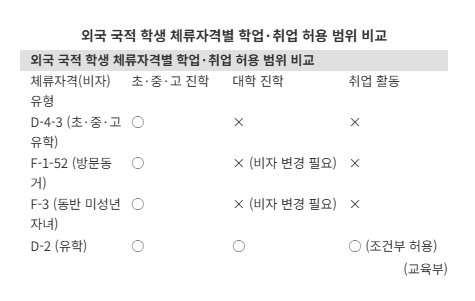
[Financial News] A guide outlining the scope of higher education and employment activities available to foreign-national students depending on their status of stay, as well as the procedures for changing that status, has been distributed to schools nationwide. It was developed to support schools struggling with career guidance because of the complexity of the status-of-stay system.
The Ministry of Education announced on the 22nd that it had published and distributed nationwide the "Career Planning Guide Based on Status of Stay for Foreign-National Students." The guide explains the statuses of stay held by foreign-national elementary and secondary school students and their guardians, and consists of resources teachers can use for career counseling and guidance.
The scope of study and employment activities permitted in South Korea, as well as the period of stay, varies according to a foreign-national student's status of stay. The Ministry of Education explained that the guide was developed because the status-of-stay system is complex and unfamiliar, making it difficult for schools to provide career guidance to foreign-national students.
The guide includes a checklist and a career-planning flowchart for teachers to use during counseling. It explains the basic concept and major types of status of stay, and outlines the scope of study and employment activities and the procedures for changing status. It also contains items for teachers to check during counseling at the beginning of a semester, career-planning weeks, and interviews before graduation.
It also presents career-planning cases by status of stay. These include cases in which students holding statuses of stay for minors, such as Visiting and Joining Family (F-1-52) and F-3 Dependent, change to Study Abroad (D-2) status to enter university. The guide also contains counseling and support cases involving students with Visiting and Joining Family (F-1), F-3 Dependent, and Other (G-1) status.
According to the Ministry of Education, there are 210,838 students from migrant backgrounds this year. The Ministry explained that it prepared the guide to address the challenges schools face as the number of students from migrant backgrounds increases.
Online training for teachers is also underway. Baeum Nuriteo of the Central Education Training Institute is offering courses including "Career-Planning Guidance Methods Based on the Status of Stay of Students from Migrant Backgrounds," "Understanding Academic Record Management for Foreign-National Students," and "Korean-Language Teaching Methods for Students from Migrant Backgrounds."
The guide can be downloaded as an electronic file from the Multicultural Education Portal, Korean for All, and the website of the Sungkyul University Research Center for Students from Migrant Backgrounds.
Noh Jin-young, director of the Student Support Bureau at the Ministry of Education, said, "I hope the guide will help ease the sense of helplessness teachers have experienced while guiding the career paths of foreign-national students at schools because of the complex status-of-stay system." Noh added, "We will continue to strengthen practical information-sharing systems that support foreign-national students' career planning and settlement."
[email protected] Kim Man-gi Reporter