AI Data Center Boom Continues... "South Korean Semiconductor Tailwinds to Continue Next Year"
- Input
- 2026-09-22 11:11:19
- Updated
- 2026-09-22 11:11:19
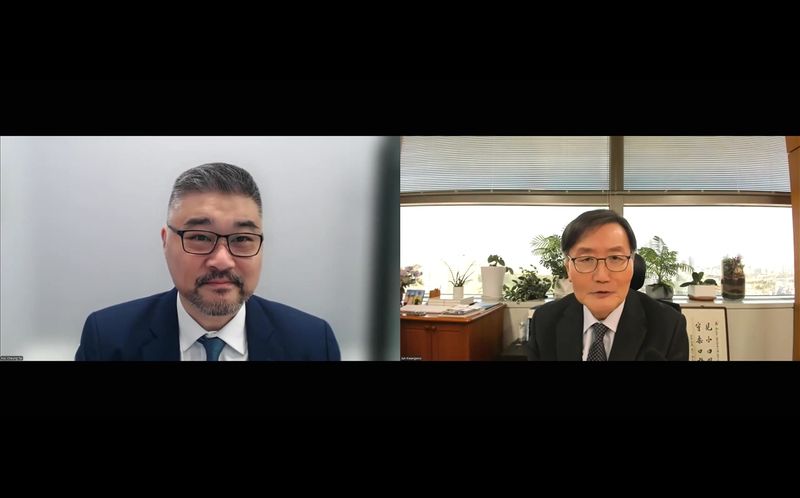
The Institute for Global Economics hosted a webinar on the 22nd titled “Global Economic and International Financial Outlook: Strategy for the Second Half of 2026.”
Tai Hui, J.P. Morgan Asset Management’s chief Asia-Pacific market strategist and a speaker at the webinar, said, "We have not changed our view that South Korea and Taiwan are beneficiaries of data centers and the AI revolution. It will be difficult to repeat this year’s returns exactly, but we expect Northeast Asian markets, including South Korea and Taiwan, to deliver better performance than other Asian regions and emerging markets."
He cited semiconductor competitiveness as the key reason for his positive outlook on the South Korean market.
Hui said, "South Korea and Taiwan have strong semiconductor production capabilities and hold significant market shares, including in high-bandwidth memory (HBM). Although Chinese latecomers are catching up, it is difficult to see South Korea’s leadership being eroded within the next few years." He added, "A substantial share of memory supply comes from South Korea, and HBM in particular is in short supply. Given that rival countries will find it difficult to catch up with the competitiveness of South Korea’s technology industry in the short term, and that excess demand for semiconductors is continuing, we will maintain our positive outlook for the next 12 to 18 months."
The possibility that investment in AI data centers will remain strong was also cited as a favorable factor for South Korea’s semiconductor sector.
Hui emphasized, "If companies such as Google, Amazon, and Microsoft find it difficult to build data centers in the United States, they can construct them in other regions, including the Middle East, Europe, and Malaysia. As long as the trend toward AI adoption does not change, demand for data center construction, as well as for hardware, memory semiconductors, graphics processing units (GPUs), and central processing units (CPUs), will inevitably continue to grow."
Hui also forecast that the won could outperform the yen over the long term. He said, "When investors think about AI, they think of Taiwan and South Korea first, not Japan. Given South Korea’s current technology cycle, the AI boom, and its relatively sound fiscal conditions, the won could be stronger than the yen over the long term."
However, he said that differentiation would be necessary among the entities investing in AI. If only a small number of companies survive the AI model race, funds invested in less competitive models could end up as excessive investment.
Meanwhile, Hui highlighted the possibility that long-term government bond yields would remain elevated in global markets because of the fiscal burdens and inflationary pressures facing major economies. He noted that bonds have become more attractive investments than before. Regarding U.S.-China relations, he said continued dialogue between the leaders was positive, but expressed caution about the possibility of a breakthrough at the leaders’ summit scheduled for the 24th (local time) in Washington, D.C.
[email protected] Ye Byung-jung Reporter