Herbal Medicine 'Eulja-tang' Shows a Surprising Effect... Found to Inhibit Coronaviruses
- Input
- 2026-09-22 10:07:03
- Updated
- 2026-09-22 10:07:03
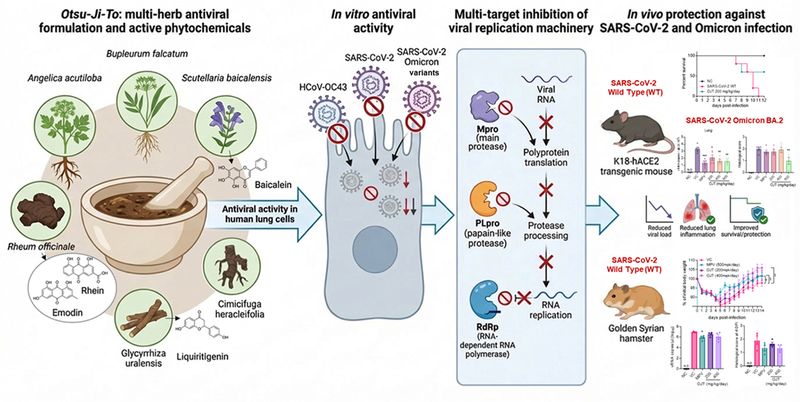
[Financial News] A research team led by Dr. Jin Young-hee at the KM Application Center of the Korea Institute of Oriental Medicine (KIOM), in collaboration with teams led by Professor Sang-Myeong Lee of the Department of Veterinary Medicine at Chungbuk National University (CBNU) and Professor Kim Tae-hoon of Kyung Hee University Korean Medicine Hospital, announced on the 22nd that it had confirmed the potential of the herbal medicine formula 'Eulja-tang (Otsu-Ji-To, OJT)' to inhibit coronaviruses.
Based on these findings, the researchers obtained approval from the Ministry of Food and Drug Safety for their clinical trial plan and entered the stage of clinical trials involving patients. Cell and animal experiments confirmed that Eulja-tang inhibited the replication of severe acute respiratory syndrome coronavirus 2 (SARS-CoV-2) and Omicron variant viruses, while reducing viral loads and lung damage in infected animals. The researchers also secured domestic and international triadic patent protection related to the technology.
The findings were published online on July 3, 2026, in the Journal of Traditional and Complementary Medicine, an international journal covering traditional and complementary medicine research with an impact factor of 3.9.
Eulja-tang (Otsu-Ji-To, OJT) is a traditional herbal medicine formula that has been used to treat inflammation caused by hemorrhoids. In this study, the researchers examined its potential for a new application by investigating its coronavirus-inhibiting effects, distinct from its established use.
In cell experiments, the researchers treated cells infected with HCoV-OC43, SARS-CoV-2, and Omicron variant viruses with Eulja-tang. The treatment reduced viral RNA and protein expression and alleviated infection-related cellular damage.
Further analysis showed that Eulja-tang inhibited the activity of several enzymes required for viral replication. The activity of the viral proteases main protease (Mpro) and papain-like protease (PLpro), as well as RNA-dependent RNA polymerase (RdRp), all decreased. The team then conducted animal experiments by administering Eulja-tang to mice and hamsters infected with SARS-CoV-2 and Omicron variants.
The research team also analyzed the major antiviral active components of Eulja-tang. Baicalein, liquiritigenin, emodin, and rhein were identified as major components exhibiting antiviral activity that lowered SARS-CoV-2 viral protein expression.
Dr. Jin Young-hee, who conducted the study, said, "This study is significant because it confirmed Eulja-tang's potential to inhibit coronaviruses in cell and animal experiments and advanced it to the stage of clinical trials involving patients." She added, "Going forward, we will thoroughly verify Eulja-tang's efficacy and safety through clinical research."
[email protected] Yeon Ji-an Reporter