Samsung Electronics Dividend Deadline D-7... Shares Rise for Second Straight Day, 30 Trillion Won Dividend Expected
- Input
- 2026-09-22 10:24:36
- Updated
- 2026-09-22 10:24:36
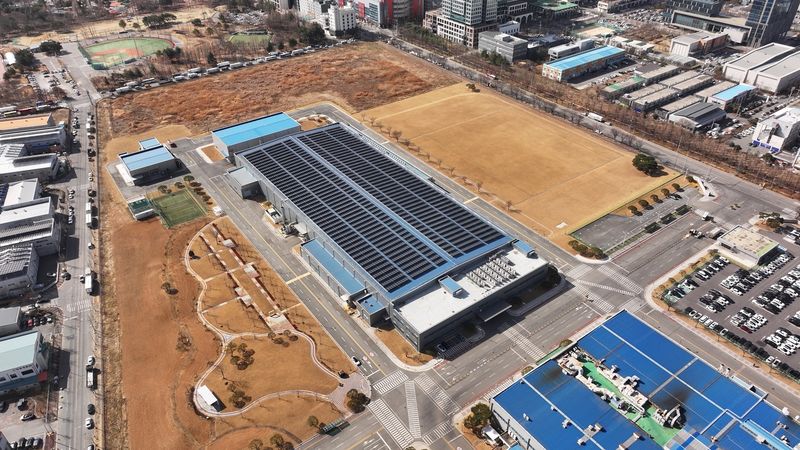
[Financial News] The last day to buy Samsung Electronics shares and qualify for its third-quarter dividend is approaching on the 28th. The record date is the 30th, and the ex-dividend date is the 29th. With the stock market closed from the 24th to the 27th for the Chuseok holiday, the only remaining trading days to buy shares as of the 22nd are the 22nd, 23rd and 28th.
According to the Korea Exchange (KRX) on the 22nd, Samsung Electronics closed at 274,000 won on the 21st, up 4.98% from the previous trading day. As of 10 a.m. on the 22nd, it was also up 2.37% from the previous close, recovering to the 280,000-won range.
Lee Jun-young, a researcher at Eugene Investment & Securities, analyzed the market, saying, "The KOSPI Composite Index recovered to the 7,000 level for the first time in seven trading days on the strength of the two leading semiconductor stocks." He added, "Trading value declined ahead of the Chuseok holiday, but institutional buying pushed the index higher." Regarding Samsung Electronics, he explained, "Expectations for shareholder returns coincided with buying demand ahead of the ex-dividend date."
The market is focusing on Samsung Electronics' large-scale dividend plan. In a disclosure last August, Samsung Electronics said it planned to pay around 30 trillion won in third-quarter cash dividends, including its regular quarterly dividend. The actual dividend amount and dividend per share will be finalized at a board meeting at the end of October.
Samsung Securities estimated that the third-quarter dividend per share would reach 4,654 won if the plan is implemented. Based on a common-share price of 280,250 won, the expected dividend yield is approximately 1.7%. Lee Jong-wook, a researcher at Samsung Securities, forecast, "Shareholder returns are a signal from management regarding the sustainability of earnings." He added, "Large-scale dividends and share buybacks and cancellations will serve as an opportunity to link earnings growth to shareholder value." He further noted, "This dividend can be viewed as an opportunity to gauge Samsung Electronics' shareholder-return policy, rather than merely as a one-time cash payment."
Some in the brokerage industry also caution that short-term purchases targeting the dividend should be assessed alongside stock-price volatility caused by the ex-dividend date. This is because the share price may be adjusted when the right to receive the dividend disappears on that date. An industry source said, "Samsung Electronics' 13,000-won gain on the 21st was larger than the 4,654-won dividend per share estimated by Samsung Securities." The source added, "Since the stock's one-day fluctuation exceeded the expected dividend, it is difficult to gauge short-term investment returns based on the dividend alone."
The DRAM market outlook is considered a key factor that will determine the stock's performance after the dividend. KB Securities analyzed that even if Samsung Electronics expands its DRAM production capacity, its ability to supply conventional DRAM could decline if the additional capacity is concentrated on high-bandwidth memory (HBM). HBM is estimated to account for 27% of total DRAM production capacity in 2025 and 40% in 2027, while the share of conventional DRAM is expected to fall from 73% to 59% over the same period.
Kim Dong-won, head of the research division at KB Securities, said, "The delivery wait for high-capacity server DDR5 has increased to as long as 52 weeks, while Samsung Electronics' DRAM inventory is estimated to have fallen to less than 10 days." He forecast, "Prices for conventional DRAM could post double-digit growth rates in the third and fourth quarters, exceeding market expectations." He added, "The reorganization of production capacity around HBM is a structural change that will prolong the shortage of conventional DRAM and drive price increases." He further noted, "After investors secure their dividend rights, their attention is expected to shift to DRAM supply and demand and price trends."
[email protected] Choi Do-seon Reporter